
The rapid growth of digital publishing has transformed how books, training materials, research papers, and professional documents are distributed and consumed. While this shift has created unprecedented convenience and global reach, it has also introduced one of the biggest challenges for publishers: how to prevent unauthorized copying, sharing, and redistribution of digital content.
Traditional PDF files are easy to duplicate, forward, and upload to unauthorized platforms. Once a file is downloaded, publishers often lose all control over how it is used. This is where Digital Rights Management (DRM) technology becomes essential.
A modern DRM system is designed to give publishers full control over document access, usage, and distribution. It does not simply encrypt files, it creates a controlled reading environment where publishers define exactly how content is accessed, viewed, and shared.
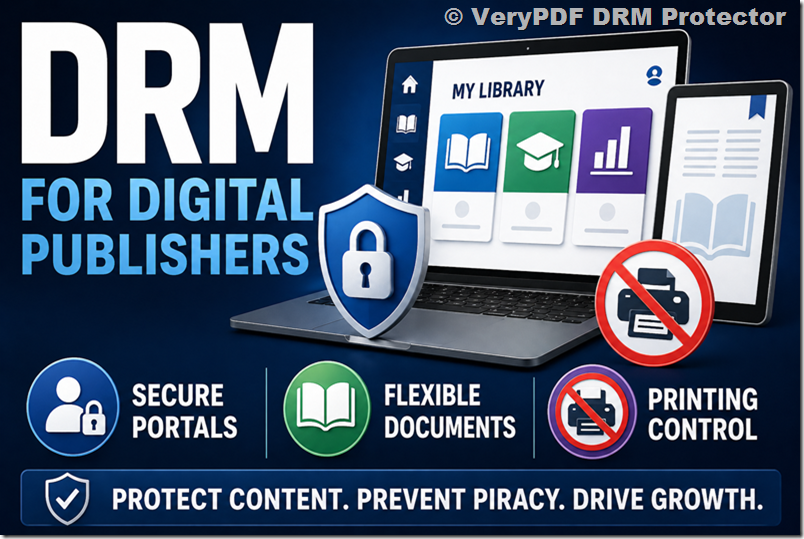
This article explains three of the most frequently asked questions from publishers evaluating DRM systems:
- Does DRM support customer portals?
- How is a “book” defined in the system?
- Can users print to PDF or virtual printers?
Each section provides a detailed explanation of how modern DRM platforms handle these requirements and why they matter for secure digital publishing.
1. Customer Portals in DRM Systems
1.1 What is a DRM customer portal?
A customer portal is a secure web-based environment where users can access their purchased or assigned digital documents. Instead of downloading raw PDF files, users log into a controlled system that manages how content is delivered and viewed.
This portal acts as a centralized digital library, allowing publishers to distribute content securely while maintaining full control over access permissions.
Admins can manage documents and users from the secure DRM dashboard.
https://drm.verypdf.com/wp-admin/admin.php?page=VeryPDFDRMFiles
1.2 Why customer portals are important
Without a portal system, publishers usually rely on file downloads or email attachments. These methods introduce several risks:
- Files can be forwarded to unauthorized users
- Downloads can be stored indefinitely without control
- No visibility into who accessed the content
- No ability to revoke access after distribution
A customer portal solves these problems by centralizing access and enforcing real-time control policies.
Your Readers can access their books/documents through the secure online reading portal:
https://online.verypdf.com/app/pdfdrm/login.php
1.3 Key features of DRM customer portals
A well-designed DRM portal typically includes the following capabilities:
User and access management
Publishers can:
- Create and manage user accounts
- Assign documents to specific users or groups
- Control access based on subscription or license rules
Centralized digital library
Instead of distributing files individually, all content is stored in a structured online library where users can browse and access their authorized materials.
Device and account restrictions
Access can be restricted based on:
- User login credentials
- Device authorization
- IP address or geographic rules (optional in advanced systems)
Integration with existing systems
Enterprise DRM platforms often support:
- Single Sign-On (SSO)
- API-based integration
- Website embedding or white-label portals
This makes it possible to integrate DRM into existing publishing workflows without redesigning infrastructure.
1.4 Reader experience in a DRM portal
From the reader’s perspective, the experience is simple:
- Log in through a secure web portal
- Access assigned books or documents
- Read content in a protected viewing environment
- No need to download or manage files manually
This creates a “Netflix-style” reading experience for digital documents, where access is controlled but usability remains smooth.
1.5 Why publishers prefer portal-based DRM
Publishers benefit from customer portals because they:
- Eliminate uncontrolled file distribution
- Enable subscription-based business models
- Allow real-time access control (including revocation)
- Provide usage tracking and analytics
For modern digital publishing, the customer portal is often the foundation of a scalable DRM strategy.
2. How DRM Defines a “Document” or “Book”
2.1 What is a document in DRM systems?
In DRM platforms, a “document” typically refers to a single protected digital file, most commonly a PDF.
This definition is important because it determines how content is organized, licensed, and controlled.
2.2 One book = one document?
In most publishing scenarios:
- One book is considered one document if it is a single PDF file
- The DRM system applies protection rules at the file level
- Access permissions, printing rules, and expiration policies are attached to that document
This makes the model simple and scalable.
2.3 Multi-part books and structured content
Not all publications are single files. Some books are structured as:
- Multiple chapters
- Separate volumes
- Supplementary materials (workbooks, exercises, appendices)
In these cases, publishers have flexibility:
Option 1: Treat each file as a document
Each chapter or volume becomes a separate protected document.
Option 2: Combine into a single document
All content is merged into one PDF and treated as a single protected unit.
2.4 Advantages of document-level control
Defining content at the document level allows DRM systems to:
- Apply different permissions to different books
- Manage licensing per title or per file
- Track usage at granular levels
- Support flexible pricing models (per book, subscription, institutional access)
This structure is especially useful for publishers with large catalogs or educational content libraries.
2.5 Why this model works for publishers
The “one PDF = one document” model aligns well with real-world publishing workflows because:
- PDFs are already the standard format for digital books
- Licensing becomes easier to manage
- Content updates can be controlled per file
- Distribution remains flexible across platforms
3. Printing Control: PDF Printing and Virtual Printer Protection
3.1 Why printing control matters
Printing is one of the most common ways digital content is redistributed without authorization. Even if copying is disabled, users can often:
- Print to physical printers
- Use virtual PDF printers
- Re-create new PDF files from protected content
This makes printing control a critical part of any DRM strategy.
3.2 Full control over printing behavior
Modern DRM systems provide multiple levels of printing control, allowing publishers to define exactly how content can be printed.
Option 1: Disable printing completely
Publishers can fully disable printing, which prevents:
- Physical printing
- Virtual PDF printing
- Print-to-file workflows
This ensures that content remains strictly digital and view-only.
Option 2: Allow printing with restrictions
If printing is required, DRM systems can enforce restrictions such as:
- Limited number of prints
- Dynamic watermarking on printed pages
- Print tracking and logging
This allows controlled offline use while maintaining traceability.
Option 3: Allow physical printing only
A more advanced configuration allows:
- Printing to physical printers
- Blocking virtual PDF printers
- Preventing file re-creation through print drivers
This is particularly useful in enterprise or educational environments.
3.3 Why virtual printer blocking is important
Virtual printers such as “Print to PDF” or third-party PDF drivers can easily bypass traditional security measures by:
- Creating new PDF copies of protected content
- Removing original DRM protections
- Enabling uncontrolled redistribution
By blocking virtual printers, DRM systems ensure that content cannot be silently duplicated into new digital files.
3.4 Combined protection strategy
Printing control is most effective when combined with additional protections:
Dynamic watermarking
Watermarks can include:
- User identity
- Email or account ID
- Timestamp of access
This discourages sharing and enables traceability.
Access control policies
Even if content is printed, access rules ensure:
- Only authorized users can view content
- Access can expire or be revoked at any time
Usage tracking
Publishers can monitor:
- Viewing activity
- Printing attempts
- Device usage patterns
3.5 Limitations of DRM protection
It is important to understand that no DRM system can completely prevent:
- Screen recording in all environments
- Physical photography of screens
- Advanced bypass techniques using external devices
However, DRM significantly raises the difficulty of unauthorized distribution and provides strong deterrence combined with accountability.
4. Business Value of DRM for Digital Publishers
Beyond technical controls, DRM systems provide significant business advantages.
4.1 Enabling new revenue models
DRM enables:
- Subscription-based access
- Pay-per-document licensing
- Institutional licensing (schools, universities, organizations)
- Time-limited access models
4.2 Reducing piracy and leakage
By controlling access at the system level, publishers can:
- Prevent uncontrolled file sharing
- Revoke access instantly if needed
- Reduce piracy risks significantly
4.3 Improving content monetization
Secure distribution allows publishers to:
- Sell digital content with confidence
- Protect high-value intellectual property
- Expand into global markets without fear of leakage
4.4 Enhancing user experience
Modern DRM systems are designed not only for security but also usability:
- No need for complex downloads
- Browser-based reading experience
- Cross-device compatibility
- Instant access after purchase
Conclusion
Digital Rights Management is no longer just a security tool, it is a foundational technology for modern digital publishing.
A well-designed DRM system provides:
- Secure customer portals for controlled access
- Flexible document definitions for books and content structures
- Advanced printing controls, including virtual printer blocking
- Strong protection against unauthorized distribution
- Scalable infrastructure for publishers of all sizes
For publishers, educators, and content creators, DRM enables a balance between content protection and user accessibility, making it possible to safely distribute valuable digital materials in a highly connected world.