
How to Prevent Unauthorized Distribution of PDF Reports and Online Courses
The Complete Guide to Building a Read-Only, Kindle-Style Publishing System with VeryPDF DRM Protector
Introduction: The Hidden Crisis Facing Modern Digital Publishers
A niche journal publisher recently asked a question that perfectly captures a growing problem in the digital knowledge economy:
“We want to sell PDFs directly on our website, but customers must only read them, not download or share them. Something like Kindle. Is a read-only PDF distribution model possible?”
This question is no longer rare.
Academic journals. Training organisations. Independent researchers. Professional associations. Course creators. Consultancy firms.
All of them face the same paradox:
- Digital distribution makes selling knowledge easier than ever.
- But the moment a PDF is downloaded… control is lost forever.
A single forwarded file can erase months, or years, of intellectual work.
Traditional PDF delivery methods were never designed for commercial publishing in the modern internet era. What publishers really want is:
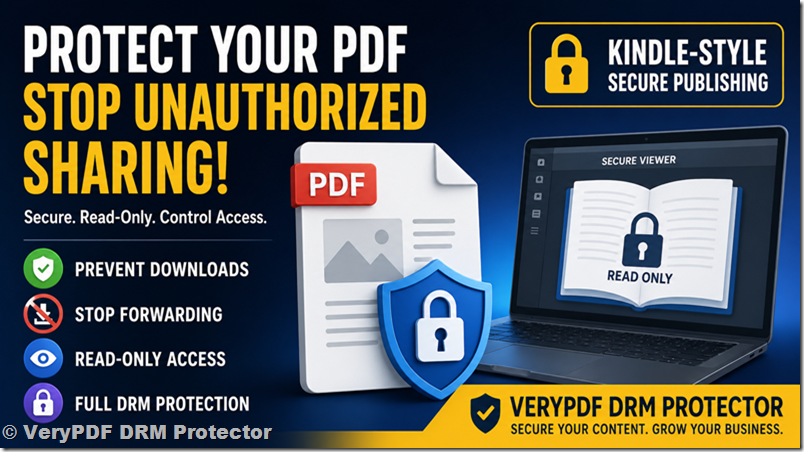
✅ View-only access
✅ No downloads
✅ No forwarding
✅ No uncontrolled sharing
✅ Controlled reading access like Kindle
✅ Revocable permissions
✅ Monetizable distribution
This article is a practical guide explaining:
- Why PDFs are easily redistributed
- Why common protection methods fail
- What a real read-only publishing workflow looks like
- How Digital Rights Management (DRM) solves the problem
- How to build your own private Kindle-style platform using VeryPDF DRM Protector
Part 1, Why PDF Distribution Is Fundamentally Broken
The Traditional PDF Workflow
Most publishers distribute PDFs using one of these approaches:
- Email attachment after purchase
- Website download link
- Marketplace platforms (Gumroad, Shopify, etc.)
- Cloud storage sharing (Google Drive / Dropbox)
At first glance, these methods seem convenient.
But technically, they all share one fatal flaw:
The user receives a permanent copy of the file.
Once downloaded, the file can be:
- Forwarded instantly
- Uploaded to piracy sites
- Shared in private communities
- Sold illegally
- Stored forever without permission control
Your intellectual property becomes impossible to reclaim.
Why Publishers Want a Kindle-Like Experience
Platforms like Amazon Kindle changed expectations.
Readers don’t download raw files.
Instead:
- Content opens inside a controlled reader.
- Access belongs to the account, not the file.
- Permissions can change anytime.
- Publishers retain ownership.
That is the model journals and training providers now want:
Sell access, not files.
Part 2, The Reality of PDF Forwarding
Let’s answer the core question directly:
Can you stop someone from forwarding a normal PDF?
No.
Not reliably.
Because standard PDFs are designed as documents, not licensed digital assets.
Even when protected, users can:
- Copy the file
- Upload it elsewhere
- Send via messaging apps
- Store locally forever
Traditional protection only slows sharing, it does not prevent it.
Part 3, Common PDF Protection Methods (And Their Limits)
Many organisations try multiple approaches before discovering DRM.
Let’s examine each method honestly.
1. Password Protection
What it does
Adds an open password to the PDF.
Problem
Passwords travel with the file.
If one user shares:
- the PDF
- and the password
…security instantly disappears.
Result: Access control fails.
2. Encryption
Encryption protects data during transmission.
But once a user decrypts the file:
- They now own a readable copy.
Encryption protects storage, not distribution.
3. Allow/Block Viewer Lists
Some systems attempt user control.
However:
- Users still download files.
- Files can still be redistributed.
Access lists cannot follow files once copied.
4. Watermarking
Watermarks discourage sharing.
They do NOT prevent sharing.
Pirates often ignore watermarks entirely.
Watermarks are forensic tools, not security systems.
5. Converting PDF to Images
Publishers sometimes convert PDFs into images.
This makes copying harder but creates new problems:
- Large file sizes
- Poor accessibility
- Still shareable
- Screenshots remain possible
Security improvement: minimal.
6. Cloud Link Sharing
Google Drive “View Only” mode seems promising.
But users can still:
- Download via loopholes
- Print to PDF
- Capture screens
- Share credentials
Cloud storage platforms were not built for paid publishing.
7. Secure Sharing Platforms
Many platforms claim secure distribution.
Most still allow:
- Offline access
- Cached files
- File extraction
The platform controls the environment, not you.
8. Digital Rights Management (DRM)
This is where the paradigm changes.
Instead of protecting the file, DRM protects usage rights.
DRM answers the real question:
What is the user allowed to do after receiving access?
Part 4, What DRM Actually Means
Digital Rights Management transforms a PDF into a licensed digital product.
Users do not receive a transferable document.
They receive controlled reading permission.
With DRM, you can:
- Prevent downloading
- Prevent copying
- Prevent printing
- Prevent forwarding
- Require authentication
- Revoke access anytime
- Limit devices
- Set expiration dates
- Track usage
In short:
You sell access, not files.
Part 5, The Publisher’s Ideal Scenario
Let’s revisit the journal publisher’s requirements:
✔ Sell PDFs online
✔ Users can only read
✔ No downloading
✔ No forwarding
✔ Similar to Kindle
✔ Access via link
✔ Screenshot attempts allowed but discouraged
This is exactly the use case DRM was designed for.
Part 6, Introducing VeryPDF DRM Protector
To achieve true read-only distribution, publishers need a professional DRM solution.
One of the most complete platforms available today is:
VeryPDF DRM Protector is a dedicated Digital Rights Management system designed specifically for secure PDF publishing and monetization.
It enables organisations to distribute documents safely while maintaining full control over usage.
Part 7, How VeryPDF DRM Protector Works
Instead of sending a downloadable PDF, the workflow becomes:
Step 1, Upload Your PDF
You upload your publication to the DRM system.
Step 2, Apply Security Policies
Define exactly what readers can do.
Examples:
- View only
- No download
- Disable printing
- Disable copy/paste
- Disable screen capture
- Limit devices
- Set expiration date
Step 3, Encrypt with DRM
The system converts your PDF into a protected format.
The original file is never exposed.
Step 4, Deliver Access Link
Customers receive a reading link or login access.
Step 5, Controlled Viewing
Readers open the document inside a secure viewer.
They cannot extract or redistribute the content.
Part 8, Building Your Own Private Kindle
Using VeryPDF DRM Protector, you effectively create:
Your Own Private Kindle Platform
Without building software from scratch.
Your workflow becomes:
- Customer purchases publication.
- Payment system triggers access.
- Reader logs in.
- Document opens securely.
- No downloadable file exists.
This is the modern publishing model used by:
- Academic publishers
- Corporate training providers
- Certification programs
- Subscription journals
- Professional research databases
Part 9, Advanced Protection Features
VeryPDF DRM Protector goes far beyond basic protection.
Read-Only Viewing Mode
Users can:
✅ Read
❌ Download
❌ Save
❌ Export
Exactly matching the original requirement.
Screenshot Protection
While no technology can stop photography entirely, DRM can:
- Block screen capture tools
- Disable OS screenshot APIs
- Deter mass copying
This dramatically raises piracy difficulty.
Dynamic Watermarking
Each reader can receive personalized watermarks showing:
- Name
- Account ID
- Timestamp
If leaks occur, the source is identifiable.
Device Authorization
Limit access to:
- One device
- Two devices
- Approved hardware only
Shared accounts become ineffective.
Expiration Control
Perfect for:
- Subscriptions
- Course access
- Membership journals
- Limited research licenses
Access automatically expires.
Instant Revocation
If misuse is detected:
You can revoke access instantly.
Even after delivery.
Offline Secure Reading
Readers may view content offline, but only within DRM protection.
Files remain encrypted and controlled.
Analytics and Tracking
Know:
- Who opened documents
- When they accessed them
- How often content is viewed
This transforms publishing into a measurable business.
Part 10, Why Gumroad and Similar Platforms Fail for This Use Case
Platforms like Gumroad are excellent for selling digital downloads.
But they operate on a download ownership model.
Once downloaded:
- Platform control ends.
- Piracy risk begins.
VeryPDF DRM Protector solves a fundamentally different problem:
Secure access distribution.
Part 11, Sharing PDFs as Secure Links (Done Properly)
Many publishers attempt link sharing manually.
DRM makes link sharing secure by adding:
- Authentication requirements
- Access permissions
- Viewer control
- Expiration policies
- Usage tracking
Benefits include:
Controlled Access
Only authorized readers can open documents.
Reduced Leakage
No transferable file exists.
Real-Time Updates
Update content without redistributing files.
Access Revocation
Remove access anytime.
Professional Monetization
Sell subscriptions instead of static downloads.
Part 12, Practical Use Cases
Academic Journals
Sell biannual publications securely.
Prevent institutional redistribution.
Training Organizations
Protect course manuals from piracy.
Limit access to enrolled students.
Corporate Research Reports
Distribute confidential intelligence securely.
Prevent competitor leaks.
Consultants & Analysts
Sell premium reports without fear of resale.
Membership Knowledge Platforms
Build recurring subscription revenue.
Part 13, Advanced Anti-Forwarding Strategy
The strongest protection combines multiple layers:
- DRM encryption
- View-only reader
- Device limits
- Dynamic watermarking
- Screenshot protection
- Expiration policies
- Access tracking
VeryPDF DRM Protector integrates all layers into one system.
Part 14, Why DRM Is Becoming Mandatory in 2026
The digital publishing economy has changed.
Knowledge is now the product.
But piracy is automated:
- Telegram sharing groups
- Course resale markets
- AI scraping tools
- Community archives
Publishers relying on downloadable PDFs will increasingly lose revenue.
DRM is no longer optional.
It is infrastructure.
Part 15, Implementation Strategy
You do NOT need to build software.
A typical deployment looks like:
- Create account on VeryPDF DRM Protector.
- Upload PDFs.
- Configure permissions.
- Integrate payment system.
- Deliver protected access links.
Deployment can happen within days.
Part 16, Customization and Enterprise Options
VeryPDF is not only a software provider.
It also offers:
- Custom DRM workflows
- API integrations
- White-label platforms
- Enterprise deployments
- Private cloud hosting
- Custom viewer development
This allows journals and publishers to create fully branded reading environments.
Part 17, Addressing the Screenshot Reality
Many publishers ask:
“What if users take screenshots?”
Important truth:
No system can stop photography.
Even Kindle cannot.
Security is about raising the cost of piracy.
DRM achieves this by:
- Preventing bulk extraction
- Preventing automated copying
- Identifying leakers
- Removing easy redistribution
Piracy becomes inconvenient instead of effortless.
And inconvenience dramatically reduces abuse.
Part 18, From PDF Files to Digital Publishing Platforms
The biggest mindset shift is this:
You are no longer selling PDFs.
You are operating a knowledge access platform.
DRM transforms static documents into:
- Licensed content
- Subscription assets
- Controlled intellectual property
Part 19, Business Benefits Beyond Security
Using VeryPDF DRM Protector enables:
Higher Pricing
Premium content becomes defensible.
Subscription Revenue
Recurring income replaces one-time sales.
Institutional Licensing
Sell controlled access to organizations.
Brand Authority
Professional reader experience increases trust.
Part 20, The Future of Secure Knowledge Distribution
The question publishers should ask is no longer:
“How do we protect a PDF?”
Instead ask:
“How do we control access to knowledge?”
The answer is DRM-based publishing.
Conclusion, The Only Real Read-Only PDF Solution
Returning to the original publisher’s requirement:
✔ Customers can read
✔ No downloading
✔ No forwarding
✔ Link-based access
✔ Kindle-like experience
Yes, this is absolutely achievable.
But not with traditional PDFs.
It requires Digital Rights Management.
VeryPDF DRM Protector provides a practical, proven way to:
- Prevent unauthorized distribution
- Deliver true read-only publications
- Monetize digital research safely
- Build your own secure publishing ecosystem
If you publish valuable knowledge, journals, reports, training materials, or courses, protecting your intellectual property is no longer optional.
It is the foundation of sustainable digital publishing.
Start building your secure publishing platform today:
https://drm.verypdf.com/
Your content deserves readers, not pirates.