
A medical publisher may need to give customers digital access to a textbook before the printed book is ready.
For example, a publisher may sell a printed medical textbook to students. While the book is being printed and shipped, the publisher wants buyers to read the PDF online. After the printed book arrives, the publisher wants to remove the buyer’s digital access.
This sounds simple, but a normal PDF download link is not a good solution.
If the PDF can be downloaded, buyers may copy it, print it, share it with classmates, or upload it to another website. For medical textbooks with valuable images, diagrams, tables, and other content, unauthorized sharing can become a serious problem.
VeryPDF DRM Protector is designed for this type of PDF protection and controlled online reading.
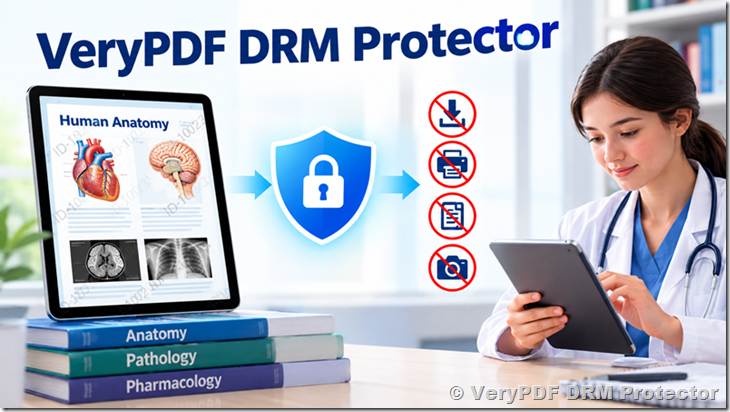
What Does a Medical Publisher Need?
A medical publisher may have several requirements:
| Requirement | What the publisher needs |
|---|---|
| PDF access | Only authorized buyers can open the textbook |
| Online reading | Readers view the textbook online instead of downloading the PDF |
| Download protection | Disable normal PDF downloading |
| Printing protection | Prevent readers from printing the textbook |
| Copy protection | Prevent copying text from the protected document |
| Watermark | Show a unique ID on every page |
| Access control | Grant or revoke access for individual buyers |
| Device control | Limit the number of devices used by each account |
| Mobile support | Read on iPhone, iPad and Android |
| Computer support | Read on Windows and Mac |
| Access logs | See basic information about document access |
| Screenshot protection | Block screenshots and screen recording where supported |
These requirements are difficult to handle with a normal PDF file or a simple password.
Why a Normal PDF Download Link Is Not Enough
Suppose a medical publisher sends this link to a customer:
https://example.com/medical-textbook.pdf
The customer can download the PDF and keep a copy.
Even if the publisher deletes the link later, the downloaded PDF may still be on the customer’s computer or phone.
A password-protected PDF has a similar problem. Once the customer has the file, the publisher has much less control over what happens to it.
For temporary access, it is better to keep the PDF under DRM control and allow the buyer to read it without giving them the original PDF file.
Recommended Solution: VeryPDF DRM Protector
For this type of medical publishing project, VeryPDF DRM Protector Standard Plan is a suitable choice.
The Standard Plan is designed for protecting PDF documents and controlling who can read them.
A publisher can upload the medical textbook, authorize individual readers, and control their access.
The reader can then open the protected textbook on supported devices without receiving a normal downloadable PDF file.
How Temporary Textbook Access Can Work
A simple workflow could look like this:
1. The customer buys the printed textbook
The publisher handles the payment through its own website, sales system, email, or another method.
2. The publisher creates or authorizes the reader
The publisher can manually give the buyer access to the protected textbook.
3. The buyer reads the textbook online
The buyer can read the textbook while waiting for the printed copy.
4. The buyer receives the printed book
Once the printed textbook arrives, the publisher can remove the buyer’s digital access.
5. The digital access is revoked
The buyer can no longer open the protected textbook.
This gives the publisher much more control than simply sending a PDF download link.
Can the Publisher Use a Unique ID Instead of the Buyer’s Name?
Yes.
This can be useful for publishers that do not want to display personal information on every page.
For example, the publisher could assign:
- Buyer ID:
MED-2026-00125 - Buyer ID:
MED-2026-00126 - Buyer ID:
MED-2026-00127
The watermark could show only:
MED-2026-00125
The publisher does not need to put the buyer’s name, email address, or other personal information in the watermark.
This also gives the publisher a way to identify the source if a screenshot or photograph of a page is shared online.
Can Downloading, Printing and Copying Be Disabled?
Yes.
VeryPDF DRM Protector can be configured to prevent common actions such as:
- Downloading
- Printing
- Copying text
- Making annotations, depending on the selected settings
This is especially useful for textbooks where the publisher wants to sell the printed book while providing only temporary digital access.
Can Readers Use iPad, iPhone, Android, Windows and Mac?
VeryPDF DRM Protector supports reading across major platforms, including:
- iPad
- iPhone
- Android
- Windows
- Mac
This is important for medical students because they may read a textbook in different places.
For example, a student may use an iPad at home, an iPhone while traveling, and a Windows or Mac computer at school.
The publisher can also use device restrictions to reduce account sharing.
Can One Account Be Limited to One Device?
Yes, device restrictions can be used to control how many devices an account can use.
For example, the publisher could allow:
| Setting | Example |
|---|---|
| One account | One authorized buyer |
| Maximum devices | 1 device |
| Access | Online reading |
| Download | Disabled |
| Printing | Disabled |
| Copying | Disabled |
| Access period | Controlled by publisher |
This can help reduce the problem of one buyer sharing an account with classmates.
For some businesses, allowing two devices may be more convenient. For example, one iPad and one computer could be allowed.
What About Medical Images?
Medical textbooks often contain detailed images, diagrams, scans, charts and illustrations.
A PDF protection system should not only protect the text. It also needs to provide a good reading experience.
Readers should be able to:
- Zoom into images
- Search the textbook
- Move between pages
- Read on a large computer screen
- Read on a tablet
- Read on a phone
This is particularly important for anatomy, radiology, pathology, surgery and other medical textbooks where image quality matters.
We recommend testing the actual textbook before starting a large distribution. A sample medical textbook can be used to check image quality, zooming, search and reading performance on the devices your students use.
Can Screenshots Be Blocked?
This is an important question for digital textbook publishers.
VeryPDF DRM Protector provides screenshot and screen-recording protection on supported platforms.
However, no DRM system can completely prevent someone from taking a photograph of the screen with another physical device.
For example:
| Method | Can DRM help? |
|---|---|
| Normal PDF download | Can be disabled |
| Printing | Can be disabled |
| Text copying | Can be disabled |
| Software screenshot | Can be blocked on supported platforms |
| Screen recording | Can be blocked on supported platforms |
| Photograph with another phone | Cannot be completely prevented |
For this reason, a unique watermark is useful in addition to screenshot protection.
If someone shares a screenshot or takes a photo of a textbook page, the unique ID shown on the page can help the publisher identify the authorized account associated with that copy.
Individual Access Revocation
Temporary access is one of the main reasons to use DRM for this type of project.
Imagine that 200 medical students have purchased the printed textbook.
Before the printed books are delivered, all 200 students can have digital access.
After a student receives the printed book, the publisher can revoke that student’s digital access.
The publisher does not have to revoke access for everyone.
For example:
| Buyer | Printed book received? | Digital access |
|---|---|---|
| MED-001 | Yes | Revoked |
| MED-002 | Yes | Revoked |
| MED-003 | No | Active |
| MED-004 | No | Active |
This gives the publisher individual control over digital access.
Access Logs Can Help Investigate Sharing
A publisher may also want to know whether an account is being shared.
Basic access logs can provide useful information such as account activity, access time and other available access information.
For example, if one account appears to be accessing the textbook from unusual devices or locations, the publisher can investigate the account and decide whether access should be revoked.
Logs cannot stop every form of sharing, but they provide useful information when investigating suspected misuse.
What About 100, 200 or 450 Readers?
For a small medical publishing business, it makes sense to start with a manageable number of authorized readers.
For example:
| Planning scenario | Possible use |
|---|---|
| 100 readers | Small first edition or pilot |
| 200 readers | Medium student group |
| 450 readers | Larger textbook distribution |
The important point is that these are authorized readers, not simply people who have a public link to the PDF.
The publisher remains in control of who can access the textbook.
Do You Need an Online Store?
Not necessarily.
If the publisher already collects payments through its own system, the initial setup can be manual.
For example:
Customer pays → Publisher confirms payment → Publisher authorizes reader → Reader receives access → Printed book arrives → Publisher revokes access
There is no need to build payment integration just to start using DRM.
Later, if the number of customers becomes large, the publisher can consider connecting its order system to the DRM API so that access can be created automatically after a successful purchase.
Is VeryPDF DRM Protector Within a $150–200 Monthly Budget?
The VeryPDF DRM Protector Standard Plan is USD $99.95 per month, billed annually.
This is below a budget of USD $150–200 per month.
You can see the current plan and purchase information here:
VeryPDF DRM Protector pricing and purchase page
For a medical publisher that needs to protect one textbook and provide temporary access to authorized buyers, this can be a practical starting point.
VeryPDF DRM Protector vs. Sending a PDF by Email
| Feature | Normal PDF | VeryPDF DRM Protector |
|---|---|---|
| Individual user access | Limited | Yes |
| Revoke access | Difficult | Yes |
| Download control | No | Yes |
| Printing control | Limited | Yes |
| Copying control | Limited | Yes |
| Device control | No | Yes |
| Screenshot protection | No | Supported on supported platforms |
| Watermark | Basic PDF watermark | DRM watermark |
| Access logs | Usually no | Yes |
| Temporary access | Difficult | Suitable |
| Cross-device reading | Depends on PDF app | Supported |
| Account sharing control | Very limited | Device/access controls |
Best Practices for a Medical Textbook DRM Project
DRM is only one part of protecting a digital textbook.
A publisher should also consider these practices:
Use a unique ID for every buyer
Do not use one shared account for all students. Individual accounts make access control and investigation much easier.
Use a visible watermark
A unique ID on every page can discourage people from sharing screenshots.
Keep temporary access simple
If the printed book is expected to arrive within two or three weeks, there is usually no reason to give permanent digital access.
Limit devices
If one student only needs an iPad, one-device access can reduce account sharing. If students need both a tablet and computer, two devices may be more practical.
Test the real textbook
Do not test only with a simple PDF. Test the actual medical textbook, especially pages with high-resolution images, charts and complex layouts.
Start manually
If there are only 100–450 buyers, manual authorization may be enough for the first edition. Automation can be added later.
Frequently Asked Questions
1. Can VeryPDF DRM Protector protect a medical textbook PDF?
Yes. VeryPDF DRM Protector can protect PDF textbooks and control who is allowed to read them.
2. Can readers download the protected textbook?
The DRM settings can be configured to prevent normal downloading of the protected document.
3. Can I disable printing?
Yes. Printing can be disabled for the protected PDF.
4. Can I prevent readers from copying text?
Yes. Copying can be disabled through the DRM protection settings.
5. Can I add a unique ID watermark to every page?
Yes. A publisher can use a unique ID as the watermark instead of displaying the reader’s name or email address.
6. Can I revoke one reader’s access without affecting other readers?
Yes. Individual access can be controlled, so one reader’s access can be revoked while other authorized readers continue reading.
7. Can I limit an account to one device?
Yes. Device restrictions can be used to limit the number of devices allowed for an account.
8. Can students read the textbook on an iPad?
Yes. VeryPDF DRM Protector supports iPad reading.
9. Can students read the textbook on iPhone and Android?
Yes. Mobile device support includes iPhone and Android.
10. Can students read the textbook on Windows and Mac?
Yes. Windows and Mac are supported platforms.
11. Can screenshots be blocked?
Screenshot and screen-recording protection is available on supported platforms. However, no DRM system can stop someone from using an external camera to photograph the screen.
12. Can a watermark help if someone takes a photo of the screen?
Yes. A unique ID watermark can help identify which authorized account was associated with the protected copy.
13. Do I need to connect my payment system to VeryPDF?
No. You can manually authorize buyers if that is easier for your business.
14. Can I use VeryPDF DRM Protector for temporary access?
Yes. This is a good use case for DRM because the publisher can control and revoke individual access.
15. Can I start with 100 readers and add more later?
You can start with your initial reader group and adjust your setup as your distribution needs grow.
16. How much does the Standard Plan cost?
The VeryPDF DRM Protector Standard Plan is USD $99.95 per month, billed annually.
17. Is VeryPDF DRM Protector suitable for medical students?
Yes. It is particularly useful when a publisher wants students to read a protected textbook digitally while still controlling downloading, printing, copying, screenshots and account sharing.
18. Should I use DRM if I am selling a printed textbook?
If digital access is only temporary and you do not want buyers to keep a downloadable PDF, DRM is much more suitable than simply emailing the PDF or providing a permanent download link.
Conclusion
For a medical publisher that sells printed textbooks but needs to provide temporary online access before delivery, VeryPDF DRM Protector provides a practical way to control the digital copy.
The publisher can authorize individual buyers, disable downloading and printing, limit devices, add a unique ID watermark, monitor access activity, and revoke access when the printed book has been delivered.
For a small medical publishing business with around 100, 200 or 450 authorized readers, the VeryPDF DRM Protector Standard Plan at USD $99.95/month billed annually is a reasonable starting point.
View VeryPDF DRM Protector plans