
4 Surefire Ways to Prevent Your Ebook From Being Stolen (And How to Actually Stay in Control in 2026)
Let’s be honest for a second.
If you’ve ever written an ebook, you already know it’s not “just a PDF”.
It’s nights you didn’t sleep. It’s weekends you gave up. It’s ideas you refined, deleted, rewrote, and rebuilt until it finally felt valuable enough to charge for.
And then the moment you publish it… it feels like a small victory.
Sales come in. People say nice things. You feel like you’ve built something real.
Then reality hits.
Someone messages you:
“Hey, just saw your ebook floating around in my WhatsApp group.”
Or worse, you find it yourself being sold on some random website you’ve never heard of. No credit. No permission. No control.
That’s the part nobody warns you about when you start selling digital products.
Ebook theft isn’t rare. It’s normal.
So the real question isn’t “Can I stop piracy completely?”
It’s:
“How do I make stealing my ebook so inconvenient that people stop bothering?”
That’s what this guide is about.
And more importantly, how tools like VeryPDF DRM Protector help you shift from “hope it doesn’t get stolen” to “I control how it’s accessed, used, and distributed.”
Let’s break it down properly.
Why Ebook Theft Happens So Easily
Before fixing the problem, you need to understand something uncomfortable:
Digital files are designed to be copied.
That’s literally how PDFs, EPUBs, and documents work.
Once someone downloads your file, it’s no longer “yours” in a technical sense. It becomes theirs to duplicate, forward, screenshot, upload, or modify.
And people do it for a few predictable reasons:
- It’s easy
- It feels harmless (“it’s just sharing”)
- There’s no immediate consequence
- They don’t see the creator losing money
Most ebook piracy isn’t even malicious. It’s convenience-driven.
That’s why traditional thinking like “just trust your customers” doesn’t work at scale.
The Most Common Types of Ebook Theft (Expanded Reality)
Let’s go deeper than the usual surface-level explanation.
1. Customer-to-Friend Sharing (The Silent Killer)
This is the most common.
One buyer becomes five readers. Then ten. Then fifty.
It usually happens like this:
- “Hey, this ebook is useful, I’ll just send it to you”
- WhatsApp forwards
- Telegram groups
- Slack communities
- Email chains
No resale. No profit. Just uncontrolled distribution.
And yet, this alone can destroy 30–80% of your potential revenue.
2. Reselling Without Permission
This one is more aggressive.
Someone:
- Buys your ebook once
- Renames it
- Repackages it
- Sells it on Gumroad, Etsy, or their own website
Sometimes they even improve the landing page and outperform you temporarily.
This is direct intellectual property theft disguised as entrepreneurship.
3. Free Upload Piracy (The “Archive Effect”)
Your ebook ends up:
- On random download sites
- Shared in forums
- Indexed by search engines
- Hosted on file-sharing platforms
This is the hardest to contain once it spreads.
At that point, you’re no longer fighting individuals, you’re fighting distribution networks.
4. Corporate or Internal Leakage
This one surprises many creators.
A company buys one copy, then:
- Shares internally with teams
- Uploads it to internal drives
- Forgets access restrictions
One purchase becomes organization-wide usage.
5. Account Sharing / Credential Abuse
If your ebook is behind a login system:
- People share passwords
- Accounts get reused
- One subscription becomes multiple users
The Hard Truth: There Is No 100% Anti-Piracy Solution
Let’s remove the illusion early.
If someone is determined enough, they can:
- Screenshot pages
- Re-type content
- Record screens
- Rebuild PDFs manually
So the goal is NOT total prevention.
The goal is:
Make piracy harder than paying you.
That’s the entire game.
The 4 Real-World Ways to Protect Your Ebook
Now let’s get practical.
1. Use a DRM-Based Distribution System (Best Option)
This is where serious creators eventually land.
Instead of selling a “file”, you sell controlled access.
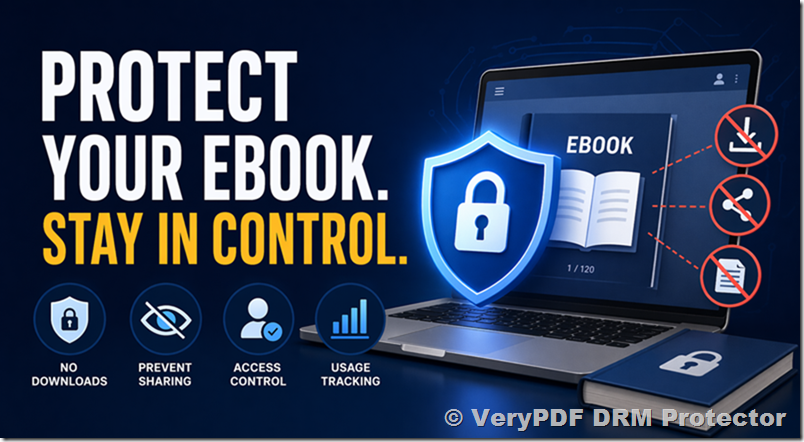
This is exactly where VeryPDF DRM Protector becomes powerful.
Instead of giving users a downloadable PDF, you can:
- Restrict downloads completely
- Force online reading only
- Control device access
- Add expiration rules
- Block unauthorized sharing
- Track usage behavior
Why this works better than traditional methods
Because even if someone “gets access”, they don’t get ownership of the file.
They get a controlled viewing experience.
Key Features That Actually Matter in Real Life
1. Read-Only Online Access
Your customers read the ebook in-browser.
No file to forward. No PDF to upload. No offline duplication.
2. No Download Option
This alone eliminates 80% of casual piracy.
3. Access Control Rules
You can define:
- Expiry dates
- Device limits
- Login restrictions
4. Instant Delivery After Payment
No manual sending. No email attachments. No human error.
5. Centralised Control Dashboard
You can revoke access instantly if abuse is detected.
What this changes for you
Instead of:
“I hope people don’t steal my ebook”
You move to:
“Even if they try, they can’t extract a usable copy.”
2. Controlled File Sharing (Google Docs / Drive Style Access)
This method is more “manual but effective”.
You:
- Upload your ebook to Google Docs or Drive
- Set permission to “View Only”
- Add customer emails individually
Pros
- Simple to set up
- Free or low-cost
- Some control over access
Cons (important)
- Manual onboarding
- Easy to screenshot or copy text
- Hard to scale
- Weak enforcement
This works for small audiences, but breaks quickly at scale.
Why creators still upgrade to DRM systems
Because tools like VeryPDF DRM Protector automate what Google Drive cannot:
- Payment integration
- User provisioning
- Access revocation
- Usage tracking
3. Product License Keys and Activation Systems
This is a more traditional software-style approach.
Each buyer gets:
- A unique license key
- Or activation code
- Or encrypted download token
They must:
- Enter the key to access content
- Validate it against a server
Advantages
- Strong identity tracking
- Harder to casually share
- Useful for premium content
Disadvantages
- Adds friction
- Customers may get confused
- Support requests increase
- Still vulnerable to account sharing
Real-world issue
If your onboarding experience is complicated, customers won’t complain about piracy, they’ll just abandon purchase.
4. Copyright Protection + Legal Enforcement
This is your “backup weapon”.
Yes, ebooks are automatically copyrighted once created, but formal registration gives you:
- Legal proof of ownership
- Stronger takedown power
- Ability to issue DMCA claims
- Grounds for legal action
What copyright does NOT do
- Prevent copying
- Stop distribution instantly
- Monitor piracy automatically
What it DOES do
- Gives you enforcement power
- Helps remove stolen copies
- Protects you in disputes
Think of it as insurance, not prevention.
Advanced Strategies Most Creators Ignore
Now let’s go beyond basics.
1. Watermark Everything (Invisible or Visible)
You can embed:
- Buyer email
- Order ID
- Timestamp
This turns every copy into a traceable asset.
Pirates hate traceability.
2. Make Piracy Less Valuable
If your ebook is:
- Regularly updated
- Linked to tools
- Connected to live resources
Then stolen versions become outdated quickly.
3. Use Behavioral Deterrence
Inside your ebook:
- Mention tracking
- Mention licensing
- Mention controlled access
Even simple messaging reduces casual sharing.
4. Pricing Strategy Matters
Cheap ebooks get shared more.
Why?
- People don’t value them enough to protect them
Higher perceived value = higher respect = lower piracy rate.
5. Build an Ecosystem, Not a File
This is where serious creators win.
Instead of selling:
“a PDF”
You sell:
- membership access
- updates
- bonuses
- community
- tools
Pirating a system is harder than pirating a file.
How VeryPDF DRM Protector Solves This End-to-End
Let’s connect everything clearly.
VeryPDF DRM Protector is not just a “file protector”.
It’s a distribution control system.
Here’s how it fits into your workflow:
Step 1: Upload your ebook
You convert your PDF into a protected format.
Step 2: Set access rules
- Online-only reading
- Expiry date
- Device limits
Step 3: Connect payment system
Users automatically get access after purchase.
Step 4: Deliver controlled access
No PDF file is ever handed over.
Step 5: Monitor usage
You see how content is accessed.
Step 6: Revoke if needed
One click to disable access.
DRM vs Traditional Methods (Simple Comparison)
|
Method |
Protection Level |
Scalability |
Ease of Use |
Piracy Resistance |
|
Google Docs sharing |
Low |
Low |
Medium |
Low |
|
License keys |
Medium |
Medium |
Medium |
Medium |
|
Manual PDF delivery |
Very low |
High |
High |
Very low |
|
Copyright only |
Legal only |
High |
High |
None (prevention) |
|
DRM system (VeryPDF DRM Protector) |
High |
High |
High |
High |
The Real Strategy That Works in 2026
If you strip everything down, successful ebook protection looks like this:
- Don’t rely on trust
- Don’t rely on file security alone
- Don’t rely on legal action alone
- Combine control + friction + automation
And ideally:
Remove the “file” entirely from the equation.
That’s what modern DRM systems are built for.
A Simple 30-Minute Setup Plan
If you want to implement this quickly:
- Upload your ebook to VeryPDF DRM Protector
- Enable online-only reading mode
- Turn on access restrictions
- Connect payment or delivery system
- Test access as a customer
- Launch
That’s it.
No complicated infrastructure. No manual delivery. No guessing.
Final Thoughts
Ebook theft will never fully disappear.
But the way you respond to it determines whether:
- it becomes a minor inconvenience
or - it becomes a business problem that eats your revenue
The smartest creators don’t try to eliminate piracy.
They design systems where piracy doesn’t matter.
And that’s the shift, from protection mindset to control mindset.
If you’re serious about protecting your work while still selling it smoothly, tools like VeryPDF DRM Protector are no longer optional, they’re infrastructure.
Because in the digital world, your content isn’t just something you sell.
It’s something you have to continuously defend.