
Publishing an eBook is no small achievement. It represents hours, often months, of research, writing, editing, formatting, and refinement. When that work is distributed digitally as a PDF, however, it becomes extremely vulnerable to unauthorized sharing. As your client already experienced, once a PDF leaves your control, it can easily be forwarded via email, uploaded to cloud storage, or shared across messaging platforms like WhatsApp in seconds.
This is not a theoretical risk, it is the default behavior of digital files.
The core challenge is this: a standard PDF is inherently designed for portability and openness, not control. Therefore, if your goal is to completely prevent sharing using native PDF features alone, that goal is technically unattainable. However, if your goal is to significantly deter sharing, reduce unauthorized distribution, and maintain control over access, then there are robust, real-world solutions available.
This article will walk through:
- Why traditional PDF protections fail
- The psychology of deterrence vs. absolute prevention
- Practical anti-sharing strategies that actually work
- A deep dive into how VeryPDF DRM Protector solves this problem
- A recommended implementation strategy for your client’s upcoming eBook launch
1. Why You Cannot “Stop” PDF Sharing (But Can Control It)
Let’s begin with a reality check.
A PDF file is fundamentally just data. Once downloaded, it behaves like any other file:
- It can be copied infinitely
- It can be transferred via any channel
- It can be uploaded, duplicated, or redistributed without friction
Even so-called “protected PDFs” have critical limitations:
1.1 Password Protection Is Weak by Design
Password-protected PDFs rely on a shared secret:
- If the buyer can open the file, they know the password
- If they know the password, they can share it
- Tools exist to remove PDF restrictions entirely
This makes password protection ineffective for commercial distribution.
1.2 Permissions (Disable Copy/Print) Are Easily Bypassed
PDF permissions (like disabling printing or copying) are:
- Advisory, not enforced
- Ignored by many PDF readers
- Removable with widely available tools
1.3 File-Based Distribution Means Loss of Control
Once a PDF is downloaded:
- You lose visibility
- You lose control
- You cannot revoke access
This is the fundamental weakness of traditional PDF distribution.
2. The Real Goal: Deterrence + Control
Instead of asking “How do I stop sharing completely?”, the better question is:
How do I make sharing difficult, risky, and inconvenient enough that most people won’t do it?
This is where strategy matters.
There are three layers of effective protection:
Layer 1: Psychological Deterrence
- Visible personalization (watermarks)
- User identification embedded in content
- Awareness of traceability
Layer 2: Technical Restrictions
- Device limits
- Expiry controls
- Offline restrictions
- Controlled viewing environment
Layer 3: Access Control Infrastructure
- Authentication-based viewing
- Server-side permission enforcement
- Real-time revocation
Traditional PDFs only support Layer 1 (and weakly at that).
DRM systems cover all three layers.
3. The Watermark Approach (Partial Solution)
As mentioned in the original discussion, watermarking is a valid deterrent:
What It Does Well:
- Displays buyer identity (name/email)
- Discourages casual sharing
- Adds accountability
Limitations:
- Can be cropped or edited
- Does not prevent file sharing
- No access control
- No tracking or revocation
Watermarking is useful, but insufficient on its own.
4. The Only Scalable Solution: DRM-Based PDF Protection
To truly control distribution, you need to move away from:
File-based access → Permission-based access
This is exactly what Digital Rights Management (DRM) systems provide.
A DRM-protected document is no longer just a file, it becomes:
- A controlled asset
- Accessed through authorized environments
- Governed by enforceable rules
5. How VeryPDF DRM Protector Solves the Problem
VeryPDF DRM Protector is designed specifically to address the weaknesses of standard PDF distribution.
Instead of relying on passwords or permissions, it transforms your PDF into a secure, encrypted format with enforced access controls.
Let’s break down its core capabilities.
5.1 No Passwords Required
This directly addresses your client’s concern.
- Users do NOT need a shared password
- Access is tied to authorized users/devices
- Eliminates password leakage risk
5.2 Secure Viewer Environment
The PDF is converted into a protected format (e.g., .vpdf):
- Can only be opened in a controlled reader
- Prevents opening in standard PDF tools
- Blocks unauthorized duplication workflows
This is critical: it removes the “open anywhere” nature of PDFs.
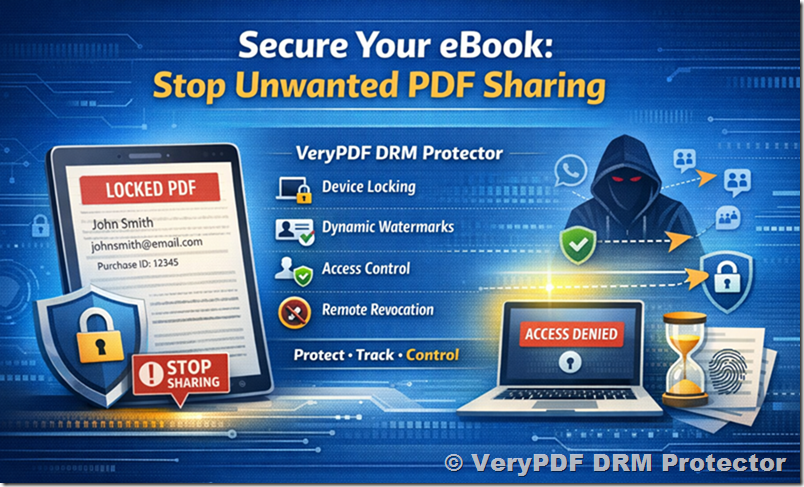
5.3 Device Locking
You can restrict access to:
- A fixed number of devices per user
- Specific devices only
Impact:
If someone shares the file:
- Others cannot open it
- Unauthorized access is denied
5.4 Expiry Controls
You can define:
- Expiration date (e.g., 30 days)
- Usage limits (e.g., number of opens)
This ensures:
- Long-term sharing becomes useless
- Access is time-bound
5.5 Dynamic Watermarking
Unlike static watermarks:
- Each user sees their own identity embedded
- Watermarks can include:
- Name
- Date/time
- IP address
Result:
- Strong psychological deterrent
- Traceability of leaks
5.6 Anti-Screenshot and Anti-Print Controls
Advanced DRM features include:
- Screenshot blocking
- Screen recording prevention
- Print restriction or watermarking
This significantly reduces content extraction.
5.7 Online & Offline Access Control
You can define:
- Whether content requires internet validation
- How long offline access is allowed
This balances:
- Security
- User convenience
5.8 Remote Revocation
This is one of the most powerful features.
You can:
- Revoke access instantly
- Disable specific users
- Shut down compromised files
Traditional PDFs cannot do this.
5.9 Usage Tracking & Analytics
You gain visibility into:
- Who opened the file
- When and where it was accessed
- Usage patterns
This provides actionable intelligence:
- Identify suspicious behavior
- Detect abuse early
6. Practical Scenario: Your Client’s eBook Launch
Let’s map this directly to your use case.
Without DRM:
1 purchase → shared in WhatsApp → unlimited free distribution
With DRM:
1 purchase → access restricted to:
- 1–2 devices
- Authorized user only
- Time-limited session
If shared:
- Others cannot open it
- Access is denied
If leaked:
- Watermark identifies the source
- Access can be revoked
7. Implementation Strategy (Step-by-Step)
Here’s a practical rollout plan.
Step 1: Convert the eBook into DRM-Protected Format
Using VeryPDF DRM Protector:
- Upload the PDF
- Apply encryption
- Convert to protected format
Step 2: Configure Access Rules
Define:
- Device limit (e.g., 2 devices)
- Expiry (e.g., 30 days or lifetime license)
- Offline access duration
Step 3: Apply Dynamic Watermarks
Include:
- Buyer name
- Email address
- Purchase ID
Make it visible but non-intrusive.
Step 4: Distribute Securely
Instead of sending raw files:
- Deliver via secure download
- Or controlled viewer access
Step 5: Monitor Usage
Track:
- Access frequency
- Device patterns
- Suspicious behavior
Step 6: Enforce When Necessary
If abuse is detected:
- Revoke access
- Disable accounts
- Update permissions
8. Balancing Security vs. User Experience
A common concern is:
“Will this make it harder for legitimate buyers?”
The answer depends on configuration.
Best practices:
- Allow 1–2 devices per user
- Enable limited offline access
- Keep onboarding simple
The goal is:
Friction for pirates, not for customers.
9. Why DRM Is Superior to “Simple Deterrence”
Let’s compare approaches.
|
Method |
Prevent Sharing |
Deter Sharing |
Control Access |
Revoke Access |
|
Password PDF |
❌ |
❌ |
❌ |
❌ |
|
Watermark Only |
❌ |
✅ |
❌ |
❌ |
|
DRM (VeryPDF) |
✅ |
✅ |
✅ |
✅ |
This is why DRM is the only comprehensive solution.
10. Addressing Common Objections
“People can still screen record”
Yes, but:
- It’s harder
- Quality is reduced
- Watermarks expose them
“Users don’t like special viewers”
Most users accept:
- Netflix-style access control
- App-based reading environments
Expectation has shifted.
“It’s not 100% secure”
Correct.
But security is about:
Raising the cost of abuse beyond convenience
11. Strategic Insight: Think Like a Platform, Not a File Sender
The biggest shift is conceptual.
Instead of:
“I’m selling a PDF file”
Think:
“I’m selling controlled access to content”
This mindset aligns with:
- Streaming platforms
- Online courses
- Subscription models
12. Final Recommendation
For your client’s upcoming eBook launch:
- Do not rely on standard PDFs
- Avoid password-only protection
- Use watermarking, but not alone
- Implement DRM for real control
The most practical and scalable approach is to adopt a system like VeryPDF DRM Protector, which combines:
- Strong technical enforcement
- Psychological deterrence
- Operational control
Conclusion
You cannot stop people from attempting to share a PDF, but you can:
- Make sharing ineffective
- Make access controlled
- Make leaks traceable
- Make abuse reversible
That is the difference between basic protection and professional-grade content security.
If your client is serious about protecting revenue, brand value, and intellectual property, then transitioning from open PDF distribution to DRM-controlled delivery is not just an option, it is a necessity.