
In the modern digital era, video content is a valuable asset for content creators, educational platforms, entertainment services, and corporate training providers. Protecting video content from piracy, unauthorized access, or redistribution is critical for maintaining revenue, intellectual property, and brand reputation. Among the technologies used for securing video, video segment encryption combined with digital rights management (DRM) protocols is widely adopted.
This article explores the differences between major DRM protocols—Google Widevine, Apple FairPlay, and Microsoft PlayReady—and compares them with a custom AES segment encryption approach coupled with a dedicated player. We will also examine the advantages of this approach and why it is an effective solution for content protection.
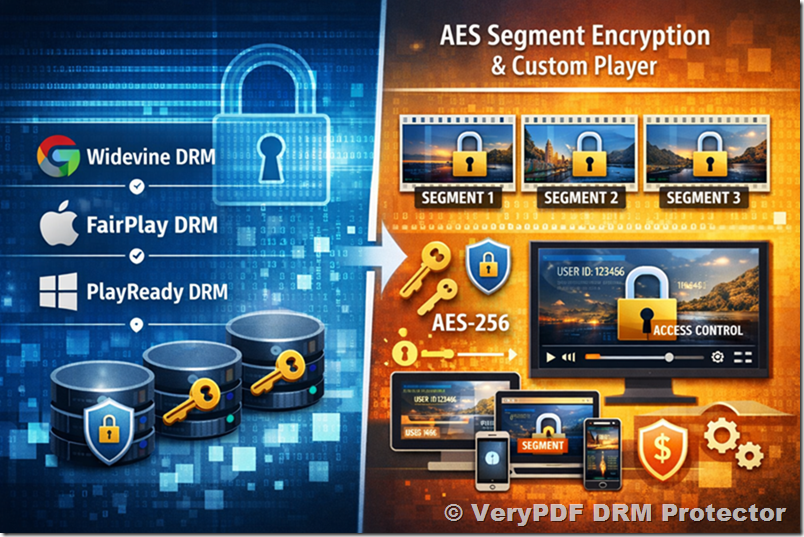
1. Video Segment Encryption: Overview
Video segment encryption is a process of dividing a video file into small segments or chunks and encrypting each segment individually. Typically, this is implemented using AES (Advanced Encryption Standard) with either 128-bit or 256-bit keys. Each segment may have its own encryption key and initialization vector (IV), ensuring that even if one segment’s key is compromised, the remaining segments remain secure.
1.1 Key Concepts
- Segments: Video files are divided into small chunks (2–10 seconds each) for streaming efficiency.
- AES Encryption: Each segment is encrypted using AES-128 or AES-256 in CBC mode, often with a unique IV.
- Playlist/Manifest: Protocols like HLS (HTTP Live Streaming) or DASH (Dynamic Adaptive Streaming over HTTP) use playlists or manifests that reference encrypted segments and key information.
- Key Management: Keys can be stored on secure servers and delivered dynamically to authorized clients.
Segment encryption ensures both secure storage and secure streaming, preventing unauthorized users from accessing or copying the video content.
2. Understanding DRM Protocols
DRM protocols are industry-standard frameworks that manage content access, licensing, and playback. The three most commonly used protocols are Google Widevine, Apple FairPlay, and Microsoft PlayReady.
2.1 Google Widevine
- Used widely for Android devices, Chrome browsers, and other platforms.
- Supports multiple security levels: L1 (hardware-backed), L2, and L3 (software).
- Provides license-based access to encrypted content.
- Integrates seamlessly with adaptive streaming formats such as DASH.
2.2 Apple FairPlay
- Exclusive to Apple devices including iOS, macOS, and Apple TV.
- Works with HLS streaming and requires integration with Apple’s FairPlay Streaming SDK.
- Manages licenses and decryption keys to ensure that content is only playable on authorized devices.
2.3 Microsoft PlayReady
- Commonly used on Windows devices, Xbox consoles, and Edge browsers.
- Supports DRM for both HLS and DASH streaming formats.
- Provides secure license management, expiration control, and playback restrictions.
2.4 Limitations of Standard DRM
While Widevine, FairPlay, and PlayReady provide strong content protection, they come with certain limitations for individual content creators or small companies:
- Integration Complexity: Requires SDKs, platform certification, and development effort.
- License Costs: Often involves per-stream or per-license fees, which may be expensive for small-scale projects.
- Platform Dependency: Each protocol is tied to specific devices or browsers, complicating cross-platform deployment.
- Limited Customization: Fine-grained control over encryption, dynamic watermarking, or user-specific content policies is often constrained.
3. AES Segment Encryption with a Custom Player
An alternative to traditional DRM is a custom AES segment encryption solution combined with a dedicated player. This approach allows complete control over encryption, key management, and playback.
3.1 How It Works
- Segmenting the Video: The original video is divided into multiple segments, typically 2–10 seconds each.
- AES Encryption: Each segment is encrypted individually using AES-128 or AES-256. A unique IV is assigned to each segment.
- Key Management: Keys are stored on a secure server and dynamically delivered to the custom player upon request.
- Playlist Generation: HLS or DASH playlists are generated referencing each encrypted segment and the corresponding key URI.
- Playback: The custom player authenticates the user, requests keys for each segment, decrypts segments in memory, and streams the video seamlessly.
3.2 Advantages Over Standard DRM
- Cost Efficiency: Unlike Widevine or PlayReady, there are no per-license fees; the encryption and key management can be implemented internally.
- Platform Independence: Works across any device or platform where your custom player is available.
- Custom Control: Enables dynamic watermarks, user tracking, expiration policies, and segment-specific access rules.
- Enhanced Security: Multi-key encryption ensures that if one segment key is compromised, only that segment is affected.
- Flexibility: You can implement your own policies for offline playback, temporary downloads, or partial access.
3.3 Key Management Best Practices
- Dynamic Key Delivery: Deliver keys only after authenticating the user or device.
- Key Rotation: Rotate keys periodically or per playback session to reduce the risk of long-term exposure.
- IV Uniqueness: Ensure each segment has a unique IV to prevent pattern attacks.
- Secure Storage: Use HTTPS and encrypted storage for all keys and metadata.
4. Comparison Between AES Segment Encryption and DRM Protocols
|
Feature |
Widevine |
FairPlay |
PlayReady |
AES Segment Encryption + Custom Player |
|
Device Coverage |
Android, Chrome, Smart TVs |
iOS, macOS, Apple TV |
Windows, Xbox, Edge |
Any device supporting custom player |
|
Integration Complexity |
High |
High |
High |
Medium (developer-controlled) |
|
Cost |
License fees per user/stream |
License fees |
License fees |
No per-license fees |
|
Custom Policies |
Limited |
Limited |
Limited |
Fully customizable (watermarking, per-segment control) |
|
Security |
High |
High |
High |
High (multi-key per segment) |
|
Key Management |
Managed by DRM |
Managed by DRM |
Managed by DRM |
Fully controllable by provider |
|
Offline Playback |
Supported but restricted |
Supported |
Supported |
Customizable (encrypted segments + keys) |
From this table, it is clear that AES segment encryption with a custom player offers more flexibility and control, while still maintaining a high level of security.
5. Practical Implementation Tips
- Segment Duration: Choose 5–10 seconds for most videos to balance performance and security. Shorter segments increase security but require more frequent key delivery.
- AES Mode: AES-128-CBC is widely supported and sufficient for streaming purposes; AES-256-CBC can be used for higher security.
- Key Storage: Use secure servers with HTTPS to deliver keys dynamically. Keys should never be embedded in the player or video file directly.
- Player Design: Your custom player must handle decryption in memory and prevent saving decrypted segments to disk.
- Watermarking: Integrate dynamic watermarks in segments to trace unauthorized sharing.
6. Conclusion
While traditional DRM protocols such as Widevine, FairPlay, and PlayReady provide secure content protection, they involve costs, integration complexity, and platform restrictions. For content creators, small studios, or platforms looking for flexibility, AES segment encryption combined with a custom player is an attractive alternative.
The benefits include:
- Full control over key management and encryption policies
- Platform independence and cross-device compatibility
- Multi-key encryption for maximum security
- Ability to implement dynamic watermarks and access control per user or per segment
By adopting AES segment encryption with a custom player, video publishers can protect their valuable content while retaining control, reducing costs, and ensuring seamless streaming experiences for authorized users.
Content creators and media platforms interested in this approach can explore solutions like VeryPDF DRM Protector, which provides tools for segment encryption, key management, and custom player integration, making it easier to secure both video and audio content effectively.