How to encrypt & securely send Gmail email messages & attachments.
Email is still one of the most common ways to share documents with customers, employees, partners, and clients. Gmail is widely used, but many people assume that Gmail encryption automatically protects everything they send.
The reality is different.
While Gmail can encrypt messages during delivery, that does not mean your attachments stay protected after they reach the recipient. If someone downloads a confidential PDF, contract, report, or financial document, Gmail provides very little control over what happens next.
In this guide, you’ll learn:
- What Gmail encryption is
- Is Gmail encrypted by default?
- How to send encrypted emails in Gmail
- Gmail Confidential Mode explained
- How to encrypt Gmail attachments
- Why Gmail attachment security has limitations
- How to stop forwarding, printing, copying, and sharing
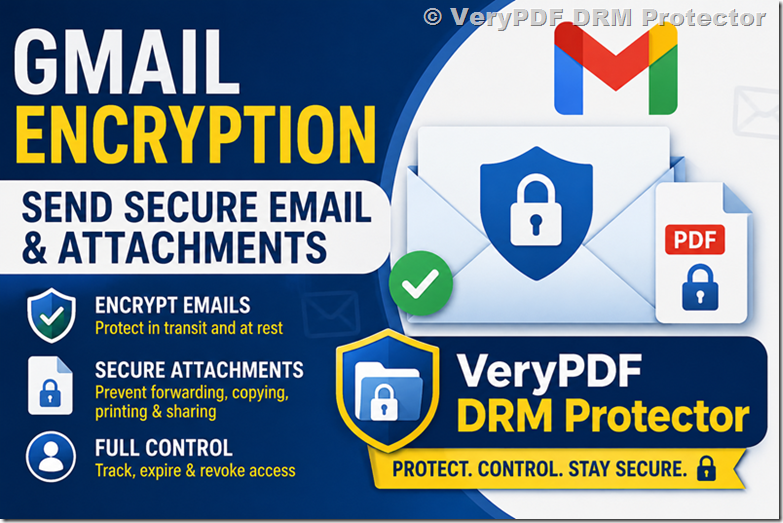
- Why VeryPDF DRM Protector provides stronger protection for sensitive PDF files
What Is Gmail Encryption?
Gmail encryption protects emails and attachments while they travel between servers.
Google currently supports three main encryption methods:
|
Encryption Type |
Protection Level |
Available For |
|
TLS |
Encrypts data during transfer |
All Gmail users |
|
S/MIME |
End-to-end email encryption |
Google Workspace Enterprise |
|
Client-Side Encryption (CSE) |
Strong enterprise encryption |
Google Workspace Enterprise |
TLS (Transport Layer Security)
TLS encrypts the connection between email servers.
When an email is being transmitted across the internet, TLS helps prevent hackers from intercepting it.
However:
- The message is decrypted after it reaches the mail server.
- Google can still access stored emails.
- Attachments are not permanently protected.
S/MIME
S/MIME provides true end-to-end encryption.
With S/MIME:
- Emails remain encrypted during transmission.
- Emails remain encrypted on mail servers.
- Only recipients with the correct private key can open them.
The downside is that both sender and recipient must support S/MIME and exchange certificates.
Client-Side Encryption (CSE)
Google’s newer Client-Side Encryption feature allows organizations to control encryption keys outside Google’s servers.
Benefits include:
- Stronger protection than TLS
- Enterprise key management
- Better compliance support
However, CSE still does not protect:
- Subject lines
- Email headers
- Timestamps
- Recipient information
Is Gmail Encrypted?
Yes, Gmail uses encryption by default.
Whenever you send an email from Gmail, Google attempts to use TLS encryption.
Free Gmail Accounts
Free Gmail users only get TLS protection.
This means:
- Messages are encrypted during delivery.
- Messages are not fully encrypted after delivery.
- Attachments remain accessible if the account is compromised.
Google Workspace Enterprise
Paid Workspace Enterprise accounts can use:
- TLS
- S/MIME
- Client-Side Encryption (CSE)
These options provide much stronger security.
Gmail Encryption Comparison
|
Feature |
TLS |
S/MIME |
CSE |
|
Encrypts in transit |
Yes |
Yes |
Yes |
|
Encrypts stored emails |
No |
Yes |
Yes |
|
End-to-end encryption |
No |
Yes |
Yes |
|
Available for free Gmail |
Yes |
No |
No |
|
Requires certificates |
No |
Yes |
Usually |
|
Protects attachments after download |
No |
No |
No |
The biggest problem is that none of these methods prevent recipients from sharing downloaded files.
How to Encrypt an Email in Gmail
Free Gmail Users
- Open Gmail.
- Compose a new email.
- Add attachments.
- Click Send.
If the recipient’s mail server supports TLS, Gmail automatically encrypts the connection.
No additional setup is required.
Google Workspace Enterprise Users
Enterprise administrators can configure:
- TLS
- S/MIME
- Client-Side Encryption
After setup, Gmail will automatically apply the selected encryption method.
How to Tell Whether Gmail Is Using Encryption
Google displays a padlock icon beside the recipient address.
|
Icon Color |
Meaning |
|
Gray |
TLS encryption |
|
Green |
S/MIME encryption |
|
Red |
No encryption |
For free Gmail users, visibility is limited and you may not always know how the recipient’s mail server handled encryption.
Are Gmail Attachments Really Secure?
This is where many users run into problems.
Problem 1: Attachments Are Usually Not End-to-End Encrypted
With standard Gmail:
- Attachments are protected during transmission.
- Attachments are not permanently encrypted.
- Anyone with account access can download them.
If a Gmail account is hacked, attackers can access years of attachments.
Even accounts using two-factor authentication are not completely immune. Session hijacking attacks have successfully bypassed MFA protection in many real-world cases.
Problem 2: Nothing Stops Intentional Sharing
Once a recipient downloads an attachment:
- They can forward it.
- They can upload it elsewhere.
- They can print it.
- They can copy content.
- They can share it with unauthorized users.
Even S/MIME and CSE do not prevent this.
This is one of the biggest weaknesses of Gmail attachment security.
Gmail Confidential Mode Explained
Google introduced Confidential Mode to improve email security.
It allows senders to:
- Set expiration dates
- Revoke access
- Require SMS verification
- Hide forwarding buttons
- Hide download buttons
At first glance, it sounds like the perfect solution.
Unfortunately, it has significant limitations.
Why Gmail Confidential Mode Is Not Truly Secure
1. Restrictions Only Work Inside Gmail
Confidential Mode controls are mainly enforced by Gmail itself.
If recipients use:
- Outlook
- Apple Mail
- Thunderbird
- Other email clients
many protections may not work as expected.
2. Users Can Still Capture Content
Recipients can often:
- Take screenshots
- Copy information
- Print content using other methods
The restrictions are not foolproof.
3. Google Still Stores the Content
Confidential Mode does not remove messages from Google’s servers.
The content remains accessible to Google.
4. SMS Verification Is Not Highly Secure
SMS codes are vulnerable to:
- SIM swap attacks
- Social engineering
- Phishing
- Malware
This creates additional security risks.
Does Gmail Confidential Mode Encrypt Attachments?
No.
Confidential Mode does not change how encryption works.
If Gmail is using TLS:
- Attachments remain protected only during transmission.
If Gmail is using S/MIME:
- Attachments receive end-to-end encryption.
Confidential Mode itself does not provide additional encryption.
Other Ways to Encrypt Gmail Attachments
Many users look for alternatives when Gmail security is not enough.
Common options include:
|
Method |
Good For |
Main Limitation |
|
PGP |
Strong encryption |
No usage control |
|
Mailvelope |
Gmail PGP integration |
Can still share files |
|
FlowCrypt |
Easy encryption |
No document control |
|
Virtru |
Email encryption |
Limited protection after download |
|
WinZip Password Protection |
Simple sharing |
Password management issues |
|
PDF Password Protection |
Basic access control |
Easily bypassed |
|
Secure Data Rooms |
Online viewing |
Browser security limitations |
Let’s look at these options more closely.
How to Send PGP Encrypted Email in Gmail
PGP encryption uses:
- Public keys for encryption
- Private keys for decryption
Only users with the correct private key can open protected files.
Benefits:
- Strong encryption
- Good protection during storage and transfer
Limitations:
- Recipients can still share decrypted files
- Private keys can be shared
- No control after decryption
PGP solves access control but not document control.
Gmail Encryption Add-Ons
Popular Gmail encryption add-ons include:
- Mailvelope
- FlowCrypt
- Virtru
- SendSafely
- XQ Secure Gmail
- Lockmagic
These tools improve encryption.
However, once users decrypt attachments, they still have full control over the files.
Is WinZip Password Protection Secure?
WinZip allows you to:
- Compress files
- Add passwords
- Reduce attachment size
But passwords create new problems.
|
Issue |
Explanation |
|
Password sharing |
You must send passwords separately |
|
Weak passwords |
Easy to crack |
|
User inconvenience |
Extra steps for recipients |
|
Management overhead |
Difficult at scale |
For business use, password-protected ZIP files are often inconvenient and unreliable.
Why PDF Password Protection Is Not Enough
Many people protect PDF files with passwords before sending them through Gmail.
Unfortunately, PDF password protection has major weaknesses.
Open Password Problems
Weak passwords can often be cracked quickly using modern hardware.
Permission Password Problems
Permission restrictions such as:
- No printing
- No copying
- No editing
can often be removed in seconds using free PDF tools.
As a result, PDF passwords are not suitable for protecting highly confidential documents.
Secure Cloud Storage and Download Links
Another popular option is sending links instead of attachments.
Examples include:
- Google Drive
- Dropbox
- Secure data rooms
- Enterprise document portals
Advantages:
- No attachment size limits
- Access management
- Activity tracking
Disadvantages:
- Users can often download files
- Browser protections can be bypassed
- Authorized users can still share documents
Cloud storage improves security but does not fully solve the sharing problem.
VeryPDF DRM Protector: Protect Gmail Attachments Even After Download
If your goal is simply encryption, Gmail already provides basic options.
If your goal is preventing unauthorized sharing, encryption alone is not enough.
This is where VeryPDF DRM Protector is different.
VeryPDF DRM Protector combines:
- AES 256-bit encryption
- Digital Rights Management (DRM)
- Device locking
- Secure licensing
- Usage tracking
Instead of only protecting files during transmission, it protects documents after they have been downloaded.
What Can VeryPDF DRM Protector Prevent?
After protecting a PDF:
|
Restriction |
Supported |
|
Prevent forwarding |
Yes |
|
Prevent copying |
Yes |
|
Prevent editing |
Yes |
|
Prevent unauthorized printing |
Yes |
|
Prevent unauthorized screenshots |
Yes |
|
Device locking |
Yes |
|
Remote revocation |
Yes |
|
Expiry dates |
Yes |
|
Open limits |
Yes |
|
Print limits |
Yes |
|
View tracking |
Yes |
Only authorized users can open protected files.
Even if someone shares the PDF, unauthorized users cannot access it.
How to Send Secure Gmail PDF Attachments
The process is simple.
Step 1
Right-click your PDF and select:
Make Secure PDF
Step 2
Choose:
Selected Customers
under Document Access.
Step 3
Apply your DRM settings:
- Printing permissions
- Copy restrictions
- Screenshot restrictions
- Expiration rules
Step 4
Click Publish.
The PDF is encrypted using AES 256-bit encryption.
Step 5
Upload the protected PDF to Gmail as a normal attachment.
Step 6
Assign document permissions through the VeryPDF DRM Protector admin portal.
Recipients receive:
- License information
- Secure viewer download instructions
Only authorized users can open the document.
Gmail Attachment Tracking
Many attachment tracking tools only track the original file.
Users can create copies that are never tracked.
VeryPDF DRM Protector solves this problem because users cannot create unrestricted copies.
You can track:
- Views
- Opens
- Prints
- User activity
directly from the administration portal.
How to Send Expiring Attachments in Gmail
VeryPDF DRM Protector allows you to set:
|
Expiration Type |
Supported |
|
Expire on date |
Yes |
|
Expire after first open |
Yes |
|
Expire after X days |
Yes |
|
Expire after X views |
Yes |
|
Expire after X prints |
Yes |
|
Manual revocation |
Yes |
Even after an attachment has been delivered, access can be removed instantly.
Best Way to Send Secure Gmail Attachments
Gmail encryption protects emails while they travel across the internet.
That is important, but it is only part of the security picture.
The bigger risk often comes after the recipient downloads the file.
If you need to protect:
- Contracts
- Financial reports
- Training materials
- Intellectual property
- Legal documents
- Confidential PDFs
then encryption alone is not enough.
VeryPDF DRM Protector provides protection before delivery, during delivery, and after delivery. It prevents forwarding, printing, copying, and unauthorized sharing while giving administrators complete control over document access.
For businesses that send sensitive PDF files through Gmail, it is one of the most effective ways to keep documents secure.
Frequently Asked Questions (FAQs)
1. Is Gmail encrypted by default?
Yes. Gmail uses TLS encryption by default whenever the receiving mail server supports it.
2. Is Gmail end-to-end encrypted?
Not usually. End-to-end encryption requires S/MIME or Client-Side Encryption (CSE).
3. Can Gmail encrypt attachments?
Yes, but typically only during transmission. Attachments are not permanently protected after download.
4. Does Gmail Confidential Mode encrypt emails?
No. Confidential Mode does not add additional encryption.
5. Can recipients forward Gmail attachments?
Yes. Once downloaded, recipients can usually share attachments freely.
6. Is Gmail secure enough for confidential documents?
For highly sensitive files, Gmail alone is usually not enough because it cannot control what happens after download.
7. What is the difference between TLS and S/MIME?
TLS protects the connection. S/MIME encrypts the actual email and attachment contents.
8. Can Gmail encrypt PDF files?
Not directly. You need a third-party solution such as PDF encryption software or DRM protection.
9. Is PDF password protection secure?
Not for highly confidential documents. Passwords can be cracked or shared, and PDF permissions can often be removed.
10. Can I stop recipients from printing a PDF attachment?
Not with Gmail alone. A DRM solution such as VeryPDF DRM Protector is required.
11. Can I revoke access to a Gmail attachment after sending it?
Gmail has limited options. VeryPDF DRM Protector allows full remote revocation.
12. How can I track who opened my Gmail attachment?
VeryPDF DRM Protector can log views, opens, and printing activity for protected PDF files.
13. Does Gmail encryption help with HIPAA compliance?
TLS alone is generally not sufficient. Organizations typically use S/MIME or stronger encryption methods for compliance requirements.
14. Can Outlook send encrypted emails to Gmail?
Yes. Gmail supports encrypted emails sent from Outlook using TLS or S/MIME.
15. What is the safest way to send confidential PDF files through Gmail?
Protect the PDF with VeryPDF DRM Protector before attaching it to Gmail. This keeps the file encrypted and controlled even after the recipient downloads it.