Original Question
I’m looking for a simple solution to provide access to videos, PDFs, presentations, and workshop materials for a small group of participants without allowing downloads.
Requirements:
- View content in a browser but prevent downloads
- User-based access, not public links
- Revoke access for individual users anytime
- Some files downloadable, some view-only
- Easy to manage for a trainer, not an IT admin
- No expensive per-user licensing if possible
This is a very common problem for trainers, coaches, consultants, online course creators, and companies that deliver workshop materials.
The challenge is simple:
You want participants to watch videos and read documents, but you don’t want them downloading your content and sharing it with others.
Unfortunately, most cloud storage services were built for file sharing, not content protection.
Let’s look at the available options.
Why OneDrive, Google Drive, and Dropbox Usually Don’t Work
Many trainers start with:
- OneDrive
- Google Drive
- Dropbox
- SharePoint
The problem is that these platforms focus on collaboration.
Even when you disable the download button, users can often still:
| Risk | What Happens |
|---|---|
| Download loopholes | Users find alternate download methods |
| Screen recording | Videos can be recorded |
| Copy content | Text can often be copied |
| Shared accounts | Multiple people use the same login |
| Public link sharing | Links get passed around |
| Sync software | Files may sync locally |
For workshop materials that have real value, these systems are usually not enough.
What Most Trainers Actually Need
Most workshop providers are looking for something like this:
| Requirement | Needed? |
|---|---|
| Stream videos only | Yes |
| Disable downloads | Yes |
| Individual user accounts | Yes |
| Revoke access anytime | Yes |
| Browser viewing | Yes |
| PDF protection | Yes |
| Folder-level permissions | Yes |
| Simple management | Yes |
The problem is that very few systems handle both:
- Video protection
- Document protection
in one place.
Option 1: Use a Learning Management System (LMS)
Examples include:
- Moodle
- Teachable
- Thinkific
- LearnDash
These platforms allow:
- User accounts
- Course enrollment
- Video hosting
- PDF sharing
Advantages
- Built for training
- User management included
- Progress tracking
Disadvantages
- Setup can be complicated
- Video protection is often limited
- Documents are usually downloadable
- Extra plugins may be needed
For many small workshop businesses, this can feel like overkill.
Option 2: Vimeo for Videos + Cloud Storage for Documents
Many trainers use:
- Vimeo Pro
- Vimeo OTT
for videos.
Then use:
- Google Drive
- Dropbox
- OneDrive
for documents.
Advantages
- Easy setup
- Good video streaming
Disadvantages
- Two separate systems
- PDFs remain exposed
- Users can still screen-record videos
- Access management becomes messy
This works for some trainers but creates more administration over time.
Option 3: Use a Dedicated DRM Content Protection Platform
If preventing downloads is your main goal, a DRM (Digital Rights Management) platform is usually the best solution.
Instead of sharing files directly, the platform:
- Encrypts videos and documents
- Streams content securely
- Controls who can access files
- Allows instant access revocation
This is how many training companies, certification providers, and publishers protect their content.
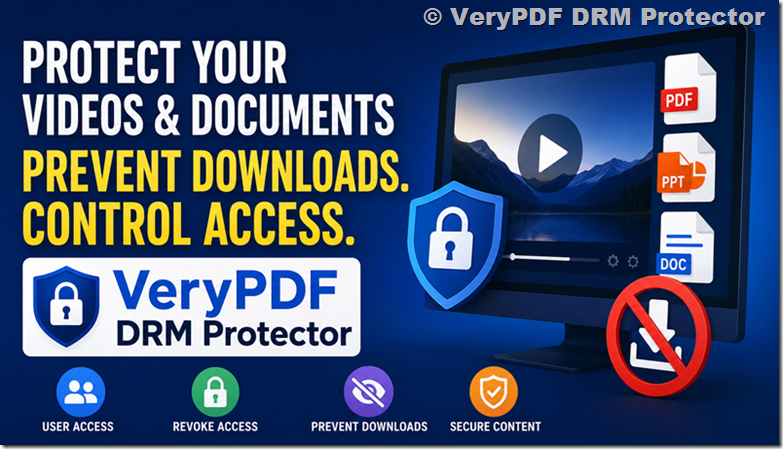
A Simple Solution: VeryPDF DRM Protector
One solution designed specifically for this use case is:
VeryPDF DRM Protector
It allows trainers to protect:
- Videos
- PDF files
- PowerPoint presentations
- Training manuals
- Workshop materials
without requiring complicated SharePoint or LMS administration.
How It Works
Upload Your Materials
Create a workshop folder and upload:
| Content Type | Supported |
|---|---|
| Videos | Yes |
| PDFs | Yes |
| PowerPoint files | Yes |
| Word documents | Yes |
| Training manuals | Yes |
Assign Users
Instead of public links, you create authorized users.
Example:
| User | Access |
|---|---|
| John | Workshop A |
| Sarah | Workshop A |
| Mike | Workshop B |
Only approved users can view content.
Disable Downloads
Participants can:
✅ Watch videos
✅ Read documents
✅ Open presentations
But cannot:
❌ Download files
❌ Save copies
❌ Share links publicly
❌ Access content after permission is removed
Revoke Access Anytime
Suppose a participant leaves your program.
You can immediately:
- Remove the user
- Disable the account
- Block future access
Even if they still have the original link.
Can I Allow Downloads for Some Files?
Yes.
This is one of the requirements many trainers have.
Example folder structure:
| Folder | Download Allowed |
|---|---|
| Workshop Videos | No |
| Workshop PDFs | No |
| Handouts | Yes |
| Exercises | Yes |
| Templates | Yes |
This allows participants to download worksheets while protecting premium content.
What About Screen Recording?
No system can completely stop a person from recording their screen with a phone camera.
However, professional DRM systems can reduce the risk significantly.
VeryPDF DRM Protector includes features such as:
- Dynamic watermarks
- User identification overlays
- Access logging
- Device restrictions
- Account-based permissions
If a recording appears online, you can often identify the source user.
This alone discourages most content sharing.
Example Workshop Scenario
Imagine you run a paid workshop for 50 participants.
You upload:
- 10 training videos
- 5 PDF manuals
- 3 PowerPoint presentations
- 2 downloadable worksheets
Participants:
- Log in using their own accounts
- Watch videos online
- Read PDFs in the browser
- Download worksheets if permitted
If someone requests a refund or violates your terms:
- Remove their account
- Access stops immediately
No need to change links or re-upload files.
Comparison of Popular Solutions
| Feature | Google Drive | OneDrive | Vimeo + Drive | LMS | VeryPDF DRM Protector |
|---|---|---|---|---|---|
| Browser viewing | Yes | Yes | Yes | Yes | Yes |
| Disable downloads | Limited | Limited | Partial | Partial | Yes |
| User-based access | Yes | Yes | Yes | Yes | Yes |
| Video protection | No | No | Moderate | Moderate | Yes |
| PDF protection | No | No | No | Limited | Yes |
| Revoke users | Yes | Yes | Yes | Yes | Yes |
| Dynamic watermark | No | No | No | Rarely | Yes |
| Trainer-friendly | Yes | No | Moderate | Moderate | Yes |
Which Solution Is Best?
The answer depends on how valuable your content is.
| Situation | Recommended Solution |
|---|---|
| Free materials | Google Drive |
| Small internal team | OneDrive |
| Public video courses | Vimeo |
| Full training business | DRM platform |
| Premium workshops | VeryPDF DRM Protector |
If your workshop materials generate revenue and you want to prevent unauthorized sharing, a dedicated DRM solution is usually the safest approach.
Frequently Asked Questions (FAQ)
1. Can I completely prevent video downloads?
No system can guarantee 100% prevention. However, DRM platforms make downloading extremely difficult and stop normal file sharing.
2. Can users watch videos in a browser without downloading them?
Yes. Videos can be streamed directly in the browser while keeping the original file protected.
3. Can I revoke access after a workshop ends?
Yes. User accounts can be disabled or removed at any time.
4. Can I allow downloads for some files but not others?
Yes. Permissions can be configured per folder or per file.
5. Is OneDrive suitable for protected training videos?
Not really. OneDrive is designed for file sharing, not content protection.
6. Is Google Drive secure enough for paid workshop materials?
For basic sharing, yes. For premium content, most trainers find it too easy for users to redistribute files.
7. Can users share their login credentials?
Some DRM systems can limit access by device, browser, or account, reducing account sharing.
8. What is DRM?
DRM stands for Digital Rights Management. It controls who can access content and what they can do with it.
9. Can DRM protect PDFs as well as videos?
Yes. Modern DRM platforms can protect both documents and video content.
10. Can participants access content on mobile devices?
Yes. Most DRM systems support desktops, tablets, and smartphones.
11. Can I see who viewed my content?
Many DRM platforms provide access logs and user activity reports.
12. Do I need technical skills to use DRM software?
Not necessarily. Solutions such as VeryPDF DRM Protector are designed for trainers, publishers, and content owners who are not system administrators.
Final Answer
If you simply need file sharing, Google Drive or OneDrive may be enough.
But if your goal is to provide access to video content without allowing downloads, while also protecting PDFs, presentations, and workshop materials, a dedicated DRM platform is a much better fit.
For trainers and workshop providers, VeryPDF DRM Protector offers:
- Secure video streaming
- PDF and document protection
- User-based access control
- Download restrictions
- Dynamic watermarking
- Access revocation at any time
- Separate folders with different permission levels
This gives you the simplicity of cloud access while keeping your valuable training content under your control.