
In digital content distribution and eLearning environments, controlling the device bind, the number of devices each user can use to access a protected PDF, is crucial for security and licensing compliance. VeryPDF DRM Protector allows publishers to limit the number of Mac devices a single user can read a PDF on, ensuring content is only accessed on authorized devices.
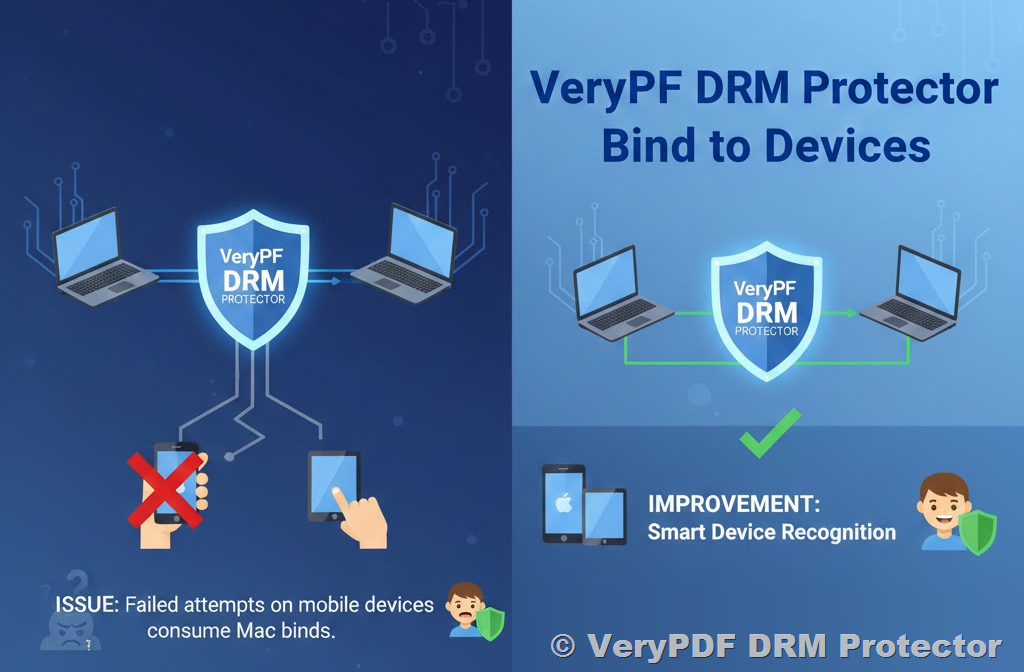
However, some users have encountered an issue where attempts to open a PDF on unsupported devices, such as iPhones or iPads, are blocked as expected, but still count toward the user’s allowed Mac device binds. This can lead to accidental exhaustion of a user’s permitted devices, preventing legitimate access on authorized Macs.
This article provides a detailed analysis of this device bind issue, explains why it occurs, and introduces the improvements in the new version of VeryPDF DRM Protector designed to prevent incorrect device bind consumption.
1. Understanding Device Binding and Its Importance
Device binding is a security mechanism that links a user account to specific devices. For example, a publisher might allow a student to read a PDF on up to 2 Mac computers. This ensures that:
- The content cannot be freely shared on multiple devices.
- Publishers maintain control over how many devices a single user can access the content from.
- Users cannot bypass DRM by simply installing the file on multiple devices.
Device binding is different from user limits. While user limits restrict the total number of users who can access a file, device binding restricts the number of devices per user. This is particularly useful in educational scenarios, where one student may have multiple devices.
2. The Problem: Unsupported Devices Consume Device Slots
A recurring issue occurs when students attempt to open a protected PDF on unsupported devices:
- Suppose a publisher allows 2 Mac devices per student.
- A student first tries to open the PDF on their iPhone or iPad.
- The DRM system correctly blocks access because iOS is not allowed.
The unexpected problem: In the current version of VeryPDF DRM Protector, this failed attempt still counts as a consumed device slot. As a result:
- The student cannot access the PDF on their allowed Mac devices.
- The publisher’s intended device limit is effectively reduced, causing frustration for both educators and students.
This behavior happens because the system previously tracked all access attempts to a protected file without distinguishing between successful access on a permitted device and blocked access on unsupported devices.
3. Why This Happens: Technical Analysis
The problem can be traced to two main factors:
- Access tracking logic:
The system was designed to record all access attempts as “device usage.” It did not check whether the attempt was made on a supported OS. - Device classification:
When a device is not recognized as MacOS (e.g., an iPhone or iPad), the system blocks access. However, the binding logic still increments the count of devices associated with the user.
Combined, these factors lead to “phantom device consumption,” where the allowed device slots are reduced even though the user has not successfully accessed the file on an authorized Mac.
4. Real-World Example
Consider the following scenario:
- A university lecturer distributes a PDF textbook to students via VeryPDF DRM Protector.
- Each student is allowed 2 Mac devices to read the PDF.
- A student attempts to open the PDF on their iPhone first. The system blocks access, as expected.
- However, the student then tries to open the PDF on a Mac. The system now reports that only 1 device slot remains instead of 2.
This scenario highlights how students using unsupported devices can unintentionally waste their allowed Mac device slots, creating access problems and unnecessary support requests.
5. The Solution in the New Version
VeryPDF DRM Protector is addressing this issue with a comprehensive update:
- Accurate Device Binding Counting:
- Only successful access attempts on allowed operating systems (e.g., MacOS) will count toward a user’s device limit.
- Attempts from unsupported devices (iPhone, iPad, Android, etc.) will not consume a device slot.
- This ensures that students can safely try accessing the PDF on multiple devices without accidentally losing allowed slots.
- Improved OS Detection:
- The system will correctly identify the latest macOS versions, including macOS 26, which previously caused Mac users to be classified as “others.”
- Mac users will now be recognized accurately, preventing blocked access due to misclassification.
- Enhanced User Experience:
- Students can attempt access on multiple devices without risk of losing their allowed Mac device slots.
- Publishers gain more accurate control over device usage and can better manage licensing restrictions.
6. Benefits for Educators and Publishers
The new improvements provide multiple advantages:
- Reliability: Device counts now accurately reflect actual usage on permitted devices.
- Reduced Support Requests: Fewer students will report being locked out due to phantom device consumption.
- Better Security: Unauthorized attempts on unsupported devices are still blocked, maintaining DRM protection.
- Future-Proofing: With updated OS detection, new MacOS releases will be supported without disruption.
7. Looking Forward: Future Enhancements
VeryPDF DRM Protector continues to focus on usability and security. Planned future updates include:
- Detailed device usage reports for publishers, showing exactly which devices accessed the PDF successfully.
- Notifications for users when an access attempt is made on a blocked device, helping them understand why the attempt failed.
- Support for additional operating systems in case publishers want to allow other devices in the future.
Conclusion
Device binding is a critical feature of DRM systems, ensuring that protected content is only accessed on authorized devices. The current version of VeryPDF DRM Protector occasionally consumed device slots for blocked access attempts, causing confusion and frustration.
The upcoming version solves this problem by:
- Counting only successful access on permitted devices toward device limits.
- Correctly detecting the latest MacOS versions to prevent misclassification.
These improvements will provide a more accurate, reliable, and user-friendly DRM experience, benefiting both publishers and students.
Call to Action:
Publishers and educators using VeryPDF DRM Protector can look forward to these updates, which will prevent device binding issues and enhance secure access management. Stay tuned for the release to take full advantage of the improved system.