
Ebook Piracy Problem: My PDF Is Being Shared Everywhere — What Can Authors Do to Stop It?
If you sell ebooks as PDF downloads, this situation is very common.
A customer recently told me this:
They found their paid ebook on multiple piracy websites.
They sent takedown requests. The files were removed, but new copies kept appearing again.
The real problem was not only lost sales. It was time.
They were spending hours chasing piracy instead of writing new content.
So they asked a simple question:
“Is there a better way to protect my PDF before it gets shared everywhere?”
Why PDF ebooks are easy to pirate
A normal PDF file is easy to copy once it leaves your control.
Here is what usually happens:
- One customer downloads the file
- They upload it to a forum or file-sharing site
- Others download and redistribute it again
- Even if you remove one link, new ones appear
This is why takedown requests often feel endless.
The hard truth about DRM and piracy
No system can fully stop piracy.
One comment I often see is this:
“Even a strong DRM cannot stop someone from using OCR and rebuilding the content.”
That is true.
But this is only part of the story.
The goal of PDF protection is not “perfect prevention.”
The goal is:
- Stop easy sharing
- Reduce mass distribution
- Control access to paid content
- Make piracy harder and less attractive
If copying becomes difficult, most people simply won’t bother.
Common ways people try to protect ebooks
Here are the most common methods authors use:
|
Method |
What it does |
Weak point |
|
PDF password |
Stops casual opening |
Password can be shared |
|
Watermarking |
Shows buyer name on file |
File still fully accessible |
|
Download links |
Controls access to file |
File still ends up shared |
|
Manual takedown |
Removes piracy sites |
New sites appear again |
|
DRM system |
Controls access rules |
Cannot stop screenshots/OCR |
Each method helps a little, but none solves the full problem alone.
What actually works better: controlling access instead of file sharing
The key shift is this:
Stop thinking “how do I protect a PDF file”
Start thinking “how do I control how people read my content”
Instead of sending a downloadable PDF, many publishers now use controlled viewing systems.
This is where tools like VeryPDF DRM Protector come in.
Using VeryPDF DRM Protector for ebook protection
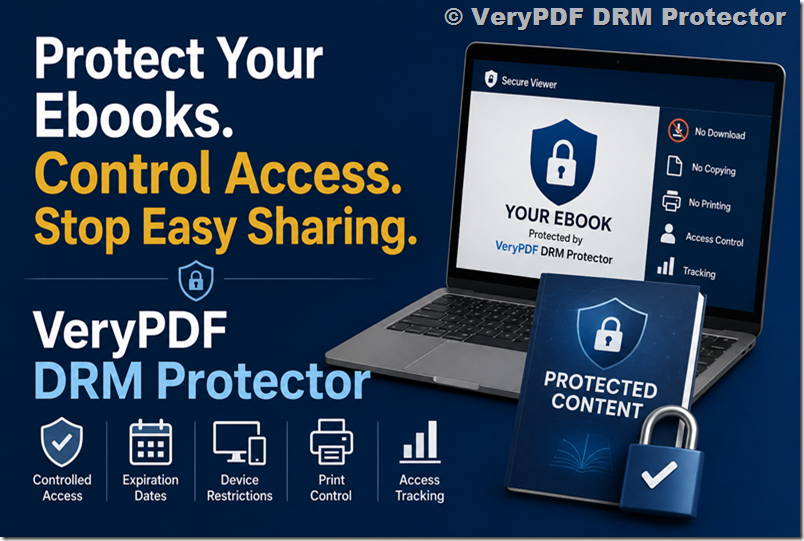
VeryPDF DRM Protector is designed for protecting PDF documents by changing how users access the file.
Instead of sending a normal PDF download, you can:
- Deliver content through controlled access
- Set expiration dates
- Restrict devices or user accounts
- Limit printing or copying
- Track access activity
This reduces the chance that one buyer can freely distribute the file to thousands of others.
PDF download vs DRM-controlled access
Here is a simple comparison:
|
Feature |
Normal PDF download |
DRM-controlled ebook (VeryPDF DRM Protector) |
|
Easy sharing |
Very easy |
Controlled |
|
Offline file copy |
Full file available |
Restricted |
|
Expiry control |
No |
Yes |
|
User tracking |
No |
Yes |
|
Printing control |
No |
Yes |
|
Piracy risk |
High |
Lower |
The biggest change is simple:
You are no longer sending a permanent file.
You are giving controlled access.
Real expectation: what DRM can and cannot do
It is important to be realistic.
DRM can:
- Stop casual sharing
- Reduce bulk redistribution
- Protect revenue from most users
- Make piracy less convenient
DRM cannot:
- Stop screenshots
- Stop OCR scanning
- Stop someone determined to rebuild content manually
So the goal is not perfection.
The goal is damage control.
Why authors still lose sleep over piracy
Most authors don’t worry about one or two leaks.
They worry about:
- Their whole ebook ending up on Google search
- Competitors reselling their content
- Months of work spreading for free
- Constant takedown work with no end
This is why many publishers switch to controlled access systems instead of pure PDF downloads.
Practical approach many publishers use
A more realistic strategy looks like this:
- Use DRM for primary distribution (controlled access)
- Add watermarking for traceability
- Monitor piracy sites occasionally (not daily)
- Use takedowns only for major leaks
- Focus energy on new content creation
This reduces stress and saves time.
FAQs
1. Can PDF piracy be fully stopped?
No. Even strong protection cannot stop screenshots or manual copying.
2. Is DRM worth it for ebooks?
Yes, if your goal is to reduce large-scale sharing and protect revenue.
3. What is the biggest weakness of PDF files?
Once downloaded, the file can be easily shared without control.
4. Does watermarking stop piracy?
No. It only helps identify the source of leaks.
5. Are takedown requests effective?
Only partially. They remove links, but new ones often appear.
6. Can DRM stop screenshots?
No DRM can fully stop screenshots.
7. What is the best protection for ebooks?
A combination of DRM + controlled access + watermarking.
8. Is password protection enough?
No. Passwords are easy to share.
9. Why do pirates re-upload ebooks so fast?
Because sharing a PDF file is simple and fast once it is downloaded.
10. What is the main goal of DRM?
To reduce easy sharing and control access, not to eliminate copying completely.
11. Does DRM slow down sales?
It depends on setup. A well-designed system usually does not affect sales much.
12. Can I still sell PDFs normally with DRM?
Yes, but access is usually delivered through a viewer or portal instead of raw download.
Final thought
If you sell ebooks, the real question is not:
“How do I stop all piracy?”
The better question is:
“How do I stop easy sharing and protect most of my revenue?”
For many publishers, moving away from simple PDF downloads and using tools like VeryPDF DRM Protector is a practical step in that direction.