
A year ago, I was in the same position as many people searching for financial independence: constantly looking for a realistic, scalable source of passive income that didn’t require a huge upfront investment or consume all of my time. I had already experimented with several popular online business models, dropshipping, print-on-demand, cryptocurrency trading, but none of them gave me the combination of simplicity, control, and sustainability I was looking for. Most of them required constant attention, ongoing costs, or carried risks that didn’t align with my long-term vision.
Then something unexpected happened. I discovered a business model that seemed almost too simple to be true: selling a single PDF file.
At first, I dismissed the idea. How could a basic digital document generate consistent income? There was no inventory, no shipping, no physical product, nothing tangible. But that simplicity turned out to be the biggest advantage. Today, that same idea generates around $2,300 per month in passive income, and it requires very little ongoing effort.
This is the complete story of how I built it, how I scaled it, and most importantly, how I protected and monetized it effectively using the right tools, especially VeryPDF DRM Protector, which became a critical part of turning a simple file into a controlled, revenue-generating digital asset.
The Starting Point: Searching for a Real Opportunity
Like many aspiring entrepreneurs, I had a strong desire to build something meaningful. I am naturally driven by the need to create, to test ideas, and to succeed. Over the years, I tried multiple ventures. Some worked temporarily, most didn’t. That’s part of the process.
At the time, I was balancing several responsibilities: a full-time job in the environmental sector, investments in rental real estate, crypto trading, ETF portfolios, and small digital marketing experiments. My wife had also been building her own business for over 10 years, and I supported her along the way.
Despite all of this activity, I still wanted a reliable stream of passive income, something scalable, something that didn’t require constant operational effort.
That’s when I shifted my thinking.
Instead of asking, “What business should I start?” I asked a more precise question:
“What problem can I solve with information that people are willing to pay for?”
Step 1: Finding a Real, Specific Problem
Rather than creating a random product, I focused on identifying a clear demand.
I spent time analyzing discussions on platforms like Reddit, Quora, and Facebook groups. I wasn’t looking for trends, I was looking for repeated frustrations.
What I found was surprisingly consistent: people were constantly searching for practical documents, contract templates, administrative forms, structured guides, especially in niche areas like freelancing, real estate, and small business operations.
The key insight was this:
People don’t just want information. They want organized, ready-to-use solutions.
That was my entry point.
Step 2: Creating a Simple but Valuable Product
I dedicated a single weekend to creating my first product.
It wasn’t complicated. I compiled high-quality information from reliable sources, structured it clearly, and transformed it into a set of practical templates and guides. The goal was usability, not perfection.
I formatted everything into a clean, professional PDF. The focus was on clarity, structure, and immediate value.
I didn’t need to be the world’s leading expert. I needed to be someone who could organize information better than the average person and present it in a way that saved others time.
That distinction is important.
Step 3: Selling Without Building a Website
Instead of spending weeks building a website, I used existing platforms:
- Etsy
- Gumroad
- Payhip
These platforms allowed me to start selling immediately without technical complexity or upfront costs.
This approach eliminated friction. I could validate the idea quickly and focus on what mattered: whether people would actually buy the product.
Step 4: Generating Traffic with Free Strategies
With the product live, the next challenge was visibility.
I didn’t have a marketing budget at the beginning, so I relied on organic strategies:
- I created a Reddit post targeting specific communities where my product was relevant.
- I answered questions on Quora, subtly integrating my solution where appropriate.
- I used Pinterest to create simple visuals that linked back to my listings.
These weren’t aggressive sales tactics. They were targeted contributions to existing conversations.
The goal was simple: be useful first, visible second.
Step 5: Automation and Scaling
Once I saw initial traction, I started optimizing:
- I created additional documents within the same niche
- I tested small paid ads (starting at just $5/day)
- I improved product descriptions using better keywords
- I refined visuals to increase conversion rates
The system began to stabilize. Sales became consistent.
But then I encountered a critical issue.
The Problem I Didn’t Anticipate: File Sharing and Piracy
As sales increased, I realized something concerning.
Customers could easily share the PDF file with others. There was nothing preventing redistribution. No control over access. No way to limit usage.
This is the hidden weakness of digital products.
Without protection, one sale can turn into unlimited unauthorized distribution.
If I wanted to build a long-term, sustainable business, I needed control over how my content was used.
The Turning Point: Implementing VeryPDF DRM Protector
This is where everything changed.
I started using VeryPDF DRM Protector to secure my PDF files, and it fundamentally transformed my business model.
Instead of simply selling a file, I began selling controlled access.
Here’s what that allowed me to do:
1. Prevent Unauthorized Sharing
With DRM protection, my PDFs could no longer be freely copied or redistributed. Access was restricted to authorized users only.
This immediately protected my revenue.
2. Control How Content Is Used
I could define exactly what users were allowed to do:
- Disable copying
- Prevent screenshots
- Restrict printing
- Block downloads in certain cases
This level of control ensured that my intellectual property remained protected.
3. Charge Based on Usage
One of the most powerful features was the ability to monetize access differently:
- Charge per user
- Charge per device
- Limit the number of views
- Set expiration dates
This allowed me to experiment with subscription-style access, not just one-time purchases.
4. Track User Activity
I gained visibility into how my documents were being used. This helped me understand customer behavior and improve my offerings.
5. Build a Sustainable Model
Instead of a one-time sale, my PDF became a recurring revenue asset.
This was the shift from a simple side hustle to a real business.
Results After 6 Months
The numbers speak for themselves:
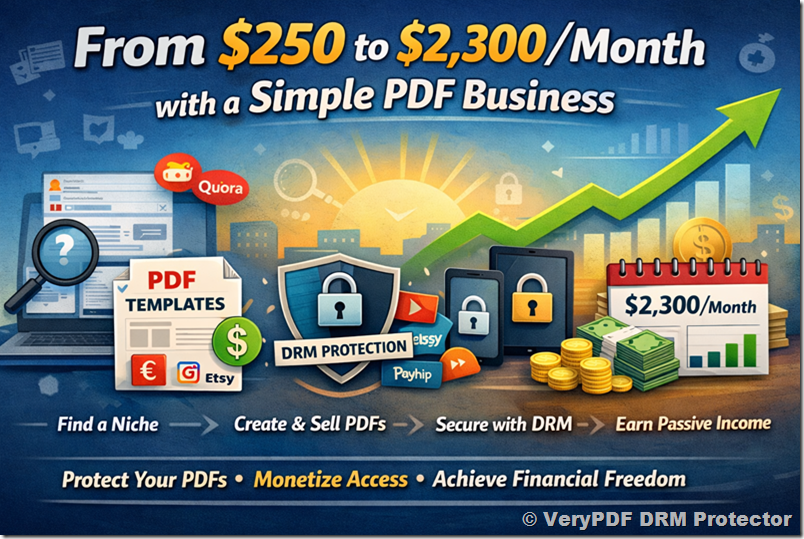
- Initial investment: $250 (ads and tools)
- Monthly income: ~$2,300
- Time required: minimal ongoing effort
- Logistics: none
- Customer service: almost zero
More importantly, the business became stable.
Why This Model Works
There are three core reasons:
1. People Pay for Clarity
Information is everywhere, but structured, actionable content is rare. People are willing to pay to save time and reduce uncertainty.
2. Digital Products Scale Infinitely
A PDF can be sold an unlimited number of times without additional production cost.
3. Control Enables Monetization
Without DRM, you’re selling a file.
With DRM, you’re selling access, experience, and value over time.
That distinction is everything.
Expanding Beyond a Single Product
Once the foundation was in place, I began thinking bigger.
- Additional document packs
- Higher-value training programs (€49 to €299)
- Personalized support services (around €1000)
I also began exploring:
- Affiliate programs
- Customer loyalty strategies
- Referral systems
The goal was not just income, but long-term growth.
The Reality Behind the Success
I want to be clear about something.
This didn’t happen overnight.
I’ve spent years trying different business models. I’ve failed multiple times. I’ve invested time, energy, and money into ideas that didn’t work.
That’s part of the process.
Today, at 46 years old, I’m finally seeing the results of consistent effort. All the actions I’ve taken over the years are starting to compound.
What It Takes to Succeed with This Model
If you want to replicate this approach, there are essential elements you need to develop:
Demonstrated Expertise
You don’t need to be the best, but you must provide real value. Show results, share insights, and build credibility.
Professional Online Presence
Your profiles, visuals, and product pages must inspire trust.
Understanding Platforms
Each platform has its own dynamics. Learn how they work and adapt your strategy accordingly.
Marketing Skills
You must know how to target the right audience and communicate effectively.
Communication Ability
Building trust requires connection. Listen, respond, and engage.
Clear Offer
Your product must solve a specific problem. The value must be obvious.
Content Creation
You need to produce content that attracts attention and delivers value.
Community Building
A loyal audience is one of the most powerful assets you can have.
Authenticity
People connect with real stories. Be transparent about your journey.
The Importance of Support Systems
One lesson I’ve learned is that success is rarely achieved alone.
Having the right people around you makes a significant difference:
- A good banker
- A reliable accountant
- A solid insurance advisor
- A knowledgeable mentor
These are investments, not expenses.
Final Thoughts: Writing Your Own Story
I am not here to sell you something. At least not yet.
I’m sharing a real experience, one that worked for me because I approached it with consistency, curiosity, and a willingness to adapt.
The opportunity is real, but it requires effort.
You have to test, learn, adjust, and keep going even when things don’t work.
My goal is clear: to build enough passive income streams to achieve financial independence by the age of 50.
I am on that path now.
And if there’s one thing I can leave you with, it’s this:
The next chapters of your life are still unwritten.
You decide the direction.
You decide the effort.
You decide whether you act or wait.
For me, it started with a simple PDF.
But what made the difference wasn’t the file itself, it was how I structured it, how I marketed it, and most importantly, how I protected and monetized it using the right tools.
That’s what turned a basic idea into a scalable, sustainable source of income.