
PDF files have become one of the most widely used formats for sharing documents, including business contracts, academic materials, e-books, and training resources. Their flexibility, platform independence, and consistent formatting make them ideal for both professional and personal use. However, the ease of sharing also creates challenges in protecting the intellectual property within these files. Unauthorized copying, redistribution, or content theft can result in financial loss, damage to brand reputation, and violations of copyright laws.
To address these concerns, securing PDF files has become a necessity for businesses, educators, authors, and anyone distributing sensitive information. In this guide, we will discuss multiple strategies for protecting PDF files from copying and introduce VeryPDF DRM Protector, a professional solution designed to safeguard your PDF content effectively.
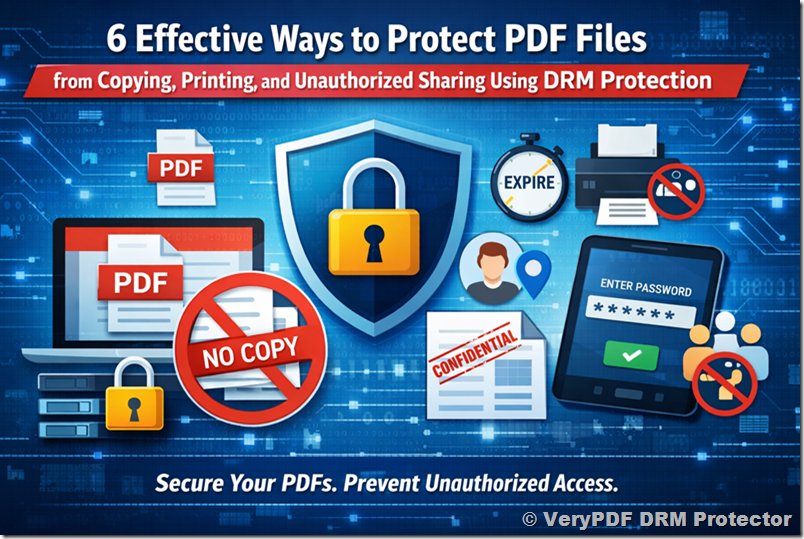
Why Protecting PDFs Is Crucial
Before diving into the methods of protection, it’s important to understand why PDF security is critical:
- Intellectual Property Protection: Authors, researchers, and educators invest significant time and resources in creating content. Unauthorized copying can undermine this effort.
- Preventing Financial Loss: Businesses often distribute sensitive information or paid resources as PDFs. Unprotected files can be freely shared, causing revenue loss.
- Maintaining Brand Reputation: If proprietary information leaks or is misused, the organization’s credibility can be damaged.
- Regulatory Compliance: Many industries are legally obligated to secure documents containing personal data, financial records, or confidential information.
Given these risks, a robust PDF protection strategy is essential. Below, we explore six ways to prevent copying and protect your files.
1. Display PDFs Within Your Web Application
A simple yet highly effective method to protect PDFs is to embed the PDF viewer inside your web application. Instead of allowing users to download the file or open it in an external PDF reader, you control the viewing environment entirely.
Benefits:
- Increased Control: By keeping the PDF inside your app, you can disable copy, print, or save options depending on the user’s role.
- Professional Presentation: Embedded PDFs can be styled seamlessly to match your platform’s design.
- Analytics & Monitoring: You can track user engagement and interactions with the PDF in real-time.
For example, many online education platforms display course materials within their platform rather than allowing students to download raw PDFs. This method not only prevents unauthorized copying but also provides a better user experience.
To implement this, developers can use HTML5-based PDF viewers that offer granular permission controls. This approach ensures that the PDF never truly leaves the server, minimizing the risk of unauthorized distribution.
2. Do Not Show the PDF File Directly
Another strategy involves never providing access to the actual PDF file. Instead, you can display a converted version of the PDF, such as:
- Images of each PDF page
- HTML5-rendered pages
Advantages:
- Impossible to Copy: Since the user never has the actual file, there’s nothing to steal.
- Faster Loading: Large PDFs can be converted to images or HTML snippets, reducing bandwidth usage.
- Selective Display: You can choose to display only specific pages or excerpts instead of the entire document.
This method is ideal for situations where users only need to view the content temporarily, such as an online demo, preview of an e-book, or a training module. For larger organizations, using server-side rendering to convert PDFs to secure images ensures that the original content remains protected.
3. Keep PDFs in Memory
In some cases, sending a PDF file to a client machine is unavoidable, for example, when using offline apps. To reduce copying risk, keep the PDF in memory rather than saving it to disk.
How It Works:
- The PDF is temporarily loaded into the application’s memory space.
- Viewing options like save, print, or export are disabled.
- Once the application closes or the machine shuts down, the PDF is erased automatically.
This approach prevents users from finding the file in temporary folders or caches. Many professional PDF management tools implement this strategy, ensuring that sensitive files do not persist on end-user machines.
4. Disable Text Copying
PDF viewers often allow users to select and copy text. Disabling this feature is a simple but effective way to reduce the risk of unauthorized duplication.
Methods:
- HTML5 Conversion: Using tools like BuildVu, PDF text can be converted into HTML5 elements with non-selectable text.
- Non-selectable PDFs: By “printing” the PDF to a new PDF with text flattened or embedded as images, the content cannot be copied.
While determined users may still capture text using OCR (Optical Character Recognition), disabling text selection increases the effort required to steal content, acting as a deterrent.
5. Use PDF Security Settings
PDF files natively support security options that can prevent unauthorized actions:
- Owner Password: Controls permissions, such as printing, copying, and editing.
- User Password: Protects the file from being opened without authorization.
Even if you choose not to require a password for users, setting restrictive permissions ensures that the content cannot be copied, printed, or modified without proper authorization.
For example, creating a PDF with an empty User password allows the file to be opened normally but restricts actions like copying or printing, providing seamless protection without inconveniencing legitimate users.
6. Use VeryPDF DRM Protector
Among all strategies for PDF protection, VeryPDF DRM Protector offers the most comprehensive solution. Designed specifically to prevent unauthorized copying and redistribution, it ensures your PDF files remain secure under any circumstances.
Key Features of VeryPDF DRM Protector:
- Copy Protection: Prevent users from copying text, images, or the entire PDF file.
- Dynamic Watermarking: Add visible or invisible watermarks linked to each user, deterring unauthorized sharing.
- Access Controls: Restrict who can open the PDF based on roles, devices, or locations.
- Time-Limited Access: Set expiration dates or limit the number of times a file can be opened.
- Offline Protection: Even if the PDF is downloaded, it remains encrypted and protected.
- Integration with Web Applications: VeryPDF DRM Protector can be embedded into web platforms for seamless, controlled viewing.
By combining these features, VeryPDF DRM Protector ensures that your intellectual property stays secure while allowing authorized users to access the content conveniently.
How VeryPDF DRM Protector Works
At its core, VeryPDF DRM Protector uses advanced 256-bit AES encryption, a standard widely recognized for high security. Each protected PDF file is encrypted in such a way that only the authorized user can open it. Any attempt to copy, print, or redistribute the file without permission is blocked automatically.
Additionally, the software supports dynamic user-based watermarks. This means each time a user opens a protected PDF, their identifying information (like username, email, or IP address) is embedded in the document. If the file is leaked, it can be traced back to the source, discouraging unauthorized sharing.
For businesses, educators, and authors, this combination of encryption and traceable watermarks provides a robust layer of protection against content theft.
Benefits for Businesses and Educators
VeryPDF DRM Protector is particularly useful in the following scenarios:
- Corporate Training Materials: Protect training manuals, guides, and presentations from being shared outside the organization.
- Online Courses and E-Learning: Ensure students can view lessons and exercises but cannot copy or redistribute the content.
- Publishing and E-Books: Authors can sell PDFs with confidence, knowing their works are protected.
- Research and Technical Documents: Universities and research centers can share sensitive studies without risking unauthorized distribution.
By providing secure access and controlling user permissions, VeryPDF DRM Protector empowers content creators to share their work safely while maintaining revenue and credibility.
Step-by-Step Implementation
Protecting your PDFs with VeryPDF DRM Protector is straightforward:
- Upload the PDF: Start by uploading your PDF file to the VeryPDF DRM Protector platform.
- Set Permissions: Choose who can access the file and what actions are allowed (view, print, copy).
- Add Watermarks: Enable dynamic watermarks to embed user-specific information.
- Apply Encryption: Use AES encryption to secure the file.
- Distribute Securely: Share the protected PDF via your web application, email, or secure download link.
Within minutes, your PDF is fully protected, and unauthorized copying becomes nearly impossible.
Real-World Examples
Consider an online language school that provides PDF workbooks to students. Without protection, a student could easily forward the PDF to friends or post it online. By using VeryPDF DRM Protector:
- Each workbook contains a watermark with the student’s name.
- Students can view the workbook on their devices, but cannot print or copy the text.
- Any attempt to share the file online is traceable, discouraging misuse.
Similarly, a corporate HR department can distribute sensitive policy manuals safely, ensuring that only authorized personnel can access the information while preventing leaks.
Additional Tips for Protecting PDFs
While VeryPDF DRM Protector is highly effective, combining multiple strategies enhances security:
- Use HTML5 Conversions for Previews: Display selected pages as images or HTML5 for preview purposes.
- Limit File Exposure: Avoid sending entire PDFs if only portions are needed.
- Educate Users: Inform users about the consequences of unauthorized copying.
- Monitor Access Logs: Keep track of who accessed which files and when.
By adopting a multi-layered approach, you can significantly reduce the risk of unauthorized copying.
Why Choose VeryPDF DRM Protector?
When considering PDF protection solutions, you may wonder why VeryPDF stands out. Here are the key reasons:
- Permanent Free Trial: Unlike competitors, you can test all features without time limitations.
- User-Friendly Interface: No technical expertise is needed to apply advanced DRM settings.
- Comprehensive Security: Protects against copying, printing, redistribution, and unauthorized sharing.
- Seamless Integration: Works with web applications, desktop apps, and cloud platforms.
- Trusted Technology: Backed by years of experience in PDF management and security.
Whether you are a business, educator, or author, VeryPDF DRM Protector offers an all-in-one solution for PDF security.
Final Thoughts
No method can completely eliminate the risk of copying, determined users could photograph the screen or manually retype content. However, by employing strategies such as embedding PDFs in web applications, disabling text selection, applying PDF security settings, and using VeryPDF DRM Protector, you make unauthorized copying much harder, time-consuming, and costly.
Investing in robust PDF protection is not just about preventing theft, it’s about maintaining control, ensuring compliance, protecting revenue, and safeguarding intellectual property. VeryPDF DRM Protector makes this possible with a combination of encryption, access control, watermarking, and user management.
If you are distributing PDFs online or within your organization, securing your files should be a top priority. With VeryPDF DRM Protector, you can confidently share your valuable content while minimizing the risk of unauthorized copying and misuse.
Protect your PDFs today and enjoy peace of mind knowing that your content is secure.
Experience VeryPDF DRM Protector for free online: https://drm.verypdf.com/