
There is a moment every online course creator remembers clearly.
It’s the moment you press Publish.
After months of recording lessons, rewriting scripts, fixing audio problems, re-editing slides, and doubting whether anyone will even care about your topic, your course finally goes live on Udemy. You feel relief more than excitement. The hard work is done. Now the platform will handle distribution, students will start enrolling, and your knowledge will finally reach the people you created it for.
At least, that’s what most of us believe.
I want to tell you a story, not about marketing success, viral growth, or passive income, but about something far more common and far less discussed: what happens when your course stops belonging to you almost immediately after you publish it.
The Beginning: A Course Built with Care
The creator whose story inspired this article wasn’t trying to become famous. He wasn’t launching a mass-market productivity course or chasing trends. His topic was deeply personal: piano training designed specifically for musicians who already understood music but wanted to refine technique and interpretation.
It was a niche course, the kind created out of passion rather than financial ambition. Weeks turned into months while recording demonstrations, correcting mistakes, and explaining concepts that took years of experience to understand. Every lesson represented accumulated knowledge, practice, and identity.
When he uploaded the course to Udemy, he assumed the biggest challenge would be visibility. Like most instructors, he worried about reviews, pricing strategies, and whether students would actually find the course among thousands of others.
Piracy never crossed his mind.
The Discovery Nobody Prepares You For
Only days after uploading the course, before he had even started promoting it publicly, a student sent him a message asking a strange question: “Is this your course on another website?”
He clicked the link.
There it was.
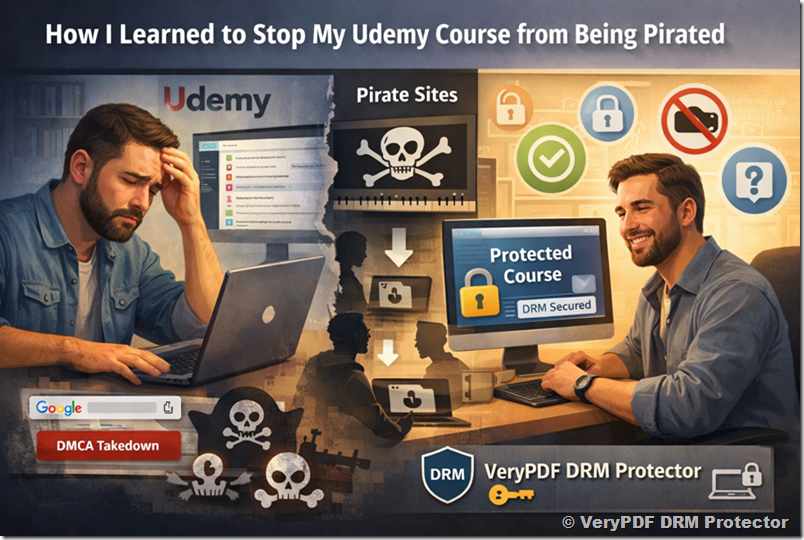
His entire course, videos, materials, structure, uploaded to multiple pirate platforms. Not one site. Several. Each offering free downloads to anyone who wanted them.
The shock wasn’t just that the course had been stolen. It was how fast it happened. The course had barely existed online long enough to gain legitimate students, yet pirates had already copied and redistributed it.
The realization hit hard: publishing online meant losing control almost instantly.
The Natural Reaction: Trust the System
Like most creators, he believed there must be a process to fix this. After all, modern internet platforms talk constantly about supporting creators and protecting intellectual property.
He began doing everything correctly.
He contacted search engines.
He filed copyright complaints.
He reported hosting providers.
He emailed piracy reporting services.
He contacted Udemy support repeatedly.
Each message was written carefully, politely, and professionally. Evidence was attached. Ownership was explained. Links were documented.
He wasn’t angry. He simply expected help.
What followed was not hostility, but something arguably worse: indifference.
The Maze of Responsibility
Responses arrived slowly, often automated, sometimes contradictory. One organization redirected him to another. A hosting company suggested contacting a search engine. A search engine requested stronger proof of ownership. Another platform provided a generic copyright form that led nowhere.
At one point, he received feedback implying authorship could not be fully verified, despite being the creator himself.
The experience felt surreal. Instead of being treated as someone whose work had been stolen, he felt like a person creating inconvenience for large systems designed to avoid liability.
No one explicitly refused to help, yet nothing meaningful happened.
The pirate copies remained online.
New mirrors appeared faster than old ones disappeared.
He realized something uncomfortable: modern platforms excel at distributing content, but they rarely prevent its theft.
The Emotional Turning Point
The financial loss wasn’t the main issue. He already knew his course was unlikely to become a bestseller. The deeper impact came from feeling invisible within systems that relied on creators but offered limited protection once problems emerged.
He began questioning whether continuing on the platform was worth it.
Eventually, he removed the course entirely and moved it elsewhere. The decision wasn’t driven by revenue calculations but by dignity. He didn’t want to feel like a troublemaker for defending his own work.
His final question to fellow educators was simple and honest:
Is there any real way to prevent this from happening?
Why This Story Matters
Almost every experienced course creator eventually faces the same situation. Some discover pirated copies months later; others find them within days. Many never even realize how widely their materials circulate outside legitimate platforms.
The uncomfortable truth is that piracy is not rare, it is predictable.
Online education has become one of the fastest-growing digital industries. Wherever valuable digital content exists, unauthorized distribution follows. Pirates do not evaluate whether a course is famous or profitable. Automated systems scan platforms continuously, capturing new content as soon as it appears.
The problem is structural rather than personal.
Creators rely on platforms designed for reach, not protection.
The Misunderstanding About Learning Platforms
Platforms like Udemy serve an important purpose. They provide infrastructure, audiences, payment processing, and discoverability. For many instructors, they are the easiest way to begin teaching online.
However, they are marketplaces, not security systems.
Their primary responsibility is enabling transactions between students and instructors, not enforcing strict digital rights management at the level required to stop determined piracy groups.
Once a student can view a lesson, technical opportunities for copying usually exist. Screen recording software, browser capture tools, shared accounts, and automated extraction scripts make unauthorized duplication surprisingly simple.
The creator in our story did nothing wrong. He followed the expected workflow. The issue was not platform failure alone but the absence of dedicated content protection.
Understanding the Difference Between Reaction and Prevention
Most anti-piracy efforts operate after theft occurs. Reporting mechanisms, DMCA notices, and takedown requests are reactive tools. They remove copies one by one, often slowly, while new versions appear elsewhere.
This creates an exhausting cycle: identify piracy, report it, wait for removal, discover new copies, and repeat indefinitely.
Creators often assume this endless battle is unavoidable.
Yet large media companies rarely rely solely on takedowns. Streaming services, corporate training providers, and premium educational institutions focus on prevention through Digital Rights Management, or DRM.
Instead of chasing pirates, they make copying technically difficult from the beginning.
Discovering DRM Protection
Imagine if the creator’s course had been encrypted so that videos could not be downloaded, screen recordings failed, and access remained tied to authorized devices. Even if someone attempted to redistribute the material, the files would remain unusable outside controlled environments.
This is precisely the role of VeryPDF DRM Protector, developed by VeryPDF.
Rather than relying on platform policies or external reporting systems, DRM protection embeds security directly into the course content itself.
The philosophy shifts from asking platforms to defend creators toward giving creators their own defensive tools.
How DRM Would Have Changed the Story
If the piano course had been protected using DRM technology, the outcome might have unfolded differently.
When pirates attempted to capture videos, they would have encountered encrypted playback streams resistant to download tools. Screen recording attempts could have been blocked or detected automatically. Access permissions tied to specific users and devices would prevent widespread account sharing.
Even if someone tried leaking material, dynamic watermarking would reveal the source of the breach, discouraging unauthorized redistribution.
Instead of discovering pirated copies days after publishing, the creator might never have encountered them at all.
The difference lies not in fighting harder but in designing distribution more securely from the start.
Why Prevention Changes Creator Psychology
Creators who adopt strong protection often describe an unexpected emotional shift. They stop viewing piracy as an unavoidable consequence of teaching online and begin treating their courses as professional intellectual property assets.
This change influences creative decisions. Instructors feel comfortable sharing deeper expertise, proprietary methods, and advanced techniques because they know their materials are not easily extracted and redistributed.
Security becomes a foundation for creativity rather than a reaction to loss.
Integrating DRM Without Abandoning Platforms
An important misconception is that adopting DRM means leaving marketplaces entirely. In reality, many successful educators use a hybrid approach.
Platforms like Udemy remain valuable discovery channels where introductory material attracts students and builds reputation. Premium lessons, certifications, or advanced training modules can then be delivered through protected environments secured by DRM technology.
This approach balances reach and ownership.
The platform introduces students; DRM preserves value.
The Broader Lesson for Online Educators
The creator’s story resonates because it highlights a moment of disillusionment familiar to many professionals entering digital education. The internet promises global distribution but rarely explains the risks accompanying that exposure.
Piracy is not merely theft of revenue. It undermines confidence, motivation, and trust in digital ecosystems. Some instructors quietly stop creating new courses after their first experience with widespread unauthorized sharing.
Yet the solution is not silence or withdrawal. It is preparation.
What VeryPDF DRM Protector Actually Provides
VeryPDF DRM Protector applies enterprise-grade protection previously available mainly to large corporations. Course creators can enforce restrictions that define how, where, and by whom content is accessed.
Videos remain encrypted even when delivered online or offline. Viewing permissions can expire automatically. Playback can be restricted to approved devices. Personalized watermarks identify viewers uniquely, discouraging leaks before they occur.
Instead of relying on external enforcement, creators maintain direct control over their materials.
For instructors who invest significant time producing high-quality courses, this level of control transforms online teaching from a vulnerable activity into a sustainable professional practice.
Rewriting the Ending of the Story
When the creator removed his course from Udemy, he felt he had reached the only available conclusion. Without meaningful protection, continuing seemed pointless.
But his experience raises a different possibility. What if creators no longer needed to choose between confrontation and silence? What if piracy prevention became part of the course creation process itself, just as recording equipment and editing software already are?
With DRM protection in place, publishing a course would no longer mean surrendering ownership. Creators could focus on teaching rather than monitoring piracy forums or composing endless takedown requests.
The story would not end with withdrawal but with confidence.
A Reflection for Every Course Creator
If you are building or planning an online course, consider the moment immediately after publication. Imagine your content spreading rapidly, not only to paying students but also to unauthorized websites beyond your control.
Now imagine launching with protection already embedded, ensuring that access remains legitimate and traceable from the beginning.
The difference between those two scenarios defines the future experience of many educators.
The creator who shared his story asked whether any platform truly takes creator protection seriously. The deeper answer may be that protection cannot rely solely on platforms. It must become part of the creator’s own strategy.
By using tools like VeryPDF DRM Protector, instructors move from reacting to piracy toward preventing it, preserving not only revenue but also the respect and dignity that motivated them to teach in the first place.
Online education thrives when creators feel safe sharing knowledge. Strong DRM protection ensures that the effort invested in teaching continues to belong to those who created it.
And perhaps that is the real lesson behind the story, not how piracy happens, but how creators can finally stop it before it begins.