
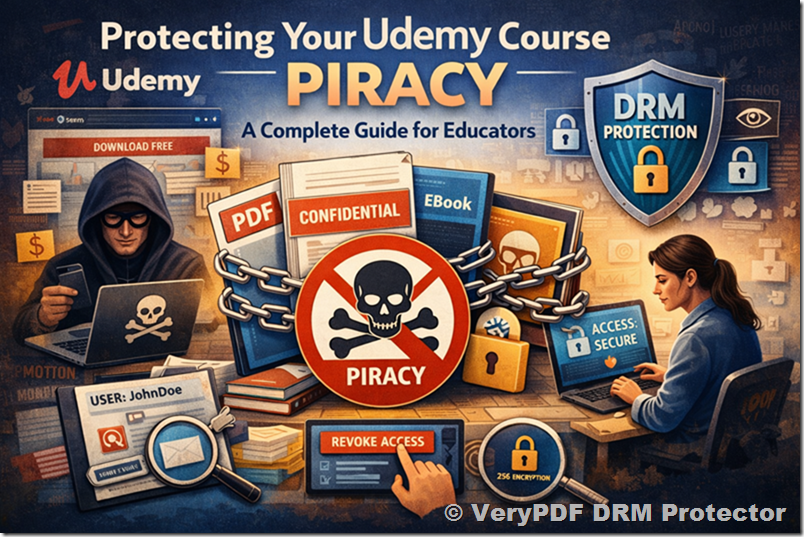
In the digital age, sharing educational content online has never been easier. Platforms like Udemy allow instructors to reach thousands, even millions, of learners worldwide. However, along with these incredible opportunities comes a serious challenge: document piracy. While much attention is paid to video piracy, the theft of course-related documents, PDFs, slides, workbooks, eBooks, and other learning materials, is equally, if not more, threatening to instructors’ intellectual property (IP).
Some argue that piracy is a “victimless crime”, reasoning that people who pirate content wouldn’t have purchased it anyway. While that may sometimes be true, there is a fundamental distinction between a teenager downloading a $70 video game without the means to pay, and a professional learner who deliberately avoids paying $10 for a valuable course document. In the latter case, piracy directly harms the creator, diminishes the value of the content, and undermines the educational ecosystem.
The good news is that by combining thoughtful best practices with modern digital rights management tools, instructors can protect their Udemy course documents effectively. One such solution is VeryPDF DRM Protector, a powerful platform designed specifically for document protection.
This article will explore how educators can secure their course materials, prevent piracy, and maintain the value of their hard work.
Understanding Document Piracy
While video piracy often gets the most attention, documents are frequently targeted because they are easier to steal and redistribute. Common forms of document piracy include:
- Sharing PDFs or eBooks via email or cloud storage
- Selling course slides or workbooks on unauthorized platforms
- Copying text or images from your materials to create derivative works
- Repurposing content for other platforms without permission
In many cases, those who steal documents are not casual learners but individuals looking to profit by redistributing content. Protecting your course materials is therefore critical to maintaining both your revenue and your professional reputation.
The Psychology Behind Document Piracy
One factor that contributes to piracy is perceived value. When learners gain access to content cheaply, through promotions, discounts, or free coupons, they may value the content but not respect it. This can manifest as:
- Requests for free copies of your documents
- Complaints about restrictions on downloads
- Sharing or reselling materials without permission
This psychological dynamic makes it even more important to implement robust document protection strategies.
Best Practices for Protecting Your Udemy Course Documents
Drawing on real-world experience, here are key strategies instructors should adopt to safeguard their course materials:
1. Limit Free Access
Many instructors receive requests for free access to course documents. Often, these requests are accompanied by personal stories, but a closer look at user behavior frequently reveals:
- Accounts collecting dozens or hundreds of free courses
- Little to no engagement with course content
- Intent to resell or share materials
Recommendation: Ignore indiscriminate requests for free access. Limit giveaways to targeted audiences with a genuine interest in your subject.
2. Avoid Unlimited Free Coupons
Issuing free coupons for documents with unlimited redemptions is risky. If leaked, your course materials could quickly spread online.
Recommendation: Create coupons with strict limits and track their usage carefully. Only distribute them to trusted learners or communities.
3. Provide Controlled Access to Documents
Allowing learners to freely download documents increases the risk of piracy. Once a PDF or eBook is downloaded, it can be shared or sold with ease.
Recommendation:
- Deliver documents through secure platforms or cloud readers when possible
- Discourage uncontrolled downloads
- Encourage learners to access documents in protected formats
This is where VeryPDF DRM Protector becomes invaluable. By encrypting your documents and controlling access, you can prevent unauthorized copying, printing, or sharing.
4. Watermark Your Materials
Watermarking is a simple yet effective deterrent. Adding a watermark with the learner’s name, email, or IP address discourages redistribution because any leaked document can be traced back to its source.
Recommendation:
- Use dynamic watermarking for each individual copy
- Ensure watermarks are visible but do not disrupt readability
- VeryPDF DRM Protector supports user-specific watermarks, making each document unique to the recipient
5. Protect Slides and Editable Files
Providing raw PowerPoint or Word files makes it easy for others to modify and republish your work.
Recommendation:
- Convert slides and notes to PDF before distribution
- Apply DRM protection with VeryPDF DRM Protector
- Include your branding on every page or slide
By doing this, you maintain control over your content while still providing a professional learning experience.
6. Keep Your Materials Up-to-Date
Pirated copies quickly lose value if your content evolves. Regularly updating your documents makes older versions obsolete, reducing the incentive for piracy.
Recommendation:
- Maintain version control
- Notify learners of updates through secure channels
- Replace older copies with DRM-protected versions
7. Monitor Distribution Channels
Be vigilant about where your documents appear. Search for unauthorized copies online and take action when necessary.
Recommendation:
- Conduct periodic online searches for your content
- Report unauthorized use to the platform hosting the pirated material
- Revise your distribution strategy if leaks are frequent
VeryPDF DRM Protector makes it easier to monitor access, track usage, and revoke permissions if necessary.
How VeryPDF DRM Protector Safeguards Your Documents
VeryPDF DRM Protector provides a comprehensive solution for protecting course documents. Its key features include:
1. Strong Encryption
All documents are encrypted with 256-bit AES encryption, ensuring only authorized users can access them. This protects your PDFs, eBooks, and slide decks from unauthorized reading.
2. Access Control
You can specify who can view your documents, on how many devices, and for how long. This ensures that materials are used only by intended learners.
3. Usage Restrictions
Prevent learners from:
- Copying text or images
- Printing documents
- Taking screenshots
- Redistributing content
These restrictions reduce the risk of your course materials appearing on piracy websites.
4. Dynamic Watermarking
Each document can be uniquely watermarked with user-specific information, including:
- Name
- Email address
- IP address
This discourages sharing, as any leak can be traced directly to the user.
5. Revocation and Online Management
If a document is leaked or misused, you can instantly revoke access. Online dashboards allow you to manage permissions in real time.
6. Cross-Platform Security
Your materials remain protected whether accessed on Windows, macOS, or mobile devices. This flexibility ensures learners can access content conveniently without compromising security.
Integrating DRM into Your Workflow
To maximize document security, combine platform best practices with DRM protection:
|
Step |
Action |
Benefit |
|
Limit free access |
Only give out controlled coupons |
Reduces risk of mass distribution |
|
Provide protected PDFs |
Convert slides and notes to DRM-protected PDFs |
Prevents editing and unauthorized sharing |
|
Watermark documents |
Add dynamic watermarks with VeryPDF DRM Protector |
Deters redistribution and identifies leaks |
|
Restrict usage |
Disable copying, printing, and sharing |
Maintains content integrity |
|
Monitor access |
Track usage and revoke if needed |
Maintains control and reduces piracy |
This layered approach ensures your intellectual property remains secure while providing a professional learning experience.
Real-World Impact of Document Protection
Instructors who implement these strategies often report:
- Significant reduction in unauthorized sharing
- Increased revenue retention
- Greater professional credibility
- Better learner trust
By protecting documents, you also protect the value of your content. Students learn to respect materials they cannot freely copy or redistribute.
Addressing Common Concerns
Will DRM frustrate learners?
When applied thoughtfully, DRM should not negatively impact the user experience. The goal is to protect your content, not restrict legitimate learning. VeryPDF DRM Protector balances usability with security.
Is piracy completely preventable?
No solution is perfect. However, robust DRM combined with best practices significantly reduces the likelihood of unauthorized access and redistribution.
Is it worth the investment?
Absolutely. Protecting your course documents preserves revenue, ensures fair use, and safeguards your professional reputation.
Conclusion
Piracy is a persistent threat in the digital education space, and documents are often more vulnerable than video content. Instructors cannot rely solely on platform protections. By combining thoughtful best practices with a tool like VeryPDF DRM Protector, educators can:
- Secure all PDF and slide-based materials
- Control who accesses content and how
- Discourage redistribution through dynamic watermarking
- Maintain the value and integrity of their work
Ultimately, protecting your course materials is about more than preventing theft, it is about preserving the value of your knowledge, expertise, and hard work. Modern educators owe it to themselves and their students to implement strong protections for all their digital content.
Taking proactive steps today will ensure that your intellectual property remains secure, your learners remain engaged, and your courses retain their value in an increasingly competitive online education landscape.