If you need to send confidential PDF files to customers, students, employees, partners, or other authorized users, a normal PDF password may not provide enough control.
A PDF can be copied, forwarded, uploaded to another computer, or shared with someone who was never supposed to receive it.
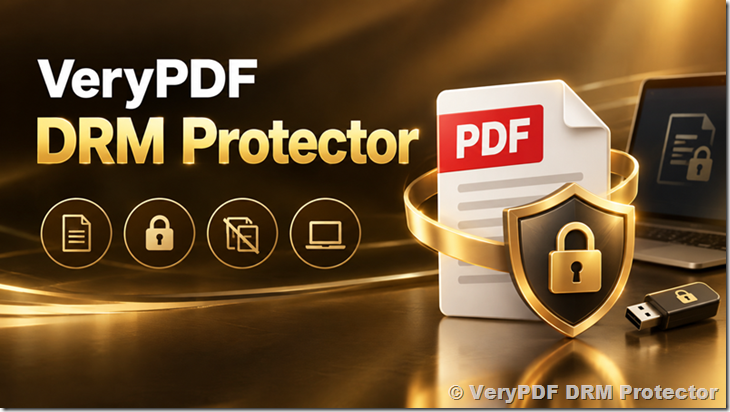
VeryPDF PDF DRM Protection is designed for situations where you need more control over who can open protected PDF documents and where they can be used. You can encrypt PDF files before sending them by email, USB drive, offline delivery, or other methods, and bind protected documents to authorized Windows computers.
It can be useful for confidential manuals, technical documents, training materials, reports, paid PDF content, and other documents that should not be freely copied or shared.
What Is PDF DRM Protection?
PDF DRM, or Digital Rights Management, controls access to a document after the file has been distributed.
A traditional PDF password mainly protects the file with a password. Once someone has the password, they may be able to open the PDF and make another copy.
PDF DRM takes a different approach.
With VeryPDF PDF DRM Protection, you can:
- Encrypt PDF documents before distribution
- Restrict protected documents to authorized computers
- Distribute encrypted files through USB drives or offline delivery
- Protect confidential manuals and reports
- Control who can access protected content
- Reduce unauthorized copying and redistribution
- Protect paid or private PDF content
The important point is that the original PDF does not have to be distributed as an ordinary readable PDF file.
Who Needs PDF DRM Protection?
PDF DRM can be useful for many types of businesses and organizations.
| User | Example |
|---|---|
| Training companies | Employee training manuals |
| Teachers and tutors | Paid course materials |
| Universities | Course notes and teaching materials |
| Consultants | Customer reports and documents |
| Engineers | Technical manuals and specifications |
| Manufacturers | Product manuals |
| Software companies | User guides and technical documentation |
| Publishers | Paid PDF books and reports |
| Professional trainers | Training courses and handbooks |
| Companies | Confidential internal documents |
| Government organizations | Restricted documents |
| Legal professionals | Confidential case documents |
| Financial companies | Reports and research |
| Individual professionals | Paid or private PDF content |
For example, suppose a training company sells a technical training course on a USB drive.
If the company simply puts normal PDF files on the USB drive, the customer can copy those PDFs to another computer.
With DRM protection, the company can distribute protected files and restrict them to authorized computers.
PDF Password Protection vs PDF DRM
A common question is: Why not just password-protect the PDF?
The difference is the level of control.
| Feature | Normal PDF Password | PDF DRM |
|---|---|---|
| Encrypt PDF | Yes | Yes |
| Require password | Yes | Yes |
| Bind document to a computer | Usually no | Yes |
| Control authorized computers | Limited | Yes |
| Offline distribution | Yes | Yes |
| USB distribution | Yes | Yes |
| Reduce unauthorized sharing | Limited | Yes |
| Suitable for confidential training material | Sometimes | Yes |
| Control access after distribution | Limited | More control |
A PDF password is useful when you simply want to prevent casual access.
DRM is more suitable when you need to control the use of a document after you give it to someone.
Protect PDF Files Before USB or Offline Delivery
Not every customer wants to download documents from a website.
Some organizations still distribute documents through:
- USB drives
- External hard drives
- DVD/CD
- Offline computers
- Private networks
- Email attachments
- Internal company systems
VeryPDF PDF DRM Protection can encrypt PDF files before you distribute them.
For example:
Original PDF → DRM encryption → protected PDF → USB delivery → authorized computer
This can be useful when internet access is limited or when documents must be delivered offline.
Bind PDF Documents to Authorized Windows Computers
One of the main reasons to use DRM is computer binding.
A protected document can be associated with an authorized Windows computer.
This makes it harder for a customer to simply copy the protected document to another PC and open it there.
For example:
A training company sends a confidential PDF manual to Customer A.
Customer A is authorized to use the manual on one specific Windows computer.
Copying the protected file to another computer does not automatically give that computer access.
This is particularly useful for:
- Paid training material
- Engineering manuals
- Internal company documents
- Confidential reports
- Technical documentation
- Licensed PDF content
Protect Confidential PDF Manuals
Technical manuals often contain valuable information that companies do not want freely distributed.
Examples include:
- Machine operation manuals
- Engineering documentation
- Maintenance manuals
- Installation guides
- Product specifications
- Service manuals
- Training handbooks
If a company sends an ordinary PDF to a customer, the customer can normally copy the file.
PDF DRM provides another layer of control over how the document is distributed and accessed.
Protect Paid PDF Books and Training Material
PDF files are also widely used for selling digital content.
For example:
- Online courses
- Exam preparation materials
- Professional training
- Technical books
- Industry reports
- Research reports
- Consulting reports
- Certification training
If you sell a PDF for $50, $100, or more, you may not want the customer to upload the file to a public file-sharing website.
DRM can make unauthorized redistribution more difficult by restricting access to authorized users or computers.
Protect Video, Audio, Images, and Other E-Learning Content
VeryPDF DRM Protection is not limited to PDF files.
It can also be used to protect different types of media, including:
- Video
- Audio
- Images
- Documents
Supported media formats include examples such as:
- MP4
- AVI
- MKV
- WMV
- MTS
- RMVB
- MXF
- VOB
- FLV
- MPEG
- TS
- MP3
- AAC
- AC3
- OGG
- WMA
- JPG
- BMP
- PNG
This makes it useful for E-Learning content protection, especially when a course contains both documents and videos.
Protect Training Videos from Unauthorized Sharing
A teacher, coach, trainer, or course creator may spend months creating training videos.
The problem comes when one customer buys the course and then sends the video files to other people.
VeryPDF DRM Protection can encrypt the video and require a playback password.
The protected content can then be distributed to authorized customers.
It supports different protection modes, including:
| Protection mode | How it works |
|---|---|
| Non-PC binding | Playback password can work on different computers |
| PC binding | Playback is restricted to one authorized computer |
| Demo video | Create a demo that does not require a playback password |
| USB binding | Content can be restricted to a specific USB drive |
| CD/DVD binding | Content can be restricted to a specific CD/DVD |
This gives content owners different ways to distribute their training material.
Add Watermarks to Protected Videos
Watermarks can help identify who received a video.
VeryPDF DRM Protection supports fixed and floating watermarks.
You can customize:
- Watermark text
- Font size
- Font color
- Watermark position
- Different watermark information for different users
For example, a training company could display:
Licensed to: John Smith
on the customer’s video.
A floating watermark can also change its position automatically.
This does not make screen recording impossible, but it can make unauthorized sharing easier to identify and discourage.
Anti-Screen-Recording Features
Screen recording is a difficult problem for digital content owners.
A person can potentially record what appears on a screen even when the original file is encrypted.
VeryPDF DRM Protection includes anti-copy and anti-screen-recording settings designed to make this harder.
Depending on the protection settings, you can configure options such as:
- Customized questions
- Automatic questions
- Blocking selected programs
- Preventing playback inside virtual machines
- Restricting playback when connected to the internet
These controls are useful for training companies and educators who want additional protection around video playback.
However, no DRM system can guarantee that a determined person will never make a copy of content. A second camera, for example, can record a screen without interacting with the protected file.
Online Password Blacklist
Sometimes you need to disable a playback password after you have already sent it to a customer.
VeryPDF DRM Protection provides a password blacklist function.
You can maintain a blacklist on your web server and configure the DRM player to check the blacklist before playback.
This can be useful when:
- A license has expired
- A password has been leaked
- A customer account has been cancelled
- A training course has ended
- A playback password should no longer work
Instead of having to redistribute every protected file, you can disable specific passwords.
Create Different Playback Passwords for Different Users
A single password shared with hundreds of customers can be difficult to control.
VeryPDF DRM Protection includes a password maker that can create different passwords for users.
For example:
| Customer | Playback Password |
|---|---|
| Customer A | Individual password |
| Customer B | Individual password |
| Customer C | Individual password |
If one customer’s password is leaked, you can deal with that password separately rather than changing the password for everyone.
Build Your Own DRM Player
The software also provides a Player Builder for customizing the player used to play protected media.
This can be useful for companies that want the protected content to be distributed with their own branding or instructions.
You can also configure an information prompt to tell users how to contact you to obtain their playback password.
Encrypt Videos Without Re-encoding
Video protection does not necessarily require converting the video into another format.
VeryPDF DRM Protection provides a high-speed encryption mode designed to avoid video conversion and quality loss.
This is important for large video files.
For example, if you have a 2 GB training video, converting the video again can take significant time and may affect quality.
A faster encryption process makes it easier to prepare large numbers of training videos for distribution.
Package Multiple Files into One Protected Package
A training course may contain:
- PDF manuals
- MP4 videos
- MP3 audio
- JPG images
- Other documents
Instead of distributing each file separately, you can package multiple files together.
VeryPDF DRM Protection can package multiple files with one playback process.
This can make offline course distribution easier.
Prevent Unauthorized Copying and Distribution
The purpose of DRM is not simply to encrypt a file.
The larger problem is what happens after the file has been delivered.
Without protection:
Send PDF → Customer receives PDF → Customer copies PDF → Customer forwards PDF
With DRM:
Encrypt content → Distribute protected file → Verify authorization → Allow playback/access
The second approach gives the content owner more control over distribution.
PDF DRM for E-Learning Companies
E-Learning companies are one of the common use cases for DRM.
A course may contain hundreds of hours of video plus PDF materials.
The company needs to protect:
- Course videos
- PDF notes
- Training documents
- Audio lessons
- Images
- Exam preparation materials
VeryPDF DRM Protection can be used to protect different types of content in the same training program.
PDF DRM for Professors and Teachers
Teachers and professors may create their own course material and sell it directly to students.
For example:
Course package
- 30 training videos
- 10 PDF textbooks
- 5 PDF exercise books
- 20 audio lessons
Instead of distributing the original files, the instructor can encrypt the content and provide protected files to authorized students.
This can be useful for:
- Online courses
- Exam preparation
- Professional certification
- Medical training
- Engineering training
- Business courses
- Language training
PDF DRM for Technical and Business Documents
DRM is not only for education.
Businesses may need to send sensitive documents to external users.
Examples include:
- Customer reports
- Technical specifications
- Product manuals
- Project documents
- Consulting reports
- Financial reports
- Research documents
- Internal training material
If the recipient only needs temporary or limited access, sending an unprotected PDF can create unnecessary risk.
What Is the Difference Between Encryption and DRM?
These terms are often confused.
Encryption protects the content by converting it into an unreadable form.
DRM adds rules around who can use the protected content and under what conditions.
A simple example:
Encryption protects the file.
DRM controls access to the protected content.
For content owners, both can be important.
Is PDF DRM 100% Copy-Proof?
No.
It is important to be realistic about DRM.
No software can guarantee that digital content can never be copied. If someone can see information on a screen, there are always ways to capture it in some form.
The goal of DRM is to make unauthorized copying and redistribution much more difficult and controllable.
For valuable PDF and training content, DRM can provide an additional layer of protection compared with sending ordinary PDF files.
VeryPDF PDF DRM Protection: Common Use Cases
| Situation | Why DRM can help |
|---|---|
| Selling PDF books | Reduce unauthorized sharing |
| Selling online courses | Protect videos and documents |
| USB training courses | Bind content to authorized devices |
| Confidential manuals | Restrict document access |
| Customer reports | Control distribution |
| Technical documentation | Reduce unauthorized copying |
| Corporate training | Protect internal materials |
| Paid video courses | Control playback |
| Professional reports | Protect paid content |
| Offline learning | Protect content without requiring a web portal |
Is VeryPDF DRM Protection Right for You?
Consider DRM if you are facing one of these problems:
- Customers share your PDF files with other people.
- Students distribute your course videos.
- You sell training material through USB drives.
- Your company sends confidential manuals to customers.
- You need to bind content to authorized computers.
- You want different passwords for different customers.
- You need to disable leaked playback passwords.
- You want to add customer-specific watermarks.
- You distribute content offline.
- You need protection for PDF, video, audio, and image files.
If your only requirement is “I want to put a password on a PDF”, standard PDF password encryption may be enough.
If you need computer binding, controlled playback, watermarking, password management, USB/CD binding, and protection after distribution, a DRM solution is more suitable.
Frequently Asked Questions
1. What is PDF DRM protection?
PDF DRM protection uses encryption and access controls to restrict who can open or use protected PDF documents.
2. Can VeryPDF DRM protect PDF files?
Yes. VeryPDF DRM Protection can encrypt PDF documents and restrict protected documents to authorized Windows computers.
3. Can I distribute DRM-protected PDFs by USB?
Yes. DRM-protected content can be prepared for offline and USB distribution.
4. Can I bind a PDF to one computer?
Yes. PC-binding protection can associate protected content with an authorized computer.
5. Can DRM prevent people from sharing PDFs?
DRM can make unauthorized sharing more difficult by restricting access to authorized computers or users. No DRM system can guarantee that digital content can never be copied.
6. Can I use DRM for paid PDF books?
Yes. DRM can be useful for paid books, reports, training manuals, and other commercial PDF content.
7. Can VeryPDF DRM protect videos?
Yes. VeryPDF DRM Protection supports video encryption and protected playback.
8. Can it protect audio files?
Yes. It can protect audio formats such as MP3, AAC, AC3, OGG, and WMA.
9. Can I protect images with DRM?
Yes. Image formats such as JPG, BMP, and PNG can be protected.
10. Can I add watermarks to protected videos?
Yes. You can use fixed or floating watermarks and customize the watermark text and appearance.
11. Can different customers have different passwords?
Yes. The password maker can create different playback passwords for different users.
12. Can I disable a password after sending it?
Yes. The online password blacklist can be used to disable passwords that should no longer work.
13. Does DRM require video conversion?
The high-speed encryption mode is designed to encrypt videos without video conversion, helping avoid unnecessary quality loss.
14. Can I package multiple files together?
Yes. Multiple files with different formats can be packaged into a protected package.
15. Can DRM protect content offline?
Yes. VeryPDF DRM Protection supports offline distribution scenarios, including USB and CD/DVD-based distribution.
16. Can DRM stop screen recording completely?
No DRM product can guarantee that screen recording will never happen. VeryPDF provides anti-copy and anti-screen-recording settings that can make some recording methods more difficult.
17. Who can use PDF DRM protection?
Teachers, professors, trainers, course creators, publishers, consultants, engineers, businesses, and other professionals who need to distribute protected digital content can use DRM.
18. What is better: PDF password protection or PDF DRM?
They solve different problems. PDF passwords are useful for basic file encryption. DRM provides additional controls such as computer binding, protected playback, password management, and controlled distribution.
19. Can I use VeryPDF DRM for E-Learning?
Yes. It can protect course PDFs, videos, audio files, and images, making it suitable for many E-Learning distribution scenarios.
20. Where can I get VeryPDF DRM Protection?
You can learn more about VeryPDF DRM Protection and use it to protect PDF, video, audio, image, and other digital content for authorized users.