Selling your own eBooks is a great way to make money, but piracy can ruin your business. If you just send a normal PDF, one buyer can easily email it to ten friends, post it on Reddit, or share it in a GroupMe chat.
You might be wondering: Can I password protect a PDF so it only opens on one laptop?
The short answer is no, not with a standard password. If you put a regular password on a PDF, the buyer can just share both the file and the password with anyone they want.
To actually lock a PDF to a single device, you need something stronger called DRM (Digital Rights Management). Here is how it works, what your options are, and how to protect your profits.
Why Regular PDF Passwords Fail
When you protect a PDF using basic tools like Adobe Acrobat or free online converters, you usually get two choices: an Open Password or a Permission Password. Neither will stop piracy.
|
Feature |
Regular PDF Password |
DRM Protection |
|
Can it be shared? |
Yes. Users can share the password easily. |
No. The file is locked to specific hardware. |
|
Can they print it? |
Yes, if they know the password. |
No. You can completely block printing. |
|
Can they copy text? |
Yes. Anyone can copy and paste the content. |
No. Copy/paste functions are disabled. |
|
Device Limit |
Unlimited. |
Restricted (e.g., only 1 laptop or phone). |
The Real Risk of Normal Sharing
Imagine you spend three months writing an eBook and sell it for $30. An online community leader buys one copy. They upload it to a shared Google Drive for their 500 members.
- You made: $30
- You lost: $15,000 in potential sales
Standard passwords cannot track who is opening the file or where it is being opened.
The Solution: How to Lock a PDF to One Device
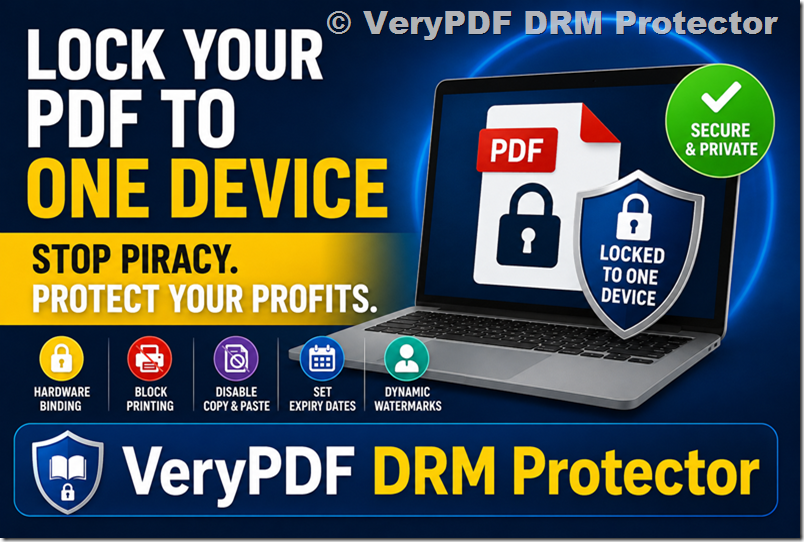
To make sure a PDF opens on only one laptop, the software needs to check the buyer’s hardware ID (like their computer’s motherboard or hard drive serial number). Once the PDF opens on that machine, it bonds with it. If the file is copied to another laptop, it simply won’t open.
If you want a reliable and straightforward way to do this, we recommend VeryPDF DRM Protector.
It is a specialized tool designed exactly for independent authors and publishers who want to stop illegal sharing. Instead of relying on weak passwords, it wraps your PDF in a secure layer that checks the user’s device credentials before opening.
Benefits of using VeryPDF DRM Protector:
- Hardware Binding: Locks the eBook to one specific laptop, PC, or device.
- No Password Sharing: Users don’t get a password they can text to friends.
- Expiry Dates: You can make the eBook expire after a certain number of days.
- Watermarking: Automatically adds the buyer’s name or email as a watermark to discourage screenshots.
FAQs About PDF Protection and eBook Piracy
1. Can someone just take screenshots of my protected PDF?
While DRM can stop file sharing and copying, someone could technically take a photo of their laptop screen with a phone. However, tools like VeryPDF DRM Protector let you put dynamic watermarks (like the buyer’s email address) across the pages. People rarely share files if their own personal email is plastered all over it.
2. What happens if my buyer buys a new laptop?
If a customer legitimately replaces their computer, they will lose access to the file. With most DRM systems, you as the seller have a dashboard where you can reset their license key, allowing them to register their new device.
3. Does Adobe Acrobat have a one-device lock feature?
No. Adobe Acrobat allows you to set passwords and restrict printing, but it cannot bind a file to a single piece of computer hardware. You need dedicated DRM software for that.
4. Can I lock a PDF to one device for free?
There are no reliable free tools that offer hardware binding. Free tools only offer basic password encryption, which is easily bypassed or shared.
5. Will this work on Mac, Windows, and phones?
Yes. High-quality DRM solutions support multiple platforms, but you can specify in your settings exactly how many devices (and what types) a single purchase allows.
6. Is it easy for my customers to use?
Usually, the buyer will need to download a specific free reader app or plugin provided by the DRM service to view the secured PDF. It is a small extra step for them, but it completely protects your work.
7. Can regular PDF passwords be cracked?
Yes. There are dozens of free websites and software tools online that can strip standard passwords from a PDF in less than three seconds.
8. Can I stop people from printing my eBook?
Yes. DRM protection allows you to disable the print button entirely, preventing people from turning your eBook into a physical copy or a new, unprotected PDF.
9. How do I send the locked PDF to my buyers?
You can sell it through your own website or email. Instead of sending a raw PDF, you send the encrypted file version generated by your DRM software along with an activation key.
10. What is the difference between encryption and DRM?
Encryption just hides the data behind a key or password. Anyone with the key can open it. DRM controls how the data is used even after it is opened, restricting copying, printing, and sharing.
11. Will DRM hurt my sales?
Honest buyers rarely mind a quick verification step, especially if you explain that it protects your independent work. The revenue you save by stopping piracy far outweighs the minor friction for the buyer.