Secure PDF Sharing: How to Protect PDF Files Using Advanced Methods

In today’s digital world, sensitive documents are constantly at risk. Businesses, researchers, educators, and individuals regularly share critical information in digital formats, and PDF files have become the standard for secure, consistent document distribution. However, the portability and accessibility of PDFs also make them vulnerable to unauthorized access, copying, or distribution. Protecting PDF files is no longer optional—it is a necessity for safeguarding intellectual property, confidential reports, legal documents, and proprietary data.

In this article, we will explore the different ways to protect PDF files, from basic methods like passwords and watermarks to advanced solutions such as Digital Rights Management (DRM) software. We will also examine the strengths and limitations of each method to help you choose the most appropriate protection strategy for your needs.

Secure PDF Sharing: How to Protect PDF Files Using Advanced Methods


Why Protect PDF Files?

Before discussing specific protection methods, it is important to understand why PDF protection matters. PDFs are widely used because they preserve the original formatting of a document across platforms, making them ideal for business contracts, financial reports, research papers, and intellectual property materials. However, this convenience comes with risks:

  1. Unauthorized Access: Sensitive PDFs can be accessed by anyone if not properly protected. This could include competitors, hackers, or even accidental recipients.
  2. Intellectual Property Theft: PDFs often contain proprietary content, such as research findings, product designs, or confidential reports. Without protection, unauthorized individuals can copy, modify, or redistribute this content.
  3. Uncontrolled Distribution: PDFs are easily forwarded or uploaded to file-sharing platforms. Businesses may lose control over who can view, copy, or print their documents.
  4. Revenue Loss: For companies distributing premium content, uncontrolled sharing of PDFs can reduce subscription revenue or compromise pay-per-view models.

Proper PDF protection ensures confidentiality, integrity, and control over your content, allowing businesses and individuals to share files securely.


Methods for Protecting PDF Files

There are several techniques for securing PDFs. Each has its own strengths and limitations. Let’s examine them in detail.

1. Protect PDFs with Passwords

Password protection is one of the simplest and most widely used methods for securing PDF files. By requiring a password to open the document, you restrict access to authorized users only. Here’s how it works:

  • Encryption: The PDF file is encrypted using a password. Only users with the correct password can open and read the document.
  • Implementation: Most PDF software, including Adobe Acrobat and free PDF tools, allow you to set passwords easily.

Advantages of Password Protection:

  • Easy to implement and understand.
  • Provides a basic barrier to unauthorized access.
  • Works well for small-scale sharing.

Limitations:

  • Passwords can be shared, reducing security.
  • Does not prevent printing, copying, or screen capture.
  • Cannot track who accessed the file or how it was used.

Best Practices:

  • Use strong, unique passwords (mix letters, numbers, and symbols).
  • Do not share passwords via insecure channels like email or chat.
  • Regularly update passwords for highly sensitive documents.

While password protection is useful for basic security, it is not sufficient for sensitive or high-value PDFs.


2. Protect PDFs with Watermarks

Watermarking adds visible or invisible identifiers to PDF files to discourage unauthorized sharing. Watermarks can include:

  • Company logos or brand names
  • Labels such as “Confidential” or “Internal Use Only”
  • Invisible digital markers that uniquely identify recipients

Advantages of Watermarks:

  • Reinforces ownership and copyright.
  • Acts as a deterrent against unauthorized redistribution.
  • Invisible watermarks can help trace leaks back to specific recipients.

Limitations:

  • Watermarks do not prevent access—they only discourage misuse.
  • Users can still copy or share files.
  • May not stop screen capturing or digital photography.

Watermarks are best used in conjunction with other protection methods, such as DRM or encryption, rather than as a standalone solution.


3. Protect PDFs with Encryption

Encryption encodes the content of a PDF so that it can only be read by authorized users. Even if the file is intercepted, its contents remain inaccessible without the decryption key. Common encryption methods include AES (Advanced Encryption Standard) with 128-bit or 256-bit keys.

How PDF Encryption Works:

  1. The PDF content is scrambled using a complex algorithm.
  2. A decryption key (usually a password or passphrase) is required to decode the content.
  3. Unauthorized users cannot access the readable content without the key.

Advantages:

  • Strong protection against unauthorized access.
  • Widely supported across PDF software.
  • Can prevent casual breaches and file tampering.

Limitations:

  • Like passwords, decryption keys can be shared.
  • Does not prevent printing, copying, or screen capturing.
  • Cannot track usage or enforce dynamic access policies.

Encryption is highly effective for basic confidentiality, but for advanced security needs, more robust solutions are required.


4. Protect PDFs with Digital Rights Management (DRM)

Digital Rights Management (DRM) is the most comprehensive and advanced method for protecting PDF files. DRM software combines encryption, access control, watermarking, and usage management into a single solution. It allows content owners to define who can access a PDF, how it can be used, and for how long.

Key Features of PDF DRM:

  • Access Control: Limit access to specific users or groups.
  • Print and Copy Restrictions: Prevent unauthorized printing, copying, or editing.
  • Dynamic Watermarking: Embed user-specific watermarks that are invisible until the PDF is opened.
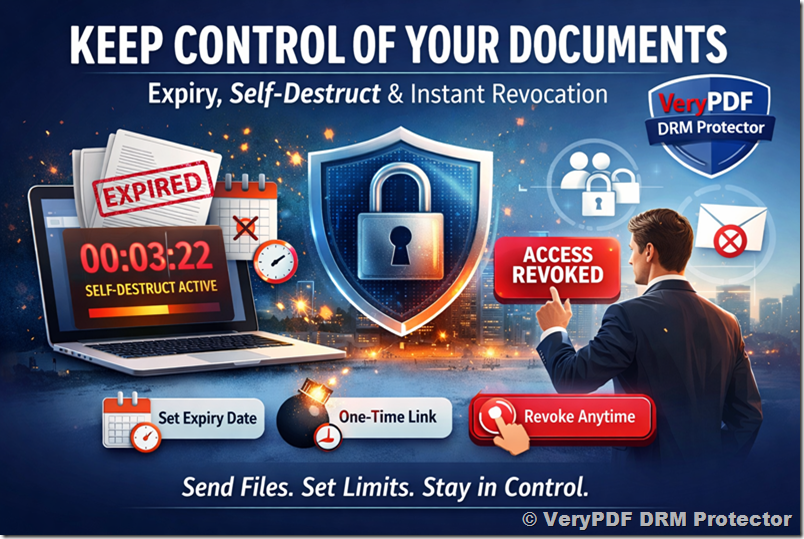
  • Expiration and Revocation: Set time limits or revoke access at any time.
  • Tracking and Reporting: Monitor document usage, including views, prints, and attempted breaches.

Benefits of DRM for PDF Protection:

  1. Granular Control: Assign different access rights to individual users, such as view-only, print-limited, or time-bound access.
  2. Enhanced Security: Combine encryption, watermarks, and access control to prevent unauthorized use.
  3. Compliance: Meet regulatory requirements for healthcare, finance, and legal sectors.
  4. Revenue Protection: Secure premium content to enable subscriptions, pay-per-view access, or licensing without fear of piracy.
  5. Tracking and Auditing: Gain insights into document usage for security assessments and compliance audits.

Why DRM Outperforms Other Methods:
Unlike simple passwords or watermarks, DRM ensures that your PDF remains secure throughout its lifecycle, even after distribution. Unauthorized users cannot open, copy, or share the document, and content owners can revoke access or track usage in real time.


Choosing the Right PDF Protection Strategy

Selecting the appropriate method depends on the sensitivity of your documents, regulatory requirements, and distribution needs. Here’s a practical guideline:

Method

Best Use Case

Strength

Limitation

Password

Low-sensitivity documents, internal sharing

Simple, easy to implement

Passwords can be shared; no usage tracking

Watermark

Brand ownership, discouraging sharing

Visual deterrent; can trace leaks

Does not prevent access

Encryption

Sensitive content during transmission

Strong confidentiality

Keys can be shared; no usage tracking

DRM

High-value, confidential, or commercial content

Comprehensive control, tracking, usage policies

Requires setup and software licensing

For organizations handling confidential business reports, premium content, or intellectual property, DRM is the most reliable choice, providing full control and robust protection.


Implementing DRM for PDF Files

To implement DRM protection effectively:

  1. Choose a DRM Solution: Select a software provider that offers PDF DRM with encryption, watermarking, and access management.
  2. Define Policies: Decide who can access the document, whether printing or copying is allowed, and set expiration dates if necessary.
  3. Encrypt and Distribute: Protect PDFs with DRM encryption and distribute them securely.
  4. Monitor Usage: Use tracking features to ensure compliance and identify potential misuse.
  5. Update Access Controls: Revoke access or adjust permissions as needed.

Example: A company distributing confidential financial reports can use DRM to allow only executive team members to view the files, prevent printing, and track who opens each report.


Conclusion

Protecting PDF files is a critical step in securing sensitive information in an increasingly digital world. While passwords, watermarks, and encryption provide basic protection, they are limited in scope. Digital Rights Management (DRM) software offers advanced features for comprehensive PDF protection, allowing organizations and individuals to control access, usage, and distribution effectively.

By leveraging DRM, content owners can:

  • Safeguard intellectual property
  • Prevent unauthorized access and piracy
  • Maintain compliance with regulatory standards
  • Monitor document usage and detect potential breaches

In summary, if your PDFs contain sensitive, proprietary, or revenue-generating content, investing in DRM solutions is the most secure and reliable way to protect your digital assets.

[Solution] How to Enforce Secure "Print-Only" PDF Access, No On-Screen Viewing and Block Virtual Printers with VeryPDF DRM Protector

In today’s digital environment, organizations distributing sensitive documents, such as training materials, confidential reports, or licensed content, face a critical challenge: how to allow necessary usage (like printing) without risking unauthorized copying, redistribution, or leakage.

For enterprises operating across multiple locations or global centers, this challenge becomes even more complex. Traditional PDF protection methods, such as passwords or basic restrictions, are no longer sufficient. Users can easily bypass these protections using screen capture tools, virtual printers, or file conversion utilities.

This is where VeryPDF DRM Protector provides a powerful and flexible solution.

[Solution] How to Enforce Secure "Print-Only" PDF Access, No On-Screen Viewing and Block Virtual Printers with VeryPDF DRM Protector


The Core Security Challenge

Many organizations require a very specific level of control:

  • Prevent users from saving documents as new PDF files via virtual printers
  • Allow printing only to authorized physical printers
  • Restrict how many times a document can be printed
  • In some cases, completely prevent on-screen viewing while still allowing printing

These requirements are especially common in:

  • Educational institutions distributing exam materials
  • Corporate environments handling confidential reports
  • Training centers providing licensed content
  • Government or compliance-driven organizations

Blocking Virtual PDF Printers: A Critical Security Layer

One of the most common ways users bypass document protection is by “re-printing” a PDF using virtual printers such as:

  • Microsoft Print to PDF
  • Adobe PDF
  • XPS Document Writer

This effectively creates a new, unprotected copy of the document.

How VeryPDF DRM Protector Solves This

VeryPDF DRM Protector includes a robust virtual printer blocking mechanism:

  • ✅ Allows printing to physical printers only
  • ❌ Blocks all virtual printers (PDF, XPS, PS, PCL, etc.)
  • Prevents regeneration of digital copies through printing

This protection is enforced at the system level, ensuring that users cannot bypass it through standard operating system tools.

For step-by-step configuration guidance, you can refer to:


Enforcing “Print Only” Mode (No On-Screen Viewing)

In high-security scenarios, simply restricting copying is not enough. Some organizations require that:

Users should NOT be able to view the document on screen, but SHOULD be able to print it.

This is known as “Print Only” Mode.

Supported by VeryPDF DRM Protector

VeryPDF DRM Protector supports this advanced requirement through a specialized configuration:

  • On-screen content viewing is blocked or masked
  • ️ Printing is allowed under controlled conditions
  • Print count limits can be enforced (e.g., 1 print per user)
  • Content is only rendered securely during the printing process

This ensures that:

  • Users cannot read, screenshot, or record the document
  • The only way to access content is through a controlled physical print

Print Count Control: Limiting Document Usage

Another critical feature is print count limitation, which allows you to define exactly how many times a document can be printed.

Key Capabilities

  • Set maximum number of prints per user
  • Track printing activity
  • Prevent excessive or unauthorized duplication
  • Combine with expiry dates or user authentication

For example:

  • A training manual can be printed only once
  • An exam paper can be printed a limited number of times per center
  • A licensed document can have strict usage quotas

Flexible Permission Modes

VeryPDF DRM Protector provides multiple permission configurations to suit different use cases:

Mode

Description

View Only

Users can read but cannot print

View + Print

Standard controlled access

Print Only

No screen viewing, print-only access

Limited Access

Control by view count, print count, or expiration

This flexibility allows organizations to tailor security policies based on their operational needs.


Why Traditional PDF Protection Is Not Enough

Standard PDF security (such as passwords or “no print” flags) can be easily bypassed using:

  • Screenshot tools
  • PDF converters
  • Virtual printers
  • File extraction software

In contrast, VeryPDF DRM Protector uses:

  • Strong encryption
  • Secure document viewers
  • Hardware-aware print control
  • Dynamic permission enforcement

This creates a closed and controlled document environment, significantly reducing the risk of data leakage.


Ideal Use Cases

VeryPDF DRM Protector is particularly effective for:

  • Global training organizations
  • Educational institutions
  • Certification providers
  • Enterprises handling confidential documentation
  • Content publishers protecting intellectual property

Conclusion

If your organization needs to:

  • Block virtual PDF printers
  • Allow printing only to physical devices
  • Enforce strict print count limits
  • Enable secure “Print Only” access without on-screen viewing

Then VeryPDF DRM Protector offers a comprehensive and enterprise-ready solution.

To explore the full capabilities and test the system, visit:

Why Educators, Publishers, and Businesses Are Switching from Adobe DRM to VeryPDF’s Simple, Affordable, Lightweight DRM

In today’s digital world, protecting your intellectual property is more critical than ever. Publishers, educators, and businesses rely on digital documents to distribute books, reports, research papers, or training materials. However, once a PDF is released digitally, controlling access and preventing unauthorized sharing can be extremely challenging. This is where DRM (Digital Rights Management) comes into play. While Adobe DRM has long been the industry standard, it comes with significant drawbacks that many content creators find prohibitive. High costs, complex installation and management, and slow adoption make Adobe DRM unsuitable for many users.

Fortunately, VeryPDF DRM Protector offers a lightweight and affordable alternative that meets the needs of modern publishers and educators without the headaches associated with Adobe DRM. In this article, we will explore the pain points of Adobe DRM, introduce VeryPDF DRM Protector, and explain why its simple DRM, lite DRM, and affordable DRM solutions are transforming the way content creators protect their PDFs.

Why Educators, Publishers, and Businesses Are Switching from Adobe DRM to VeryPDF's Simple, Affordable, Lightweight DRM


The Pain Points of Adobe DRM

Adobe DRM is widely recognized as a powerful tool for controlling access to digital documents, but it comes with several significant issues that content creators often struggle with:

1. High Costs

Adobe DRM is expensive. Licensing fees can be prohibitive, especially for small publishers, independent educators, and startups. For a single academic institution or small publishing company, Adobe DRM costs can easily run into thousands of dollars annually, not including the cost of training staff or integrating the system into existing workflows.

High costs often force smaller organizations to either compromise on security or seek less robust alternatives. Many users find themselves paying for features they do not even need, simply because Adobe DRM packages everything together in one expensive bundle.

2. Complexity and Steep Learning Curve

Adobe DRM is complex. Setting up the system requires extensive technical knowledge, and even routine tasks—like assigning permissions, managing licenses, or distributing protected files—can be cumbersome. For educators who just want to distribute course materials or for small publishers trying to protect a few eBooks, Adobe DRM often feels like an overengineered solution.

The system requires specific Adobe software for both the creator and the reader, and users often experience compatibility issues across platforms. This complexity discourages adoption, especially for organizations that need a quick and easy way to protect PDFs.

3. Slow Implementation and Inflexibility

Implementing Adobe DRM takes time. Organizations often need weeks or months to fully configure licenses, deploy software, and train users. This delay can be a serious problem in industries where content needs to be released quickly, such as educational materials, corporate reports, or time-sensitive publications.

Additionally, Adobe DRM is not always flexible enough to accommodate the unique needs of smaller publishers or educators. Customized permissions, limited-time access, or single-user licenses may require workarounds, additional fees, or special technical support.

4. Dependence on Adobe Ecosystem

Adobe DRM ties users into the Adobe ecosystem. Recipients of protected PDFs often need to install Adobe Reader or other specific Adobe tools to access the content. This dependency can frustrate users, limit accessibility, and create friction in content distribution.

Many users prefer lightweight DRM solutions that work seamlessly across platforms and devices without forcing end-users to adopt complex software.


Enter VeryPDF DRM Protector: Affordable, Lightweight, and Simple

VeryPDF DRM Protector was designed with these pain points in mind. Unlike Adobe DRM, which is expensive and complex, VeryPDF offers a simple, lightweight, and affordable DRM solution for protecting PDF content.

Key Advantages of VeryPDF DRM Protector

  1. Affordable DRM: VeryPDF offers a pricing model that makes DRM accessible to small publishers, educators, and independent content creators. You pay for what you need without unnecessary add-ons or excessive licensing fees. This ensures that high-quality DRM protection is no longer restricted to large corporations.
  2. Lightweight DRM: Installation is fast, and the software runs smoothly without heavy system requirements. VeryPDF DRM Protector is designed to be lightweight, meaning it doesn’t burden your computer, doesn’t require complex server setups, and is easy to integrate into existing workflows.
  3. Simple DRM Interface: You don’t need to be a tech expert to use VeryPDF DRM Protector. Its intuitive interface allows users to quickly protect PDFs, set access permissions, add watermarks, or limit printing and copying. This simple DRM approach dramatically reduces the time and effort required to secure digital content.
  4. Cross-Platform Compatibility: VeryPDF DRM Protector works on multiple platforms, including Windows, macOS, and mobile devices. Unlike Adobe DRM, your readers don’t need specialized software; they can access protected PDFs with a straightforward reader, making the content distribution seamless.
  5. Dynamic and Flexible Permissions: The software allows granular control over who can view, print, or copy content. Temporary access, expiration dates, and user-specific permissions are all configurable, giving publishers and educators full control over document security.

Why Lightweight DRM Matters

Many users underestimate the importance of lightweight DRM, but the reality is that heavy, complex DRM systems create friction. Slow software, compatibility issues, and complicated licensing processes can drive users away from your content. Lightweight DRM like VeryPDF’s ensures:

  • Fast setup and deployment: You can protect a batch of PDFs in minutes instead of days.
  • Minimal system requirements: Works even on older machines without slowing down operations.
  • User-friendly experience: End-users access documents quickly without encountering technical errors.

By focusing on lightweight solutions, VeryPDF eliminates the barriers that traditionally prevent smaller organizations from adopting DRM.


Affordable DRM: Making Content Protection Accessible

The term affordable DRM is not just marketing—it’s a fundamental principle of VeryPDF DRM Protector. Unlike Adobe, which targets enterprise-level clients, VeryPDF aims to democratize document protection:

  • No excessive fees: Pay for exactly what you need.
  • Free trials available: Test all features before committing.
  • Scalable pricing: Suitable for individual educators, small institutions, and mid-size publishers.

This approach ensures that anyone distributing valuable digital content—whether an eBook, a financial report, or educational materials—can afford reliable protection without breaking the budget.


Lite DRM: Quick, Efficient, and User-Friendly

Another way to describe VeryPDF DRM Protector is as Lite DRM. Lite DRM emphasizes simplicity, efficiency, and speed. Features include:

  • One-click PDF protection
  • Automatic watermarking
  • Easy user license management
  • No need for complex servers or backend infrastructure

Lite DRM is perfect for educators who want to protect their course materials, corporate trainers distributing proprietary manuals, or small publishers releasing eBooks. The goal is to protect content without creating friction for either the creator or the reader.


Use Cases for VeryPDF DRM Protector

1. Educational Institutions

Teachers and universities often distribute PDFs for lectures, homework, and research. Protecting this content is crucial to prevent leaks on platforms like Telegram, Reddit, or other file-sharing communities. VeryPDF DRM Protector allows:

  • Expiration of access after the semester ends
  • User-specific permissions
  • Embedded watermarks to trace leaks

2. Small Publishers and Independent Authors

Independent authors and small publishers cannot afford Adobe DRM, yet they need to secure eBooks and reports. VeryPDF DRM Protector provides affordable DRM without compromising security. Its lightweight DRM ensures easy distribution and quick protection.

3. Corporate Training Materials

Companies distributing confidential training manuals or proprietary reports face the risk of internal leaks. VeryPDF DRM Protector allows:

  • Time-limited access for temporary employees
  • Restricting print and copy functions
  • Tracking user access with embedded watermarks

Keyword Optimization: Capturing Search Traffic

To ensure visibility in search engines, VeryPDF DRM Protector targets highly relevant keywords such as:

  • Simple DRM
  • Lightweight DRM
  • Affordable DRM
  • Lite DRM

By emphasizing these terms throughout the website, marketing materials, and product descriptions, VeryPDF attracts users specifically searching for DRM solutions that are easier, faster, and more cost-effective than Adobe DRM.


Comparing Adobe DRM and VeryPDF DRM Protector

Feature

Adobe DRM

VeryPDF DRM Protector

Cost

High, enterprise-focused

Affordable, scalable

Installation & Setup

Complex, technical knowledge needed

Simple, lightweight, fast

User Experience

Dependent on Adobe software

Cross-platform, intuitive

Licensing Flexibility

Limited and rigid

Granular, flexible

Content Control

Strong but complicated

Strong and simple

Target Users

Large publishers, enterprises

Educators, small publishers, corporates

Watermarking

Limited options

Dynamic and customizable

This comparison clearly shows that VeryPDF DRM Protector delivers affordable, lightweight, and simple DRM without the high cost and complexity of Adobe DRM.


Testimonials and Success Stories

Many educators, authors, and publishers have switched to VeryPDF DRM Protector after struggling with Adobe DRM. Here’s what they say:

  • “We couldn’t justify Adobe’s pricing for our small eBook series. VeryPDF gave us a lightweight and affordable solution that works perfectly for our needs.” – Independent Author
  • “As a university professor, I needed a simple DRM system for my course PDFs. VeryPDF DRM Protector allowed me to protect my lectures in minutes without requiring any IT help.” – Professor, Economics Department
  • “Our corporate training manuals are now protected against leaks. The lightweight DRM ensures employees can access content on any device without headaches.” – Training Manager, Tech Company

How VeryPDF DRM Protector Works

  1. Upload Your PDF: Simply upload your file into the VeryPDF DRM Protector platform.
  2. Set Permissions: Define who can access the document, whether printing is allowed, or if content can be copied.
  3. Add Watermarks: Dynamic watermarks can display the user’s name or email, discouraging unauthorized sharing.
  4. Distribute Securely: Share the protected PDF via email, cloud, or your website.
  5. Track and Monitor: Monitor user activity to ensure compliance.

Everything is lightweight, simple, and affordable, making DRM accessible to anyone.


Conclusion: Affordable and Lightweight DRM for Everyone

While Adobe DRM has dominated the market for years, its high cost and complexity make it inaccessible for many educators, small publishers, and corporate trainers. VeryPDF DRM Protector fills this gap with simple, lightweight, and affordable DRM solutions that protect digital content without creating unnecessary headaches.

By focusing on Lite DRM, Affordable DRM, Simple DRM, and Lightweight DRM, VeryPDF empowers content creators to:

  • Protect valuable PDFs against leaks and unauthorized sharing
  • Reduce friction for end-users
  • Save costs while maintaining high security standards

For anyone looking for a DRM solution that combines efficiency, affordability, and ease of use, VeryPDF DRM Protector is the smart choice. Switch today, secure your content, and stop worrying about expensive, cumbersome DRM systems that slow down your workflow.

Try it now at https://drm.verypdf.com/ – protect your PDFs with affordable, lightweight, and simple DRM today.

How to Prevent Your Premium Reports from Being Leaked on Telegram and Reddit

How to Prevent Your Premium Reports from Being Leaked on Telegram and Reddit

A Complete Guide for Companies Selling High-Value PDF Reports


Introduction: The Silent Crisis Facing Report Sellers

If you sell premium reports online — market research reports, investment insights, industry intelligence, consulting whitepapers, trading strategies, or proprietary data analysis — you already know one uncomfortable truth:

Your biggest competitor isn’t another company.

It’s piracy.

Across Telegram channels, Reddit communities, private Discord servers, and file-sharing forums, thousands of paid reports are redistributed every single day. Reports that took months of research, expert interviews, data acquisition, and analysis to produce suddenly appear online for free — sometimes within hours after release.

For companies selling PDF reports priced at $49, $299, $999, or even $5,000+, a single leak can destroy months of revenue.

Many report publishers assume piracy is unavoidable.

It isn’t.

This article explains:

  • Why premium reports are heavily targeted
  • How leaks actually happen
  • Why traditional PDF protection fails
  • The real business damage caused by Telegram/Reddit piracy
  • And how modern DRM technology — including VeryPDF DRM Protector — can prevent leaks and protect your profits

This is not theory. These are the real problems report-selling businesses face today.


How to Prevent Your Premium Reports from Being Leaked on Telegram and Reddit


The Real Value of High-Price Reports

Before understanding piracy, we need to understand why premium reports exist.

Companies sell high-value reports because they contain information asymmetry — insights others don’t have.

Typical examples include:

  • Market research reports
  • Industry forecasts
  • Investment analysis
  • Startup intelligence
  • Supply chain data
  • Competitive intelligence
  • Consulting frameworks
  • Trading or crypto research
  • Academic datasets
  • Government policy analysis

Unlike ebooks or entertainment content, these reports often:

  • Require months of research
  • Depend on proprietary data sources
  • Involve domain experts
  • Cost tens or hundreds of thousands of dollars to produce

Your business model depends on controlled distribution.

Once control disappears, so does profit.


Why Telegram and Reddit Are the Biggest Threat Today

Ten years ago, piracy mostly happened on torrent sites.

Today, the ecosystem has changed.

1. Telegram Channels

Telegram has become the largest underground distribution platform for premium documents.

Why?

  • Massive group sizes
  • Anonymous accounts
  • Instant file sharing
  • Encrypted communication
  • Hard-to-track administrators

A single buyer purchases your report and uploads it into a Telegram channel with 20,000 members.

Within minutes:

  • Your report spreads globally
  • Resellers repackage it
  • Competitors download it
  • Secondary leaks begin

Your pricing model collapses overnight.


2. Reddit Communities

Reddit piracy operates differently.

Instead of hosting files directly, users share:

  • Download links
  • Google Drive mirrors
  • Mega links
  • Telegram invitations
  • Archive copies

Even worse, Reddit posts rank highly in Google search results.

Potential customers searching for your report may see:

“[FREE DOWNLOAD] Premium Industry Report 2026 PDF”

Before they ever reach your sales page.


3. Private Sharing Networks

After the first leak, redistribution becomes unstoppable:

  • Discord groups
  • Slack communities
  • Paid piracy memberships
  • Corporate internal sharing
  • University databases

One leaked copy can reach tens of thousands of readers.


The Pain Points Faced by PDF Report Companies

Let’s talk about the real business problems.

Revenue Loss

A company selling a $499 report needs only a few hundred customers to succeed.

But if a leaked version spreads:

  • Sales drop immediately
  • Conversion rates fall
  • Marketing ROI collapses

Customers who would have paid simply download it elsewhere.


Brand Devaluation

Premium pricing depends on exclusivity.

If your report is freely available:

  • Perceived value decreases
  • Clients question pricing
  • Future releases sell worse

Your brand shifts from premium intelligence provider to easily pirated content.


Enterprise Client Concerns

Corporate buyers expect confidentiality.

If clients discover reports publicly shared:

  • Trust erodes
  • Renewal contracts disappear
  • Licensing negotiations fail

Security becomes a sales requirement.


Competitor Advantage

Your competitors gain:

  • Your research
  • Your analysis
  • Your data models
  • Your strategic insights

Without paying.

You funded their intelligence.


How Reports Actually Leak

Most companies assume hackers break into systems.

In reality, leaks usually happen through authorized buyers.

Common scenarios:

  1. A buyer downloads the PDF.
  2. They remove restrictions.
  3. They upload it to Telegram.
  4. Others redistribute endlessly.

No hacking required.

Just one customer.


Why Traditional PDF Protection Fails

Many report sellers rely on basic PDF security methods.

Unfortunately, these methods were designed decades ago.

Password Protection

Problems:

  • Passwords are shared easily.
  • Files can be unlocked.
  • Screenshots bypass protection.

Result: ineffective.


Watermarks Alone

Watermarks help identification but do not prevent sharing.

Pirates simply ignore them.


Download Restrictions

Once a user downloads the file:

You lose control.

Forever.


Secure Portals Without DRM

Even secure websites fail because users can:

  • Save local copies
  • Print to PDF
  • Capture screens
  • Share files externally

The core issue remains:

Standard PDFs cannot enforce usage rules after delivery.


The Shift Toward DRM Protection

To truly stop leaks, companies must move beyond traditional PDFs.

The solution is Digital Rights Management (DRM).

DRM changes one fundamental rule:

The file no longer belongs to the downloader.

Instead, access is continuously controlled.


What DRM Protection Really Means

Modern DRM protection allows report publishers to control:

  • Who opens the report
  • Where it opens
  • On which device
  • For how long
  • Whether printing is allowed
  • Whether copying is allowed
  • Whether screenshots are blocked
  • Whether sharing works at all

Even after delivery.


Introducing VeryPDF DRM Protector

VeryPDF DRM Protector is designed specifically for organizations distributing valuable PDF content.

Instead of sending a normal PDF, you distribute a DRM-protected document that remains under your control.

This directly addresses the Telegram and Reddit leak problem.


How VeryPDF DRM Protector Prevents Telegram Leaks

1. Device Binding

Each purchased report is locked to authorized devices.

If a buyer uploads the file to Telegram:

Other users cannot open it.

The leak becomes useless.


2. User Authentication

Only verified customers can access the report.

Shared files fail authentication instantly.


3. No Password Sharing

Unlike passwords, authentication cannot be forwarded.

Access stays tied to the licensed user.


4. Screenshot Protection

Many Telegram leaks originate from screenshots.

DRM protection can block screen capture attempts, preventing visual copying.


5. Disable Copy & Print

Pirates often copy text or print to new PDFs.

DRM restrictions stop:

  • Copying
  • Printing
  • Saving alternative versions

6. Dynamic Watermarking

Each viewer can display personalized watermarks such as:

  • User name
  • Email
  • Company
  • IP address
  • Date/time

If someone attempts sharing, the source becomes traceable.

This alone discourages internal leaks.


7. Expiration Control

You can set reports to:

  • Expire after days
  • Expire after subscription ends
  • Revoke access instantly

Leaked files stop working automatically.


How DRM Stops Reddit Distribution

Reddit pirates rely on shareable files.

DRM breaks this model.

When someone uploads a protected report:

  • Downloaders cannot open it.
  • Authentication fails.
  • Access rights are denied.

The leaked file becomes worthless.

Piracy communities quickly stop distributing content that doesn’t work.


Protecting Your Business Model

Implementing DRM protection is not just about security.

It protects your entire revenue structure.

Preserve Premium Pricing

When sharing becomes impossible:

  • Customers must purchase legitimately.
  • Discounts become unnecessary.
  • Value perception remains high.

Increase Enterprise Sales

Corporate clients prefer vendors with strong IP protection.

DRM demonstrates professionalism and security maturity.


Enable Subscription Revenue

With DRM, you can sell:

  • Monthly access
  • Annual research subscriptions
  • Time-limited licenses

Instead of one-time downloads.


Reduce Customer Abuse

Common abuse patterns disappear:

  • Team sharing
  • Internal redistribution
  • Unauthorized reselling

Each license stays individual.


Real-World Example

Imagine a consulting company selling a $1,200 annual industry report.

Before DRM:

  • 300 buyers
  • Report leaked on Telegram
  • Sales drop by 60%
  • Competitors obtain insights

After DRM protection:

  • Shared files cannot open
  • Telegram users abandon distribution
  • Sales stabilize
  • Enterprise clients increase

The difference isn’t marketing.

It’s control.


Why Prevention Is Better Than Takedowns

Many companies attempt DMCA takedowns.

Problems:

  • Links reappear instantly.
  • Telegram ignores requests.
  • Reddit mirrors multiply.
  • Legal costs rise.

Takedowns fight symptoms.

DRM eliminates the cause.


Common Objections About DRM

“Will DRM hurt user experience?”

Modern DRM solutions are seamless.

Authorized users open reports normally after authentication.

Most readers never notice additional protection.


“Is DRM only for big companies?”

No.

Independent analysts, research startups, and niche publishers benefit the most because every sale matters.


“Can pirates still bypass DRM?”

No protection is theoretically perfect, but strong DRM dramatically raises the barrier.

Pirates target easy content.

When your report becomes difficult to redistribute, they move on.


Implementation Strategy for Report Sellers

Step 1 — Identify High-Risk Content

Protect:

  • Premium reports
  • Annual research
  • Proprietary datasets
  • Client deliverables

Step 2 — Convert PDFs to DRM-Protected Files

Upload your report into a DRM protection platform.

Apply security policies.


Step 3 — Define Access Rules

Decide:

  • Device limits
  • Viewing duration
  • Printing permissions
  • Screenshot rules

Step 4 — Distribute Securely

Send licensed access instead of raw PDFs.


Step 5 — Monitor Usage

Track:

  • Access logs
  • Suspicious activity
  • Unauthorized attempts

The Psychological Effect of DRM

An overlooked benefit is deterrence.

When users see:

  • Personalized watermarks
  • Restricted controls
  • Licensed access

They think twice before sharing.

Most leaks are casual, not malicious.

DRM stops casual piracy — which represents the majority of leaks.


Protecting Long-Term Profitability

Companies that ignore piracy often experience:

  • Gradual revenue decline
  • Lower pricing pressure
  • Increasing marketing costs
  • Loss of exclusivity

Companies that adopt DRM early maintain:

  • Stable pricing
  • Controlled distribution
  • Strong brand authority
  • Sustainable growth

The Future of Premium Digital Reports

The industry is shifting from:

Selling files → Selling controlled access

Just as Netflix transformed video distribution, report publishers must transition away from unrestricted PDFs.

Your report is not just a document.

It is intellectual property.

And intellectual property requires enforceable protection.


Final Thoughts

If your premium report appears on Telegram or Reddit even once, the financial damage can be significant and long-lasting.

The reality is simple:

  • Passwords don’t work.
  • Watermarks alone aren’t enough.
  • Legal takedowns are reactive.
  • Traditional PDFs cannot protect revenue.

Modern report businesses need modern protection.

By implementing a DRM solution such as VeryPDF DRM Protector, companies selling high-value PDF reports can prevent unauthorized sharing, stop Telegram redistribution, block Reddit piracy, and maintain the exclusivity that premium pricing depends on.

Protecting your reports is not merely a technical decision.

It is a business strategy.

Because in the knowledge economy, control over distribution equals control over profit.

And the companies that protect their intellectual assets today will be the ones still profitable tomorrow.

How Teachers Can Prevent Their Course Materials from Being Leaked on Telegram or Reddit

In today’s digital learning environment, educators face an unprecedented challenge: protecting their intellectual property while still providing students with accessible and engaging learning materials. PDFs, PowerPoint presentations, Word documents, and other educational resources are increasingly shared online, and once distributed, they can quickly find their way onto public platforms such as Telegram, Reddit, and other file-sharing channels. For teachers, this represents not only a loss of control over their content but also potential damage to their reputation, professional integrity, and the educational process itself.

How Teachers Can Prevent Their Course Materials from Being Leaked on Telegram or RedditThe Rising Challenge of Digital Content Leakage

The transition to digital classrooms has brought immense benefits: students can access learning materials anytime, anywhere, and teachers can deliver content more effectively. However, this convenience comes with a significant risk. Once a file is distributed electronically, it can be copied, forwarded, and uploaded with minimal effort. Even a single student sharing a lecture PDF on Telegram or Reddit can lead to widespread dissemination in just hours.

Many teachers report discovering their course materials being shared on public forums without their consent. These leaks can occur for various reasons:

  1. Unauthorized sharing by students: Some students may intentionally share files to help peers who are not enrolled in the course.
  2. Accidental forwarding: Students may unknowingly send a copy of the material to the wrong group or person.
  3. Lack of access control: Traditional PDF files or PowerPoint presentations often rely on simple passwords or unsecured email attachments, which are easily bypassed.

The consequences of such leaks are serious:

  • Loss of Intellectual Property: Teachers invest hours of research and preparation into their materials. Once leaked, this work can be freely copied and reused without credit or compensation.
  • Academic Integrity Issues: Leaked materials give some students unfair advantages, potentially compromising exams, assignments, and classroom evaluations.
  • Professional Reputation: Publicly available course content might reflect outdated information or errors that the teacher intended to revise, potentially affecting their professional image.
  • Financial Impact: For teachers who sell or license educational content, leaks can directly reduce revenue.

Understanding Teacher Pain Points

To fully appreciate the need for protection, it’s important to understand the specific pain points educators face:

1. Fear of Unauthorized Distribution

Teachers often worry that sharing materials digitally could lead to their work being posted online. Unlike a physical textbook that is harder to duplicate without cost, digital materials are easily copied. Platforms like Telegram and Reddit enable anonymous sharing, making it nearly impossible to track the source once content is leaked.

2. Difficulty Controlling Student Access

Even with classroom management software or LMS systems, controlling who can access files outside the school environment is challenging. Students can download PDFs, screenshots, or convert materials into other formats, bypassing simple restrictions.

3. Loss of Student Engagement and Value of Learning

When course materials are widely available online, students may skip attending classes or completing assignments, assuming they can access all necessary resources elsewhere. This not only reduces engagement but also undermines the teacher’s role in guiding learning.

4. Time and Effort Wasted on Repeated Work

Teachers often need to revise materials each semester to prevent unauthorized reuse. Leaked files make it necessary to recreate or heavily modify content frequently, consuming valuable time that could be spent on instruction or research.

5. Risk of Misuse and Misrepresentation

Leaked content may be edited or misinterpreted, potentially misrepresenting the teacher’s ideas or course objectives. Once material circulates publicly, it is nearly impossible to remove it entirely from the internet.

Traditional Methods and Their Limitations

Many teachers attempt to protect their materials using standard methods:

  • Password-protected PDFs: While adding a password may prevent casual access, passwords can be shared easily among students.
  • Email attachments: Sending files via email provides no control once the student downloads the document.
  • LMS restrictions: Some learning management systems allow limited access to files, but students can still take screenshots or use other devices to copy content.

These methods provide minimal protection and cannot prevent determined students from distributing materials online. This is where Digital Rights Management (DRM) solutions become critical.

How VeryPDF DRM Protector Solves the Problem

VeryPDF DRM Protector is designed specifically to address the challenges faced by educators in the digital age. This powerful tool allows teachers to protect PDF documents and other course materials with advanced security features that go far beyond simple passwords.

Key Features for Educators

  1. Access Control

With VeryPDF DRM Protector, teachers can define exactly who can open a document. Each file can be assigned to individual students or groups, ensuring that unauthorized users cannot access the content.

  1. Copy and Print Restrictions

The software can prevent students from copying text, taking screenshots, or printing materials. Even if a file is shared with others, its content remains protected, limiting the possibility of redistribution.

  1. Dynamic Watermarking

One of the most effective deterrents against leaks is dynamic watermarking. Each document can be stamped with the student’s name, email, or other identifying information. If a file is leaked online, it is possible to trace it back to the source.

  1. Expiration and Revocation

Teachers can set expiration dates for documents or revoke access at any time. This ensures that materials are only available for the duration of the course and cannot be reused indefinitely.

  1. Cross-Platform Protection

VeryPDF DRM Protector works across multiple devices and platforms. Whether students use Windows, Mac, or mobile devices, the protection remains intact, preventing unauthorized access regardless of the device used.

How It Works

Using VeryPDF DRM Protector is simple:

  1. Upload your course materials (PDFs, presentations, or other files) to the platform.
  2. Configure the security settings according to your needs—decide who can view the document, apply watermarks, and set expiration dates.
  3. Distribute the secured files to students.

Once the files are protected, they cannot be forwarded, copied, or printed without your authorization. Even if a student attempts to share the document on Telegram, Reddit, or other platforms, the content remains secure.

Real-Life Scenario

Imagine a professor preparing a set of lecture notes for a graduate course. Without DRM protection, a student could easily upload the notes to a Telegram group, where hundreds of others could access them instantly. This could lead to a loss of control over the course, complaints from the administration, and even reputational damage if the materials are misused.

With VeryPDF DRM Protector, the same notes can be distributed securely. Each student receives a copy with a personalized watermark and restrictions that prevent printing or sharing. If the notes appear online, the professor can identify the source and take action immediately.

Benefits Beyond Security

While preventing leaks is the primary goal, using VeryPDF DRM Protector also offers additional advantages:

  • Peace of Mind: Teachers can focus on teaching instead of worrying about unauthorized distribution.
  • Maintaining Academic Integrity: Ensures that all students access materials fairly, reducing cheating and plagiarism.
  • Efficiency: No need to constantly revise materials to prevent leaks; secure files can be reused semester after semester.
  • Professional Credibility: Demonstrates that the teacher takes intellectual property seriously, enhancing reputation and authority.

Implementation Tips for Teachers

To maximize the effectiveness of DRM protection, teachers should consider the following:

  1. Personalize Watermarks: Include student-specific information to discourage sharing.
  2. Set Expiration Dates: Ensure materials are only available during the active period of the course.
  3. Monitor Access: Keep track of who opens documents to identify unusual activity.
  4. Combine with LMS: Use DRM protection alongside your Learning Management System for an added layer of security.
  5. Educate Students: Inform students about the importance of respecting digital materials and the consequences of unauthorized sharing.

Conclusion

Digital course materials are invaluable, but without proper protection, they are vulnerable to unauthorized distribution. Teachers face significant challenges when their hard work is leaked online, from loss of intellectual property to compromised academic integrity. Traditional methods like passwords and LMS restrictions provide limited security and are easily bypassed.

VeryPDF DRM Protector offers a robust solution. With features such as access control, copy and print restrictions, dynamic watermarking, and expiration management, educators can distribute materials safely, knowing that their content remains protected. By using DRM protection, teachers regain control over their work, maintain fairness in the classroom, and ensure their efforts are respected.

If you want to try VeryPDF DRM Protector for free and see how it can safeguard your teaching materials, visit https://drm.verypdf.com/. Protect your intellectual property, preserve academic integrity, and take control of your course materials today.