How I Learned to Stop My Udemy Course from Being Pirated , A Story Every Course Creator Should Read

There is a moment every online course creator remembers clearly.

It’s the moment you press Publish.

After months of recording lessons, rewriting scripts, fixing audio problems, re-editing slides, and doubting whether anyone will even care about your topic, your course finally goes live on Udemy. You feel relief more than excitement. The hard work is done. Now the platform will handle distribution, students will start enrolling, and your knowledge will finally reach the people you created it for.

At least, that’s what most of us believe.

I want to tell you a story, not about marketing success, viral growth, or passive income, but about something far more common and far less discussed: what happens when your course stops belonging to you almost immediately after you publish it.


The Beginning: A Course Built with Care

The creator whose story inspired this article wasn’t trying to become famous. He wasn’t launching a mass-market productivity course or chasing trends. His topic was deeply personal: piano training designed specifically for musicians who already understood music but wanted to refine technique and interpretation.

It was a niche course, the kind created out of passion rather than financial ambition. Weeks turned into months while recording demonstrations, correcting mistakes, and explaining concepts that took years of experience to understand. Every lesson represented accumulated knowledge, practice, and identity.

When he uploaded the course to Udemy, he assumed the biggest challenge would be visibility. Like most instructors, he worried about reviews, pricing strategies, and whether students would actually find the course among thousands of others.

Piracy never crossed his mind.


How I Learned to Stop My Udemy Course from Being Pirated , A Story Every Course Creator Should Read


The Discovery Nobody Prepares You For

Only days after uploading the course, before he had even started promoting it publicly, a student sent him a message asking a strange question: “Is this your course on another website?”

He clicked the link.

There it was.

His entire course, videos, materials, structure, uploaded to multiple pirate platforms. Not one site. Several. Each offering free downloads to anyone who wanted them.

The shock wasn’t just that the course had been stolen. It was how fast it happened. The course had barely existed online long enough to gain legitimate students, yet pirates had already copied and redistributed it.

The realization hit hard: publishing online meant losing control almost instantly.


The Natural Reaction: Trust the System

Like most creators, he believed there must be a process to fix this. After all, modern internet platforms talk constantly about supporting creators and protecting intellectual property.

He began doing everything correctly.

He contacted search engines.
He filed copyright complaints.
He reported hosting providers.
He emailed piracy reporting services.
He contacted Udemy support repeatedly.

Each message was written carefully, politely, and professionally. Evidence was attached. Ownership was explained. Links were documented.

He wasn’t angry. He simply expected help.

What followed was not hostility, but something arguably worse: indifference.


The Maze of Responsibility

Responses arrived slowly, often automated, sometimes contradictory. One organization redirected him to another. A hosting company suggested contacting a search engine. A search engine requested stronger proof of ownership. Another platform provided a generic copyright form that led nowhere.

At one point, he received feedback implying authorship could not be fully verified, despite being the creator himself.

The experience felt surreal. Instead of being treated as someone whose work had been stolen, he felt like a person creating inconvenience for large systems designed to avoid liability.

No one explicitly refused to help, yet nothing meaningful happened.

The pirate copies remained online.

New mirrors appeared faster than old ones disappeared.

He realized something uncomfortable: modern platforms excel at distributing content, but they rarely prevent its theft.


The Emotional Turning Point

The financial loss wasn’t the main issue. He already knew his course was unlikely to become a bestseller. The deeper impact came from feeling invisible within systems that relied on creators but offered limited protection once problems emerged.

He began questioning whether continuing on the platform was worth it.

Eventually, he removed the course entirely and moved it elsewhere. The decision wasn’t driven by revenue calculations but by dignity. He didn’t want to feel like a troublemaker for defending his own work.

His final question to fellow educators was simple and honest:

Is there any real way to prevent this from happening?


Why This Story Matters

Almost every experienced course creator eventually faces the same situation. Some discover pirated copies months later; others find them within days. Many never even realize how widely their materials circulate outside legitimate platforms.

The uncomfortable truth is that piracy is not rare, it is predictable.

Online education has become one of the fastest-growing digital industries. Wherever valuable digital content exists, unauthorized distribution follows. Pirates do not evaluate whether a course is famous or profitable. Automated systems scan platforms continuously, capturing new content as soon as it appears.

The problem is structural rather than personal.

Creators rely on platforms designed for reach, not protection.


The Misunderstanding About Learning Platforms

Platforms like Udemy serve an important purpose. They provide infrastructure, audiences, payment processing, and discoverability. For many instructors, they are the easiest way to begin teaching online.

However, they are marketplaces, not security systems.

Their primary responsibility is enabling transactions between students and instructors, not enforcing strict digital rights management at the level required to stop determined piracy groups.

Once a student can view a lesson, technical opportunities for copying usually exist. Screen recording software, browser capture tools, shared accounts, and automated extraction scripts make unauthorized duplication surprisingly simple.

The creator in our story did nothing wrong. He followed the expected workflow. The issue was not platform failure alone but the absence of dedicated content protection.


Understanding the Difference Between Reaction and Prevention

Most anti-piracy efforts operate after theft occurs. Reporting mechanisms, DMCA notices, and takedown requests are reactive tools. They remove copies one by one, often slowly, while new versions appear elsewhere.

This creates an exhausting cycle: identify piracy, report it, wait for removal, discover new copies, and repeat indefinitely.

Creators often assume this endless battle is unavoidable.

Yet large media companies rarely rely solely on takedowns. Streaming services, corporate training providers, and premium educational institutions focus on prevention through Digital Rights Management, or DRM.

Instead of chasing pirates, they make copying technically difficult from the beginning.


Discovering DRM Protection

Imagine if the creator’s course had been encrypted so that videos could not be downloaded, screen recordings failed, and access remained tied to authorized devices. Even if someone attempted to redistribute the material, the files would remain unusable outside controlled environments.

This is precisely the role of VeryPDF DRM Protector, developed by VeryPDF.

Rather than relying on platform policies or external reporting systems, DRM protection embeds security directly into the course content itself.

The philosophy shifts from asking platforms to defend creators toward giving creators their own defensive tools.


How DRM Would Have Changed the Story

If the piano course had been protected using DRM technology, the outcome might have unfolded differently.

When pirates attempted to capture videos, they would have encountered encrypted playback streams resistant to download tools. Screen recording attempts could have been blocked or detected automatically. Access permissions tied to specific users and devices would prevent widespread account sharing.

Even if someone tried leaking material, dynamic watermarking would reveal the source of the breach, discouraging unauthorized redistribution.

Instead of discovering pirated copies days after publishing, the creator might never have encountered them at all.

The difference lies not in fighting harder but in designing distribution more securely from the start.


Why Prevention Changes Creator Psychology

Creators who adopt strong protection often describe an unexpected emotional shift. They stop viewing piracy as an unavoidable consequence of teaching online and begin treating their courses as professional intellectual property assets.

This change influences creative decisions. Instructors feel comfortable sharing deeper expertise, proprietary methods, and advanced techniques because they know their materials are not easily extracted and redistributed.

Security becomes a foundation for creativity rather than a reaction to loss.


Integrating DRM Without Abandoning Platforms

An important misconception is that adopting DRM means leaving marketplaces entirely. In reality, many successful educators use a hybrid approach.

Platforms like Udemy remain valuable discovery channels where introductory material attracts students and builds reputation. Premium lessons, certifications, or advanced training modules can then be delivered through protected environments secured by DRM technology.

This approach balances reach and ownership.

The platform introduces students; DRM preserves value.


The Broader Lesson for Online Educators

The creator’s story resonates because it highlights a moment of disillusionment familiar to many professionals entering digital education. The internet promises global distribution but rarely explains the risks accompanying that exposure.

Piracy is not merely theft of revenue. It undermines confidence, motivation, and trust in digital ecosystems. Some instructors quietly stop creating new courses after their first experience with widespread unauthorized sharing.

Yet the solution is not silence or withdrawal. It is preparation.


What VeryPDF DRM Protector Actually Provides

VeryPDF DRM Protector applies enterprise-grade protection previously available mainly to large corporations. Course creators can enforce restrictions that define how, where, and by whom content is accessed.

Videos remain encrypted even when delivered online or offline. Viewing permissions can expire automatically. Playback can be restricted to approved devices. Personalized watermarks identify viewers uniquely, discouraging leaks before they occur.

Instead of relying on external enforcement, creators maintain direct control over their materials.

For instructors who invest significant time producing high-quality courses, this level of control transforms online teaching from a vulnerable activity into a sustainable professional practice.


Rewriting the Ending of the Story

When the creator removed his course from Udemy, he felt he had reached the only available conclusion. Without meaningful protection, continuing seemed pointless.

But his experience raises a different possibility. What if creators no longer needed to choose between confrontation and silence? What if piracy prevention became part of the course creation process itself, just as recording equipment and editing software already are?

With DRM protection in place, publishing a course would no longer mean surrendering ownership. Creators could focus on teaching rather than monitoring piracy forums or composing endless takedown requests.

The story would not end with withdrawal but with confidence.


A Reflection for Every Course Creator

If you are building or planning an online course, consider the moment immediately after publication. Imagine your content spreading rapidly, not only to paying students but also to unauthorized websites beyond your control.

Now imagine launching with protection already embedded, ensuring that access remains legitimate and traceable from the beginning.

The difference between those two scenarios defines the future experience of many educators.

The creator who shared his story asked whether any platform truly takes creator protection seriously. The deeper answer may be that protection cannot rely solely on platforms. It must become part of the creator’s own strategy.

By using tools like VeryPDF DRM Protector, instructors move from reacting to piracy toward preventing it, preserving not only revenue but also the respect and dignity that motivated them to teach in the first place.

Online education thrives when creators feel safe sharing knowledge. Strong DRM protection ensures that the effort invested in teaching continues to belong to those who created it.

And perhaps that is the real lesson behind the story, not how piracy happens, but how creators can finally stop it before it begins.

[Solution] VeryPDF DRM Protector Custom Development Service. Hardware-Level DRM Protection for Images, Videos, and PDFs Using Widevine, PlayReady, and FairPlay

VeryPDF DRM Protector Custom Development Service

Hardware-Level DRM Protection for Images, Videos, and PDFs Using Widevine, PlayReady, and FairPlay

If you’ve ever tried to share valuable content online, training materials, premium videos, internal documents, you already know the problem:

You send a file…
And then you lose control.

People download it.
Forward it.
Screenshot it.
Record it.
Upload it somewhere else.

And suddenly, something you created is everywhere.

That’s exactly the gap VeryPDF DRM Protector is built to close.

But beyond the standard product, there’s something much more powerful available:

Custom DRM development based on hardware-backed technologies like Widevine, PlayReady, and FairPlay.

This isn’t a one-size-fits-all tool.
It’s a tailored security system built around your exact use case.


[Solution] VeryPDF DRM Protector Custom Development Service. Hardware-Level DRM Protection for Images, Videos, and PDFs Using Widevine, PlayReady, and FairPlay


What This Custom DRM Service Actually Means

VeryPDF DRM Protector’s custom development service is designed for organisations that need more than basic protection.

You’re not just applying restrictions.
You’re building a controlled viewing environment.

At the core, this service integrates:

  • Google Widevine
  • Microsoft PlayReady
  • Apple FairPlay

These are the same DRM technologies used by major streaming platforms.

But instead of protecting movies or TV shows, they’re applied to:

  • Images
  • Videos
  • PDFs
  • Training materials
  • Internal documentation
  • Commercial content

And more importantly:

They’re tied to hardware-level security, not just software restrictions.


Why Hardware-Based DRM Matters

Most “protection tools” rely on software rules.

That means:

  • Disable right-click
  • Block downloads
  • Hide UI buttons

But here’s the reality:

Anyone determined enough can bypass those.

Hardware DRM changes the game completely.

Instead of trusting the browser or app, it relies on secure execution environments built into the device itself.

So even if someone tries to:

  • Inspect the page
  • Modify scripts
  • Record streams
  • Extract files

They hit a wall.

Because the content is never exposed in a usable form.


Turning “Please don’t share” Into “You CAN’T share”

This is the core philosophy behind VeryPDF DRM Protector.

Not asking nicely.
Not hoping users behave.

Enforcing control.

With features like:

  • Locking content to a single browser
  • Binding access to a verified identity
  • Preventing screenshots and recordings
  • Blocking downloads completely

You move from:

“Please don’t share”

To:

“You CAN’T share.”


What Makes This Service Different From Typical DRM Tools

Let’s break it down simply.

Most tools:

  • Add passwords
  • Encrypt files
  • Maybe track downloads

But once the file is opened…
Control is gone.

VeryPDF DRM Protector does things differently.

It doesn’t just protect files.

It controls how they are viewed, where, and under what conditions.

And with custom development, you can go even further:

  • Integrate DRM into your own platform
  • Build custom workflows
  • Apply different policies per user or content type
  • Connect with your authentication systems
  • Automate access rules at scale

Zero Software Installation: Why This Matters More Than You Think

One of the biggest barriers to secure sharing is friction.

If users need to:

  • Install software
  • Add extensions
  • Configure settings

They either:

  • Don’t do it
  • Do it incorrectly
  • Or find workarounds

VeryPDF DRM Protector removes that completely.

Everything runs directly in the browser.

No plugins.
No installations.
No IT headaches.

Users just click and view.

But behind the scenes, everything is locked down.


A Real-World Scenario

Let’s say you run an online training business.

You sell premium video courses and downloadable materials.

Without protection:

  • Users download videos
  • Share them on forums
  • Upload them to other platforms
  • Resell your content

Revenue drops.
Your brand gets diluted.

Now apply VeryPDF DRM Protector with custom DRM:

  • Videos are streamed with hardware DRM (Widevine / FairPlay / PlayReady)
  • PDFs are protected with browser-based controls
  • Access is tied to user identity
  • Screenshots and recording are blocked
  • Content expires after a set time
  • Access is limited to one device

Now:

Users can watch your content.
But they cannot extract it, copy it, or redistribute it.


Full Protection Feature Breakdown (And What They Actually Do)

Let’s go through the features, not as a list, but in practical terms.

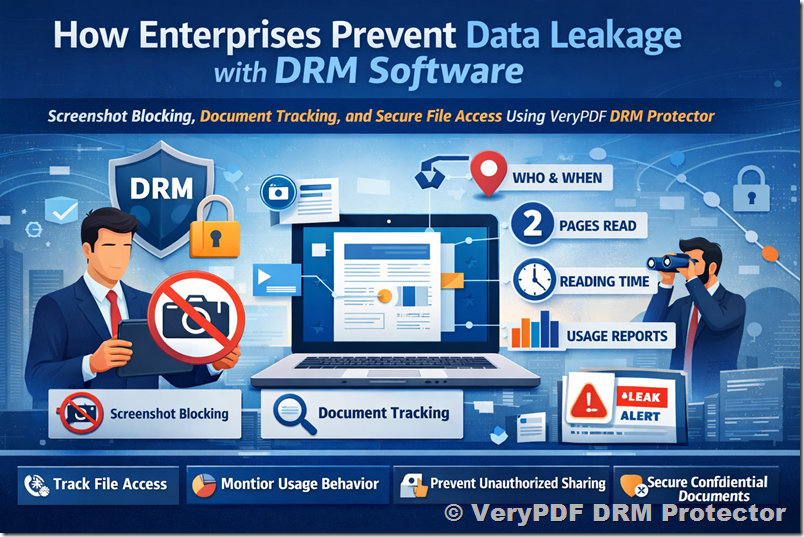
Screenshot Prevention

Users cannot capture your content using:

  • Built-in screenshot tools
  • Screen capture software

Even if they try, they get:

  • Blank screens
  • Masked content

Scanning Prevention

Prevents:

  • Automated scraping tools
  • Bots scanning your content

AI Prevention

Stops:

  • AI tools from reading and extracting your data
  • Automated content harvesting

This is becoming more important every day.

Download Neutralization

Even if someone “downloads” something:

It’s useless.

The file stays encrypted and cannot be opened outside the secure environment.

Dynamic Watermark

Every viewer sees:

  • Their email
  • IP address
  • Phone number

Right on the content.

So if something leaks, you know exactly who did it.

Viewing Timeout

Leave the screen open?

It locks automatically after a set time (e.g., 10 minutes).

Screen Masking

Switch tabs or minimise the browser?

Content disappears instantly.

Camera Shield

Prevents people from using another device to take photos.

It does this by:

  • Requiring interaction
  • Disrupting static capture

Verification (SMS / Email / Contact Match)

Only the intended user can access the content.

Even if someone shares the link, it won’t work.

Lock to First Browser

This is a big one.

Once opened:

That file is tied to that browser.

No sharing. No switching devices.

Password Protection

Add an extra layer when needed.

Access Lock

You can:

  • Instantly revoke access
  • Even after the file is sent

Print Control

Allow printing… or block it entirely.

Expiry Control

Set a time limit.

After that:

Access is gone.

View Count Limit

Limit how many times a file can be opened.

VPN & Proxy Blocking

Stops anonymous access attempts.

Human Check

Prevents bots from accessing content.

Security Level Setting

Different files = different protection levels.

Device Type Control

Allow only:

  • Mobile
  • Desktop
  • Or specific devices

Geo-Blocking & IP Control

Restrict access to:

  • Specific countries
  • Specific IP addresses

What Are VeryPDF DRM Protected Files?

This is important to understand.

When you protect a file with VeryPDF DRM Protector:

It’s not just encrypted.

It’s converted into a format that can only be accessed through a secure viewing environment.

That environment enforces:

  • Access rules
  • Viewing restrictions
  • Security policies

And everything is backed by a robust infrastructure.

Your data remains yours.

Your copyright remains yours.

But now:

Your control stays intact—even after sharing.


Why Traditional File Sharing Fails

Most platforms focus on convenience.

Upload → Share link → Done.

But they don’t solve:

  • Downloading
  • Screen recording
  • Printing
  • Forwarding

Which means:

Once access is granted…
Control is gone.

VeryPDF DRM Protector flips that model.

You don’t just share files.

You share controlled access.


Remote Control: After Sending the File

This is where things get powerful.

With traditional sharing:

Once sent = permanent access.

With VeryPDF DRM Protector:

You can:

  • Revoke access instantly
  • Change permissions
  • Lock files remotely

Even after users have opened them.


Granular Tracking: Knowing Exactly What Happens

You’re not guessing anymore.

You can track:

  • Who accessed the file
  • When they accessed it
  • How many times
  • From where

This gives you:

  • Visibility
  • Accountability
  • Proof

Built for Real Businesses (Not Just Enterprises)

A lot of DRM solutions are:

  • Expensive
  • Complex
  • Over-engineered

VeryPDF DRM Protector is different.

It’s designed to be:

  • Simple to use
  • Quick to deploy
  • Scalable

Even small teams can use it effectively.


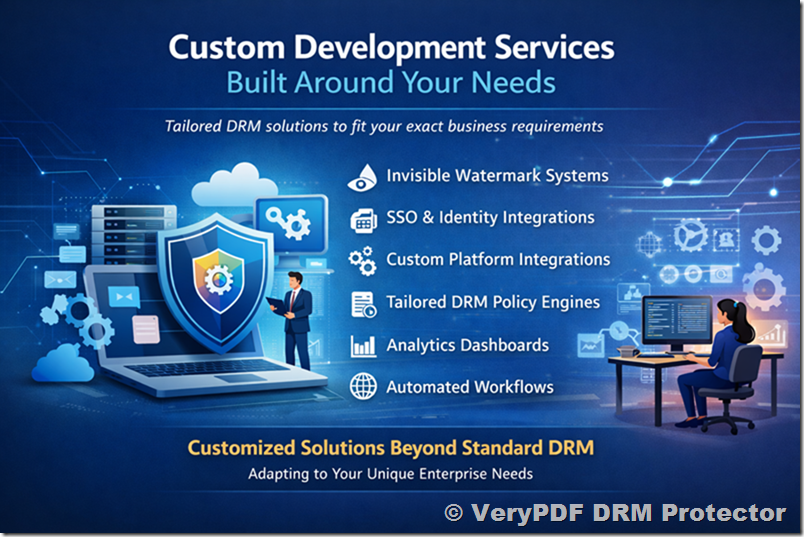
Custom Development: When You Need More

The standard platform is powerful.

But sometimes, you need something specific.

That’s where custom development comes in.

You can build:

  • Custom DRM workflows
  • Integration with your systems
  • API-driven automation
  • Custom authentication logic
  • Industry-specific protections

For example:

  • E-learning platforms
  • Corporate training systems
  • Content marketplaces
  • Internal document systems

Everything can be tailored.


Universal Compatibility

Your users might be on:

  • Windows
  • macOS
  • iOS
  • Android

Doesn’t matter.

Protection stays consistent.


Zero Compromises: Secure or Not Accessible

This is a key principle.

VeryPDF DRM Protector does not allow “partial security”.

It’s either:

  • Fully secure viewing

Or:

  • No access at all

No weak points.
No fallback loopholes.


They Can View It, But They Can Never Own It

That’s the real outcome.

Users can:

  • Read
  • Watch
  • Learn

But they cannot:

  • Copy
  • Download usable versions
  • Redistribute
  • Extract content

Ownership stays with you.


Who Should Use This?

This isn’t for casual file sharing.

It’s for people who care about their content.

Typical use cases:

  • Online course creators
  • Training organisations
  • Corporate teams
  • Publishers
  • Media companies
  • Legal and financial firms

If your content has value, this matters.


Getting Started

You don’t need to build everything from scratch.

You can start with:

  • The standard platform
  • Apply protection features immediately

Then scale into:

  • Custom DRM development
  • Hardware-level integrations
  • Advanced workflows

Final Thoughts

Most people only realise the value of protection after something goes wrong.

After:

  • Content leaks
  • Revenue drops
  • Intellectual property is copied

By then, it’s too late.

VeryPDF DRM Protector changes that.

It gives you control from the start.

Not just over files.

But over how they’re used.


Call to Action

Want to prevent unauthorized copying and sharing of your images and PDFs?
No software or extensions required.

Stop unauthorized screenshots, downloads, sharing, photography, and AI scraping.

VeryPDF DRM Protector provides seamless, high-level protection directly in your web browser.

Zero compromises: a secure environment, or no viewing at all.

They can view your work, but they can never own it.

Get started with VeryPDF DRM Protector for free today.

https://drm.verypdf.com/purchase/

If you need custom DRM development based on Widevine, PlayReady, and FairPlay, contact VeryPDF to discuss your requirements and get a tailored quote.

Protect Your Online Courses and Paid Content with VeryPDF DRM Protector: A Complete Guide for Educators and Knowledge-Based Professionals

Online education has rapidly evolved into a thriving global industry, enabling educators to deliver programming courses, language training, CFA exam preparation, civil service coaching, postgraduate entrance guidance, and construction licensing programs to a wide audience. Through online platforms, subscription-based models, and knowledge-commerce websites, instructors can now reach thousands of learners across the world with ease. However, alongside these opportunities comes a significant and ongoing challenge, digital piracy, which continues to threaten the value and security of educational content.

The Rising Threat of Online Content Piracy

For an online educator, the moment you upload your course content to a platform or share it with your students, you take on a risk. PDFs containing notes, guides, and exercises, as well as video lessons, audio recordings, and e-books, are all susceptible to unauthorized sharing. Students who pay for your content may copy it, distribute it to friends, or even upload it to file-sharing sites. In some cases, competitors can get hold of your materials and redistribute them without your permission.

This is not just a theoretical risk. Many educators face situations where entire courses have been leaked online. For example, a programming instructor may spend months recording tutorials and creating reference guides, only to discover that these materials are freely available on a torrent site. Language teachers may see their exclusive vocabulary or grammar guides circulating without credit. CFA, postgraduate, and civil service exam instructors often deal with critical study materials being shared illegally, undermining both their revenue and credibility.

What makes this problem worse is the ease of digital sharing. A simple screenshot, a PDF copy, or a screen recording can make your hard work available to hundreds, if not thousands, of people. Even well-intentioned students who want to “help” friends or classmates can inadvertently cause financial and professional harm.

Protect Your Online Courses and Paid Content with VeryPDF DRM Protector: A Complete Guide for Educators and Knowledge-Based ProfessionalsConsequences of Pirated Content

The consequences of digital piracy are severe and multifaceted:

  1. Revenue Loss: Every pirated copy of your PDF, video, or audio material represents a potential paying student lost. Over time, these losses can be substantial, especially for educators with large audiences or subscription-based models.
  2. Brand Damage: Uncontrolled distribution can harm your professional reputation. Students may encounter outdated versions of your content or poorly formatted copies, associating the low quality with you rather than the piracy issue.
  3. Legal Risks: Unauthorized sharing can sometimes involve copyrighted content or third-party materials included in your courses. Without proper control, you may be held partially responsible.
  4. Reduced Course Value: If your materials are widely available for free, future students may hesitate to pay for new courses, reducing your long-term income potential.
  5. Loss of Competitive Advantage: Knowledge-based courses often rely on exclusive content. Piracy dilutes this exclusivity, allowing competitors to capitalize on your work without investing the same effort.

For online educators, the risk is not only financial. It is about losing control over intellectual property, the foundation of your teaching business.

Discovering VeryPDF DRM Protector

After experiencing the risks and consequences of content piracy firsthand, many educators search for solutions. Password protection or basic encryption often proves insufficient. Passwords can be shared, removed, or cracked with minimal effort. Traditional PDF protection or video file encryption does not prevent screenshots, screen recording, or offline distribution.

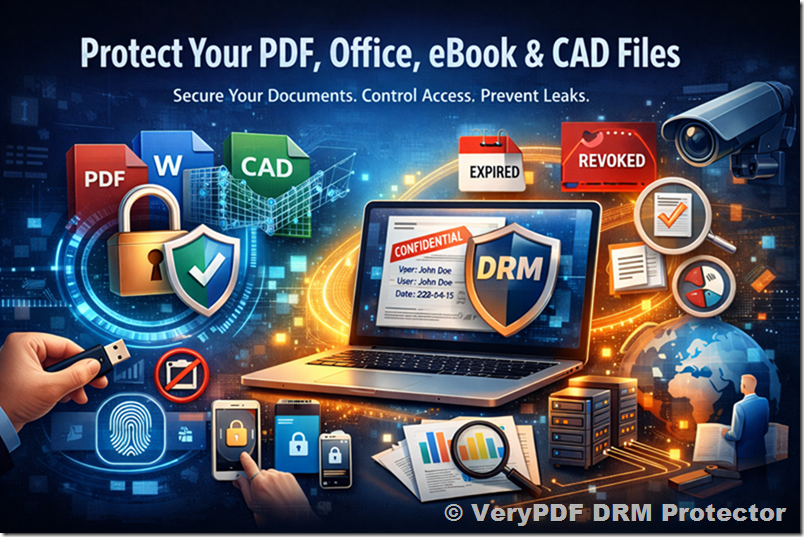
This is where VeryPDF DRM Protector comes in. VeryPDF DRM Protector is a professional digital rights management solution specifically designed to protect PDFs, e-books, and other digital materials from unauthorized access and distribution. Unlike simple password-based protection, VeryPDF DRM Protector provides advanced control over your content, ensuring only authorized users can view it while giving you the ability to manage and track access.

What sets VeryPDF DRM Protector apart is its comprehensive set of permissions and features designed to address the exact challenges online educators face:

  • It secures your content without interfering with the student experience.
  • It allows you to define who can access the content and how.
  • It embeds traceable watermarks to track unauthorized sharing.
  • It supports both offline and online access control.

The result is a system that empowers educators to maintain full control over their intellectual property, protecting both revenue and reputation.

Setting Permissions with VeryPDF DRM Protector

When using VeryPDF DRM Protector, educators can customize the level of control over their materials based on the type of content and intended distribution. The main permissions and features include:

1. Access Control

You can define who can open and read your materials. Access can be restricted to specific students, email addresses, or accounts, ensuring that only authorized individuals can view your content. This is particularly valuable for subscription-based courses or private coaching programs.

  • Individual Student Access: Assign content to each student uniquely. Even if a file is shared, only the assigned user can open it.
  • Group Access: Grant access to a cohort or class for a specific period.

2. Copy and Print Restrictions

Prevent unauthorized copying, printing, or exporting of your content. This ensures that your PDFs cannot be duplicated, shared via email, or printed for redistribution.

  • Disable Copying: Prevent text or image selection in PDFs.
  • Disable Printing: Stop physical reproduction of course materials.

3. Time-Limited Access

You can control how long a student can access your materials. This is perfect for subscription courses, seasonal content, or limited-time workshops. After the expiration date, access is automatically revoked.

  • Expiration Date: Set a specific date after which the material becomes inaccessible.
  • Access Duration: Limit access to a number of days after enrollment or first access.

4. Dynamic Watermarking

Every PDF copy can carry an invisible watermark with the student’s information, such as name, email, or unique ID. If a file is leaked, you can identify the source immediately.

  • Traceable Watermarks: Pinpoint unauthorized sharing to a specific student or account.
  • Invisible Protection: Students can’t remove or tamper with the watermark.

5. Offline or Online Viewing Control

You decide whether content can be accessed offline or only through an online viewer. This flexibility allows you to balance convenience for your students with security needs.

  • Offline Viewing: Students can view content without an internet connection, but security remains in place.
  • Online-Only Viewing: Access requires a secure connection, preventing unauthorized distribution of files.

6. Cross-Platform Support

VeryPDF DRM Protector works on multiple operating systems and devices, including Windows, Mac, iOS, and Android. Students can access materials seamlessly on their preferred devices while security remains intact.

  • Desktop and Mobile Access: Ensure learning continuity without compromising protection.
  • Unified Experience: The user interface is simple and consistent across platforms.

7. Real-Time Access Management

Educators can revoke access at any time, manage licenses, and track user activity. This is especially useful for instructors offering trial periods or handling refunds.

  • Revoke Access: Remove a student’s access instantly if needed.
  • Audit Logs: See who accessed content and when, providing complete visibility.

The Results: Secure, Profitable, and Reputable Courses

Since implementing VeryPDF DRM Protector, educators report significant improvements in content security and business outcomes. Key results include:

  • Revenue Protection: Unauthorized sharing is virtually eliminated, ensuring every paying student contributes to income.
  • Enhanced Brand Reputation: Students know they are accessing legitimate, high-quality content directly from the source.
  • Intellectual Property Control: Educators maintain full control over their digital materials, reducing risk of piracy.
  • Student Confidence: Students feel confident that they are using official materials, increasing engagement and trust.
  • Operational Simplicity: Permissions, watermarks, and access management are easy to set up and modify, saving time for educators.

For instance, a CFA instructor who previously struggled with widespread PDF leaks reported a 90% decrease in unauthorized file sharing after using VeryPDF DRM Protector. A programming course provider saw student subscriptions increase because paying students no longer had to compete with freely shared pirated copies. Language educators, who distribute extensive vocabulary and grammar guides, found that dynamic watermarking allowed them to identify and address leaks immediately.

Conclusion

The digital era presents incredible opportunities for educators, but it also comes with challenges that cannot be ignored. Piracy and unauthorized sharing of course materials can severely affect income, reputation, and long-term success.

VeryPDF DRM Protector offers a robust, flexible, and user-friendly solution to these challenges. By controlling access, restricting copying and printing, implementing time-limited access, adding traceable watermarks, and enabling both online and offline viewing, educators can protect their work without compromising the learning experience.

For online educators, knowledge professionals, and anyone selling paid digital content, the choice is clear: protecting your intellectual property is not optional, it is essential. VeryPDF DRM Protector provides the tools, control, and peace of mind necessary to thrive in a competitive digital education landscape.

Stop worrying about pirated PDFs, leaked videos, or unauthorized course sharing. Secure your content, safeguard your revenue, and protect your professional reputation today with VeryPDF DRM Protector.

Video Segment Encryption and DRM Protocols: Comparing Widevine, FairPlay, PlayReady, and the Benefits of AES Segment Encryption with a Custom Player

In the modern digital era, video content is a valuable asset for content creators, educational platforms, entertainment services, and corporate training providers. Protecting video content from piracy, unauthorized access, or redistribution is critical for maintaining revenue, intellectual property, and brand reputation. Among the technologies used for securing video, video segment encryption combined with digital rights management (DRM) protocols is widely adopted.

This article explores the differences between major DRM protocols—Google Widevine, Apple FairPlay, and Microsoft PlayReady—and compares them with a custom AES segment encryption approach coupled with a dedicated player. We will also examine the advantages of this approach and why it is an effective solution for content protection.

Video Segment Encryption and DRM Protocols: Comparing Widevine, FairPlay, PlayReady, and the Benefits of AES Segment Encryption with a Custom Player


1. Video Segment Encryption: Overview

Video segment encryption is a process of dividing a video file into small segments or chunks and encrypting each segment individually. Typically, this is implemented using AES (Advanced Encryption Standard) with either 128-bit or 256-bit keys. Each segment may have its own encryption key and initialization vector (IV), ensuring that even if one segment’s key is compromised, the remaining segments remain secure.

1.1 Key Concepts

  • Segments: Video files are divided into small chunks (2–10 seconds each) for streaming efficiency.
  • AES Encryption: Each segment is encrypted using AES-128 or AES-256 in CBC mode, often with a unique IV.
  • Playlist/Manifest: Protocols like HLS (HTTP Live Streaming) or DASH (Dynamic Adaptive Streaming over HTTP) use playlists or manifests that reference encrypted segments and key information.
  • Key Management: Keys can be stored on secure servers and delivered dynamically to authorized clients.

Segment encryption ensures both secure storage and secure streaming, preventing unauthorized users from accessing or copying the video content.


2. Understanding DRM Protocols

DRM protocols are industry-standard frameworks that manage content access, licensing, and playback. The three most commonly used protocols are Google Widevine, Apple FairPlay, and Microsoft PlayReady.

2.1 Google Widevine

  • Used widely for Android devices, Chrome browsers, and other platforms.
  • Supports multiple security levels: L1 (hardware-backed), L2, and L3 (software).
  • Provides license-based access to encrypted content.
  • Integrates seamlessly with adaptive streaming formats such as DASH.

2.2 Apple FairPlay

  • Exclusive to Apple devices including iOS, macOS, and Apple TV.
  • Works with HLS streaming and requires integration with Apple’s FairPlay Streaming SDK.
  • Manages licenses and decryption keys to ensure that content is only playable on authorized devices.

2.3 Microsoft PlayReady

  • Commonly used on Windows devices, Xbox consoles, and Edge browsers.
  • Supports DRM for both HLS and DASH streaming formats.
  • Provides secure license management, expiration control, and playback restrictions.

2.4 Limitations of Standard DRM

While Widevine, FairPlay, and PlayReady provide strong content protection, they come with certain limitations for individual content creators or small companies:

  • Integration Complexity: Requires SDKs, platform certification, and development effort.
  • License Costs: Often involves per-stream or per-license fees, which may be expensive for small-scale projects.
  • Platform Dependency: Each protocol is tied to specific devices or browsers, complicating cross-platform deployment.
  • Limited Customization: Fine-grained control over encryption, dynamic watermarking, or user-specific content policies is often constrained.

3. AES Segment Encryption with a Custom Player

An alternative to traditional DRM is a custom AES segment encryption solution combined with a dedicated player. This approach allows complete control over encryption, key management, and playback.

3.1 How It Works

  1. Segmenting the Video: The original video is divided into multiple segments, typically 2–10 seconds each.
  2. AES Encryption: Each segment is encrypted individually using AES-128 or AES-256. A unique IV is assigned to each segment.
  3. Key Management: Keys are stored on a secure server and dynamically delivered to the custom player upon request.
  4. Playlist Generation: HLS or DASH playlists are generated referencing each encrypted segment and the corresponding key URI.
  5. Playback: The custom player authenticates the user, requests keys for each segment, decrypts segments in memory, and streams the video seamlessly.

3.2 Advantages Over Standard DRM

  1. Cost Efficiency: Unlike Widevine or PlayReady, there are no per-license fees; the encryption and key management can be implemented internally.
  2. Platform Independence: Works across any device or platform where your custom player is available.
  3. Custom Control: Enables dynamic watermarks, user tracking, expiration policies, and segment-specific access rules.
  4. Enhanced Security: Multi-key encryption ensures that if one segment key is compromised, only that segment is affected.
  5. Flexibility: You can implement your own policies for offline playback, temporary downloads, or partial access.

3.3 Key Management Best Practices

  • Dynamic Key Delivery: Deliver keys only after authenticating the user or device.
  • Key Rotation: Rotate keys periodically or per playback session to reduce the risk of long-term exposure.
  • IV Uniqueness: Ensure each segment has a unique IV to prevent pattern attacks.
  • Secure Storage: Use HTTPS and encrypted storage for all keys and metadata.

4. Comparison Between AES Segment Encryption and DRM Protocols

Feature

Widevine

FairPlay

PlayReady

AES Segment Encryption + Custom Player

Device Coverage

Android, Chrome, Smart TVs

iOS, macOS, Apple TV

Windows, Xbox, Edge

Any device supporting custom player

Integration Complexity

High

High

High

Medium (developer-controlled)

Cost

License fees per user/stream

License fees

License fees

No per-license fees

Custom Policies

Limited

Limited

Limited

Fully customizable (watermarking, per-segment control)

Security

High

High

High

High (multi-key per segment)

Key Management

Managed by DRM

Managed by DRM

Managed by DRM

Fully controllable by provider

Offline Playback

Supported but restricted

Supported

Supported

Customizable (encrypted segments + keys)

From this table, it is clear that AES segment encryption with a custom player offers more flexibility and control, while still maintaining a high level of security.


5. Practical Implementation Tips

  1. Segment Duration: Choose 5–10 seconds for most videos to balance performance and security. Shorter segments increase security but require more frequent key delivery.
  2. AES Mode: AES-128-CBC is widely supported and sufficient for streaming purposes; AES-256-CBC can be used for higher security.
  3. Key Storage: Use secure servers with HTTPS to deliver keys dynamically. Keys should never be embedded in the player or video file directly.
  4. Player Design: Your custom player must handle decryption in memory and prevent saving decrypted segments to disk.
  5. Watermarking: Integrate dynamic watermarks in segments to trace unauthorized sharing.

6. Conclusion

While traditional DRM protocols such as Widevine, FairPlay, and PlayReady provide secure content protection, they involve costs, integration complexity, and platform restrictions. For content creators, small studios, or platforms looking for flexibility, AES segment encryption combined with a custom player is an attractive alternative.

The benefits include:

  • Full control over key management and encryption policies
  • Platform independence and cross-device compatibility
  • Multi-key encryption for maximum security
  • Ability to implement dynamic watermarks and access control per user or per segment

By adopting AES segment encryption with a custom player, video publishers can protect their valuable content while retaining control, reducing costs, and ensuring seamless streaming experiences for authorized users.

Content creators and media platforms interested in this approach can explore solutions like VeryPDF DRM Protector, which provides tools for segment encryption, key management, and custom player integration, making it easier to secure both video and audio content effectively.