
There is a moment every digital creator dreads.
Not the moment you finish your course.
Not the moment you hit publish.
But the moment you discover that your work, your intellectual effort, your structured teaching, your nights of refinement, has already been copied, redistributed, and uploaded somewhere else without your permission.
That is exactly what happened to a course creator who published a niche Udemy course on piano for musicians.
Within a week of uploading it, before it even had a chance to gain traction, the course was already circulating on multiple piracy websites.
And what followed was not resolution, but frustration.
Emails were sent to platforms, hosting providers, search engines, and takedown services. Reports were filed with Google, Bing, Cloudflare, and other enforcement channels. Even Udemy was contacted directly in hopes of support or intervention.
The response was not action.
It was silence, automation, and deflection.
Each organization redirected responsibility to another. Each system required proof that was difficult to establish in a way they would accept. Even authorship claims were questioned in some cases, making enforcement even more difficult.
Eventually, after repeated attempts and no meaningful resolution, the creator made a decision many others quietly make in similar situations: the course was removed from Udemy and moved to another platform.
Not because the content failed.
But because the protection ecosystem failed.
The uncomfortable truth about modern course platforms
Most creators assume that publishing on a major platform means their content is protected. Platforms like Udemy, YouTube, and similar marketplaces give the impression of safety because they are large, established, and widely trusted.
But in reality, these platforms are primarily distribution systems, not protection systems.
They help you reach audiences.
They do not prevent copying.
Once your content is uploaded, it exists in an environment where:
- It can be downloaded or recorded
- It can be redistributed externally
- It can be re-uploaded within hours
- It can spread beyond your control before you are even aware of it
The key misunderstanding many creators have is assuming that publishing equals protection.
In practice, publishing only means availability.
It does not mean control.
Why reporting piracy often feels ineffective
When creators attempt to resolve piracy issues, they usually enter a fragmented system involving multiple entities:
- Search engines that index content
- Hosting providers that store content
- CDN services that distribute content
- Takedown platforms that process reports
Each system operates independently. Each has its own requirements. Each often requires proof of ownership in a format that is not always straightforward to provide.
This leads to a cycle that many creators experience:
- Report the issue
- Receive automated confirmation
- Get redirected to another service
- Submit additional documentation
- Wait for review
- Receive no clear resolution
In many cases, no direct action is taken, or the process takes so long that the content continues to circulate freely while the case is still under review.
This creates a disconnect between urgency and enforcement.
Piracy spreads quickly.
Enforcement moves slowly.
The emotional impact creators rarely talk about
Beyond the technical frustration, there is a deeper emotional impact.
Creators often describe feelings such as:
- Losing control over their own work
- Feeling ignored by platforms they trusted
- Being treated as if they are the problem rather than the victim
- Experiencing fatigue from repeated reporting processes
- Questioning whether protecting digital content is even possible
Over time, this leads to something more damaging than piracy itself: disengagement.
Some creators stop publishing. Some remove their content entirely. Others shift platforms in search of better protection, often without success.
The result is not just financial loss, but creative discouragement.
The core issue: ownership without enforcement
One of the most important lessons from these experiences is that ownership alone is not enough.
Having created the content does not automatically ensure control over it once it is distributed online.
In practical terms:
Ownership means you have rights.
Enforcement determines whether those rights can actually be protected.
And in many digital ecosystems, enforcement is reactive rather than preventive.
This is why piracy continues to be a recurring issue for course creators, educators, coaches, and digital publishers.
Why traditional platforms are not designed for protection
Platforms like Udemy are optimized for:
- Hosting content
- Managing users
- Facilitating payments
- Providing learning environments
They are not optimized for:
- Preventing unauthorized redistribution
- Controlling file-level access outside their ecosystem
- Blocking external downloads or leaks
- Enforcing real-time content restrictions across the internet
Once content leaves the platform environment, it is effectively outside their control.
This is the fundamental limitation that many creators only fully understand after experiencing piracy firsthand.
A different approach: controlling access instead of chasing leaks
Instead of reacting after piracy occurs, a more effective strategy is to control access at the content level from the beginning.
This is where digital rights management solutions become relevant.
One example is VeryPDF DRM Protector, which focuses on preventing unauthorized access rather than attempting to recover content after it has been stolen.
Instead of relying on external platforms to enforce protection, it allows creators to define how their content is accessed, used, and distributed.
What DRM protection changes in practice
With a proper DRM system in place, content protection is no longer dependent on platform enforcement or manual reporting.
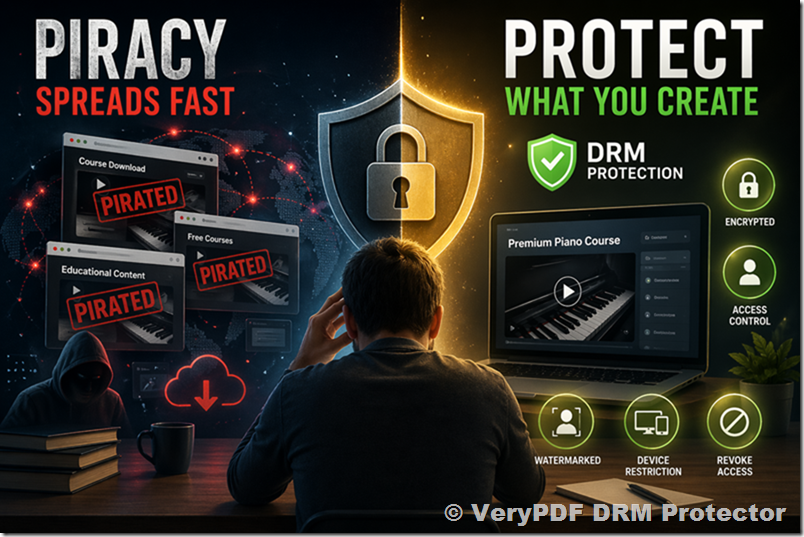
Instead, creators can:
- Restrict who can open the content
- Control which devices can access it
- Set expiration dates for access
- Prevent copying, printing, or redistribution
- Disable access instantly if misuse is detected
- Apply user-specific watermarks for traceability
This changes the security model from reactive to preventive.
Rather than trying to remove leaked content after it spreads, the content is designed so that unauthorized copies are unusable from the beginning.
Why this matters for course creators specifically
Online courses are particularly vulnerable because they are:
- High-value intellectual property
- Easy to record or download
- Frequently shared in private groups
- Often distributed across multiple platforms
Even if a course is hosted on a reputable platform, the content itself can still be extracted and redistributed.
This is why many creators eventually realize that platform security and content security are not the same thing.
Platform security protects the environment.
Content security protects the actual material.
Both are needed, but only one gives direct control to the creator.
The shift happening in 2026
The digital content landscape is changing rapidly.
Distribution is faster than ever. Content duplication is easier than ever. AI tools and automated scraping technologies have increased the speed at which content can be copied and republished.
In this environment, relying solely on platform policies or manual takedown processes is increasingly insufficient.
Creators are now moving toward models that prioritize:
- Access control
- Encryption-based protection
- User-level authorization
- Real-time permission management
This shift is not about restricting legitimate users.
It is about ensuring that access remains intentional rather than uncontrolled.
What creators need to reconsider
For anyone publishing educational or premium digital content, there are critical questions to consider:
- If your content is downloaded once, can it be redistributed without limitation?
- Do you have control over access after distribution?
- Can you revoke access if misuse is detected?
- Are you relying entirely on platforms to enforce protection?
If the answer to most of these questions is no, then your content is exposed to the same risks experienced by the Udemy course creator in this story.
Conclusion: visibility without protection is vulnerability
Publishing content online creates visibility, but visibility without protection creates vulnerability.
The experience of having a course pirated within days of release is not an isolated incident. It reflects a broader structural issue in how digital content is distributed and protected.
Platforms facilitate access, but they do not guarantee control.
Reporting systems exist, but they do not guarantee resolution.
Ownership exists legally, but enforcement in practice is inconsistent.
This is why many creators are now rethinking their approach to digital distribution entirely.
Solutions like VeryPDF DRM Protector represent a shift in mindset—from reacting to piracy after it happens to preventing unauthorized access before it begins.
For creators who rely on their content as intellectual property, education material, or business assets, this shift is no longer optional.
It is becoming essential.
Because in the current digital environment, the question is no longer whether content can be copied.
The question is whether it can still be controlled once it is released.