If you sell courses on Udemy or any other platform, this situation is painful and very common.
You spend weeks or months building a course. You upload it. You feel proud.
Then someone buys it, refunds it, and uploads it to pirate websites within days.
This is exactly what happened here. A fake account bought the course, refunded it the same day, and the content was later found on multiple piracy sites.
For many instructors, this feels unfair because there is no fast or clear way to stop it.
So the real question is:
What can you do when your Udemy course gets stolen and shared on pirate sites?
Why Udemy course piracy happens so fast
Course piracy is not random. It follows a simple pattern:
- Someone buys your course using a fake account
- They download all videos quickly
- They request a refund
- They upload the content to piracy websites
- The content spreads to multiple sites in days
Once it spreads, removing it becomes difficult because:
- Sites move hosting often
- Content is copied again by other sites
- Some websites ignore DMCA requests
- Search engines index pirated pages quickly
What instructors usually try (and what works)
Here is a simple breakdown of common actions and how effective they are:
|
Method |
How it works |
Speed |
Real effectiveness |
|
Udemy support request |
Report stolen course |
Slow |
Medium |
|
DMCA takedown |
Contact website/host |
Medium |
Medium to high |
|
Google removal request |
Remove search links |
Medium |
Low to medium |
|
Contact hosting provider |
Shut down site |
Slow |
Medium |
|
Legal action |
Lawyer sends notice |
Very slow |
High but expensive |
|
DRM protection |
Prevent copying at source |
Immediate |
High |
The key problem is simple:
Most methods try to remove stolen content AFTER it is already stolen.
That is why prevention matters more than takedown.
Why DMCA alone is not enough
DMCA takedown works, but it has limits:
- You must find each website manually
- Some sites ignore requests
- Mirror sites appear again
- You repeat the same process again and again
So even if you succeed, your course may still appear on other domains.
This is why many instructors start using protection tools instead of only reporting piracy.
How to reduce course piracy (practical steps)
If you want to reduce future theft, here are real actions that help:
1. Add visible and invisible watermarking
- Show buyer email or ID inside video
- Add hidden tracking markers in videos
2. Split course content
- Do not upload full course in one place
- Break into modules or protected sections
3. Limit downloads where possible
- Avoid downloadable video files
- Use streaming-based delivery
4. Track leaks early
- Search course title regularly
- Use alerts or monitoring tools
5. Use DRM protection for real control
This is where real protection starts.
Best way to protect online courses: DRM protection
If you want to stop unauthorized sharing instead of chasing leaks later, you need real access control.
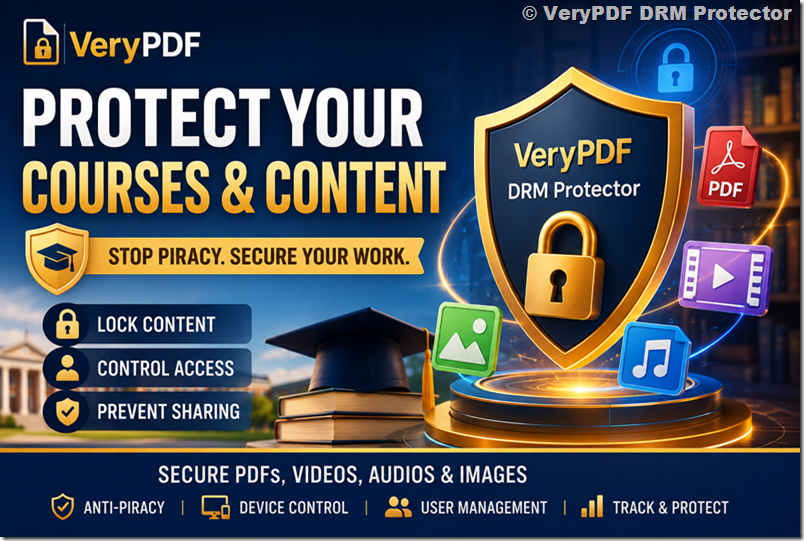
A tool like VeryPDF DRM Protector helps protect digital content by controlling how users access files.
It is commonly used for:
- Online courses
- Training materials
- Paid PDFs and ebooks
- Private video content
- Educational content for schools and teachers
What it does in simple terms
Instead of giving users normal files they can copy or upload anywhere, it:
- Controls who can open the content
- Stops direct file sharing
- Adds access rules
- Restricts unauthorized devices
- Helps reduce screen capture and redistribution risk
DMCA vs DRM (simple comparison)
|
Feature |
DMCA |
DRM Protection |
|
Removes pirated content |
Yes |
No (prevents creation) |
|
Stops first leak |
No |
Yes |
|
Works after piracy |
Yes |
Limited |
|
Prevents sharing |
No |
Yes |
|
Long-term protection |
Weak |
Strong |
Real problem instructors face
Most instructors think:
“I will just report piracy when it happens.”
But reality is:
- The content is already downloaded in minutes
- It spreads before you even find it
- Removal takes days or weeks
- Some copies never get removed
So even if you win the DMCA process, the damage is already done.
A better approach: protect before publishing
Instead of reacting after piracy, many course creators now:
- Protect content before upload
- Control access from the first day
- Reduce downloadable formats
- Use DRM systems for paid content
This does not guarantee zero piracy, but it reduces mass redistribution.
Common mistakes instructors make
- Uploading full HD videos without protection
- Allowing unrestricted downloads
- Relying only on platform security
- Not tracking piracy sites
- Thinking “small course = no piracy risk”
Even small courses get stolen quickly if they sell well.
FAQs
1. Why do Udemy courses get pirated so fast?
Because attackers use fake accounts to buy and download content immediately, then upload it to piracy sites.
2. Can Udemy remove pirated courses?
They can request takedowns, but they cannot control external piracy websites.
3. Does DMCA really work?
Yes, but it only removes specific links. New copies often appear again.
4. How long does DMCA removal take?
Usually a few days to a few weeks depending on the website.
5. Can I find who stole my course?
Most of the time no. Fake accounts and VPNs hide identity.
6. What is the fastest way to stop piracy?
There is no instant fix. Prevention is faster than takedown.
7. Can watermarking stop piracy?
It does not stop sharing, but it helps identify leaks.
8. Are small courses safe from piracy?
No. Even new or small courses can be stolen quickly.
9. Do piracy sites care about DMCA?
Some do, some ignore it completely.
10. What is DRM protection?
It is a method that controls how users access and use digital content.
11. Can DRM stop screen recording?
It can reduce it in some systems, but no solution is 100% perfect.
12. What is the best long-term solution?
Combining DRM protection + monitoring + takedown process.
Final thought
Course piracy is frustrating because it feels like you are always one step behind.
DMCA helps remove content after it spreads, but it does not stop the first leak.
That is why many instructors now combine takedown actions with protection tools like VeryPDF DRM Protector to reduce unauthorized sharing from the start.
The goal is simple:
Less leakage. Less damage. More control over your own content.