
Many people worry about what happens if a protected PDF file is stolen or copied. With normal PDFs, once someone downloads the file, they can try to open it, share it, or attack it offline.
.vpdf files work differently. The goal is simple: even if someone gets the file, they still cannot read it.
This is especially important for sensitive documents like training materials, business files, financial reports, and paid content.
What is a .vpdf file?
A .vpdf file is a protected document format used by VeryPDF DRM systems. It is not like a normal PDF.
A normal PDF:
- Contains full readable content inside the file
- Can be opened on any device if not protected
A .vpdf file:
- Is encrypted
- Does not include the full readable content
- Needs server authorization to open
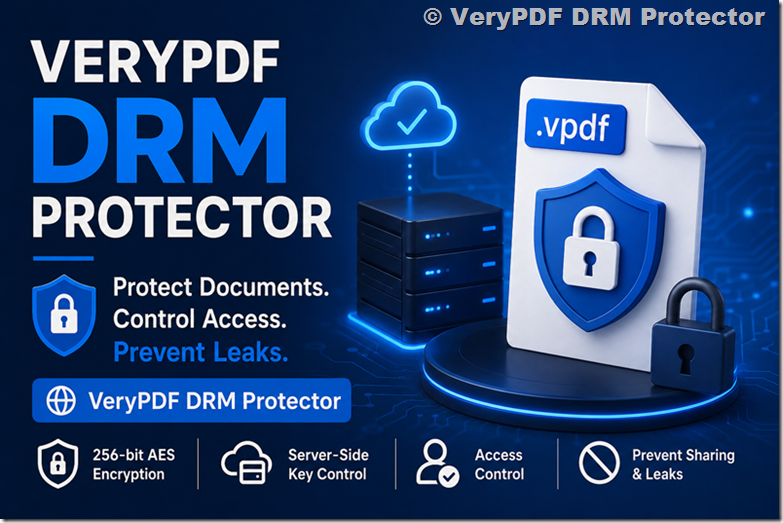
Why a stolen .vpdf file is useless
A common question is:
“If someone downloads the file, can they still open it?”
The answer is NO.
Key reasons:
|
Feature |
Normal PDF |
.vpdf file |
|
File content inside |
Yes |
Yes, but incomplete |
|
Encryption |
Optional |
256-bit AES |
|
Offline access |
Yes |
No |
|
Server dependency |
No |
Yes |
Even if a hacker copies the .vpdf file, they still cannot use it because:
- The file does not contain the decryption key
- The key is stored only on the server
- Access must be approved online
- Offline brute-force attacks do not work in practice
256-bit AES encryption in simple terms
.vpdf uses 256-bit AES encryption.
This is the same class of encryption used in high-security systems.
What it means in real life:
- You cannot guess the key
- You cannot brute-force it with a normal computer
- Even powerful hardware is not practical for breaking it
But encryption alone is not the full story.
Why server-side control matters more than encryption
Many PDF tools only encrypt files. That is not enough.
.vpdf adds another layer:
- The file is stored locally or shared
- But the decryption key is NOT inside the file
- The key is stored on the server
- The server decides who can open the file
So even if someone steals the file, they are missing the most important part: the key and permission.
Why .vpdf files are “incomplete”
This is an important concept.
A .vpdf file is not a full standalone document.
It is more like:
- A protected container
- A locked package
- A file that depends on a remote system
Without the server:
- The file cannot be fully reconstructed
- The content cannot be decrypted
- The file is not usable
.vpdf Security Model
A .vpdf file is designed for secure document distribution where control stays with the server, not the file.
The file is protected with 256-bit AES encryption, but it does not contain the decryption key or any required decryption data. All critical access information is stored on the server.
This means the file alone is not enough to open or decrypt the content. Even if someone downloads or copies the .vpdf file, it cannot be used without server authorization.
Access is always verified online. Only approved users can view the document, and permission can be controlled or revoked at any time.
In simple terms:
- The file can be shared safely
- The encryption key is never inside the file
- Required decryption data is stored on the server
- Offline opening is not possible
- Unauthorized access is blocked at the server level
This design ensures that document security does not depend on the file itself, but on controlled access from the server.
The system is built on many years of PDF security engineering experience, focused on real-world protection against copying, leakage, and unauthorized distribution.
Real-world example
Imagine this situation:
You send a training PDF to 1,000 users.
With a normal PDF:
- One user can copy and share it
- It spreads everywhere
With .vpdf:
- Even if someone copies the file
- They still cannot open it without authorization
- Access can be controlled, revoked, or limited
This is important for:
- Online courses
- Paid documents
- Internal company files
- Legal or financial documents
Common problems .vpdf helps solve
Many users choose .vpdf because of real issues:
- PDF leaks after sending to customers
- Students sharing paid course materials
- Internal documents forwarded outside company
- No control after download
- Password-protected PDFs being broken or shared
.vpdf solves these by removing offline access.
Why brute-force attacks don’t work
Some people think they can try all possible keys.
In reality:
- 256-bit encryption has an extremely large key space
- Even the fastest computers cannot test all combinations
- And .vpdf still requires server validation
So offline attacks are not realistic.
About experience and trust
PDF security is not a new field.
Systems like this are built on long-term engineering experience. In this case, the technology behind .vpdf comes from more than 25 years of work in PDF security and document processing.
This matters because document security is not just about encryption. It is about system design, access control, and real-world attack scenarios.
VeryPDF DRM Protector
If you want to protect PDF or document content online, VeryPDF DRM Protector is designed for this use case.
It helps with:
- PDF encryption and DRM control
- Online document viewing protection
- Preventing file sharing and leaks
- Access control based on users or devices
- Expiry and permission management
FAQs
1. What is a .vpdf file?
It is a DRM protected document format that requires server authorization to open.
2. Can .vpdf files be opened offline?
Yes or No. Online version require server validation. Offline version can be opened offline, but less security.
3. Is the decryption key inside the file?
Yes or No. Online version, the key is stored on the server only. Offline version, the key is encrypted and stored inside the file.
4. Can hackers brute-force a .vpdf file?
Not in practice. 256-bit AES makes brute-force unrealistic.
5. What happens if someone steals the file?
They still cannot open it without server permission.
6. Is .vpdf the same as a normal encrypted PDF?
No. It uses server-side control, not just local encryption.
7. Why is server-side key storage important?
It prevents offline attacks and unauthorized access.
8. Can I revoke access after sending the file?
Yes, access can be controlled on the server.
9. What industries use this kind of protection?
Education, finance, legal, corporate training, and digital publishing.
10. Does it slow down document access?
No, access is handled through lightweight server checks.
11. Can users share .vpdf files?
They can share the file, but others still cannot open it.
12. Why is this better than password-protected PDF?
Passwords can be shared or cracked. Server-controlled access cannot.