
In modern B2B sales and digital marketing, one of the biggest challenges is not creating content, it is understanding what happens after the content is sent.
A sales representative emails a proposal. A marketer shares a product brochure. A consultant sends a pricing deck. A founder forwards an investor presentation.
Then silence.
Did the recipient open the file?
Did they read it carefully?
Which pages interested them most?
Did they stop at the pricing page?
Did they forward it internally?
Did they spend ten minutes reviewing the proposal, or close it after five seconds?
Traditional PDFs provide no answers.
This is why PDF Reading Analytics for Sales is becoming one of the fastest-growing software opportunities in the digital document industry. It transforms static PDF files into measurable, trackable, data-driven sales assets. Instead of guessing customer intent, teams gain visibility into real reading behavior.
Imagine a system similar to link analytics tools such as Bitly, but designed specifically for PDF content.
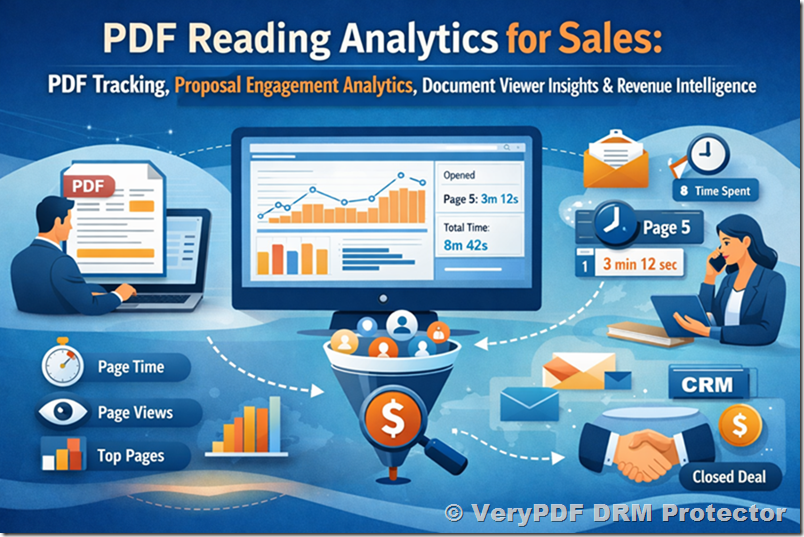
You upload a PDF, share a secure web link, and instantly see:
- Whether the PDF was opened
- Who opened it
- When it was opened
- Which pages were viewed
- How long each page was viewed
- Total reading time
- Which page was viewed most frequently
- Which page had the longest engagement
- Whether readers dropped off early
- Whether multiple stakeholders viewed it
- How engagement changes over time
This is not just analytics. It is sales intelligence.
And for organizations that already have a plugin-free web PDF viewer, the technical barrier is lower than many people think. An MVP can be built quickly because the core reading environment already exists.
The market demand is enormous. In many cases, the potential audience for PDF Analytics is 100 times larger than traditional DRM-only markets because nearly every sales team, marketer, recruiter, trainer, consultant, agency, and SaaS company shares PDFs.
This article explores why PDF Reading Analytics matters, how the system works, what features customers need, why it creates long-term user dependence, and why now is the perfect time to build it.
The Hidden Problem with Traditional PDFs
PDF remains one of the most widely used business formats in the world. It is universal, professional, printable, and easy to distribute.
Companies use PDFs for:
- Sales proposals
- Product brochures
- Price lists
- Case studies
- White papers
- Investor decks
- Reports
- Contracts
- Training manuals
- Product catalogs
- Technical documentation
- Lead magnets
- Event materials
But traditional PDF workflows have a major weakness:
Once sent, the sender loses visibility.
A salesperson may spend hours preparing a proposal, but after sending it, they know nothing about buyer engagement.
A marketer may run campaigns driving traffic to a downloadable brochure, but cannot measure reading depth.
A founder may send an investor deck but cannot tell whether investors reviewed the financial slides.
This lack of visibility creates three major business problems:
1. Poor Follow-Up Timing
Sales teams often follow up too early or too late.
Without engagement data, they cannot know whether the prospect has reviewed the document.
2. Weak Qualification
Not all leads are equal. Some prospects deeply study the proposal. Others ignore it.
Without analytics, both appear identical.
3. Lost Optimization Opportunities
If page 3 consistently causes readers to exit, something is wrong. If pricing pages receive the most attention, that insight should shape strategy.
Without measurement, improvement is impossible.
What Is PDF Reading Analytics?
PDF Reading Analytics is a cloud-based system that combines:
- PDF hosting
- Web-based viewing
- Real-time event tracking
- Engagement analytics
- Sales notifications
- Historical reporting
Instead of emailing a raw PDF attachment, the user uploads the PDF to the platform and shares a trackable web link.
When recipients open the link in a browser, the built-in web viewer records behavioral events such as:
- Open event
- Session start
- Page entered
- Page exited
- Scroll behavior
- Zoom behavior
- Time spent
- Device type
- Location (optional)
- Repeat visits
- Completion percentage
All of this is converted into dashboards, alerts, and insights.
The result is simple:
Your PDF becomes a measurable sales funnel.
Real Example: Proposal Tracking in Action
Imagine a salesperson named Sarah sends a 12-page proposal to a prospect.
At 10:14 AM, the system notifies her:
Prospect opened your proposal.
Then she sees:
- Total reading time: 8 minutes 42 seconds
- Pages viewed: 1–8
- Page 5 viewed for 3 minutes 12 seconds
- Page 6 viewed twice
- Closed after page 8
- Reopened later at 2:17 PM
What does this tell Sarah?
- The prospect is genuinely interested
- Pricing or ROI on page 5 matters most
- Internal review may be happening
- This is the right time to call
Without analytics, Sarah would be guessing.
With analytics, she acts with confidence.
Why Sales Teams Love This Product
Among all business users, sales professionals often become the most emotionally attached users of document analytics systems.
Why?
Because sales is a game of timing, psychology, and momentum.
Every signal matters.
The “God View” Advantage
Once a salesperson becomes used to seeing buyer behavior in real time, it feels like having a strategic superpower.
Instead of operating blindly, they can see:
- Who is engaged
- What matters most
- When interest rises
- When to follow up
- Which deal is hot
- Which lead is cold
Taking that away feels like losing control.
That is why this product category has strong retention.
It is not just useful, it becomes addictive.
Why Marketers Need PDF Analytics Too
This system is not only for sales teams.
Marketers share PDFs constantly:
- Lead magnets
- eBooks
- White papers
- Industry reports
- Product one-pagers
- Event brochures
- Webinar decks
- Media kits
Most marketing analytics stop at:
- Clicks
- Downloads
- Form submissions
But downloads do not equal engagement.
A user may download a report and never open it.
PDF analytics adds the missing layer:
- Did they read it?
- How much did they read?
- Which topics interested them?
- Where did they drop off?
This allows marketers to optimize campaigns based on real content consumption.
Core Features of a Powerful PDF Reading Analytics Platform
To compete successfully, the platform should include a strong feature set.
1. Trackable PDF Links
Upload any PDF and generate a shareable link.
Benefits:
- No attachment limits
- Easy sharing
- Controlled access
- Real-time tracking
- Update content without changing link
2. Real-Time Open Notifications
Know instantly when someone opens the document.
Use cases:
- Follow up while interest is high
- Prioritize active prospects
- React during live negotiations
3. Per-Page Time Tracking
One of the most valuable features.
Measure exactly how long a reader stays on each page.
Examples:
- Page 1: 5 seconds
- Page 2: 14 seconds
- Page 5 (pricing): 180 seconds
- Page 6: 45 seconds
This reveals attention patterns impossible to see otherwise.
4. Most Viewed Page
Identify which page receives the highest number of visits.
This often reveals what buyers care about most:
- Pricing
- ROI
- Testimonials
- Features
- Implementation
- Security
5. Longest Engagement Page
Which page kept readers the longest?
This may indicate:
- Strong interest
- Confusion
- Need for clarification
- Internal discussion
Either way, it is valuable intelligence.
6. Total Reading Time
Measure the total time spent on the entire PDF.
This helps qualify engagement levels:
- 10 seconds = weak interest
- 2 minutes = moderate interest
- 15 minutes = serious review
7. Repeat Visits
Returning readers are often stronger prospects.
Track:
- Number of sessions
- Time between sessions
- Reopened pages
- Last activity time
8. Session Timeline
Visualize the reading journey:
10:00 Opened
10:01 Page 1
10:02 Page 2
10:05 Page 5
10:08 Closed
This creates a story from behavior.
9. Viewer Identification
Depending on workflow, identify readers through:
- Named links
- Email-gated access
- CRM-linked sessions
- Shared recipient links
This allows engagement to be tied to real leads.
10. Historical Analytics
Store all interaction history over time.
This is extremely important.
Why?
Because historical data becomes a strategic asset.
You can compare:
- Prospect A vs Prospect B
- Proposal Version 1 vs Version 2
- Quarter-over-quarter engagement
- Campaign performance by content type
Why Historical Data Creates Lock-In
One reason users stay with platforms like CRM systems is data history.
The same applies here.
When months or years of buyer engagement records are stored inside the platform, switching providers becomes difficult.
Because leaving means losing:
- Lead behavior history
- Proposal engagement trends
- Team performance benchmarks
- Content effectiveness insights
- Buyer journey records
That creates powerful retention.
The software becomes more valuable over time.
Use Cases Across Industries
Although sales is the strongest use case, many industries need this.
SaaS Companies
Track interest in:
- Product decks
- Security PDFs
- Pricing proposals
- Onboarding guides
Agencies
Track:
- Client proposals
- Strategy decks
- Campaign reports
Real Estate
Track:
- Property brochures
- Investment memorandums
- Buyer guides
Finance
Track:
- Investor decks
- Product disclosures
- Loan proposals
Education
Track:
- Course catalogs
- Enrollment guides
- Sponsored programs
Consulting
Track:
- Proposals
- Research reports
- Transformation roadmaps
Recruitment
Track:
- Candidate packs
- Employer branding decks
- Compensation documents
Why This Market Is Bigger Than DRM
Traditional DRM solves security and access control.
That is valuable, but it targets narrower pain points.
PDF Analytics solves a universal business need:
Understanding engagement.
Almost every organization that shares PDFs can benefit.
Consider the audience:
- Sales teams
- Marketing teams
- Founders
- Consultants
- Recruiters
- Agencies
- Customer success teams
- Trainers
- Investors
- Real estate brokers
- Partnerships teams
This is why the addressable market can be dramatically larger than DRM alone.
Security matters to some buyers.
Analytics matters to nearly everyone.
Built on Existing Technology: Fast Time to Market
For companies that already own a web-based PDF viewer, this opportunity is especially attractive.
Much of the hard work is already done:
- Browser rendering
- Page navigation
- Zoom
- Search
- Mobile compatibility
- Access links
- Hosting
What remains is the analytics layer.
That means development can move quickly.
MVP Architecture
A minimum viable product can be launched rapidly using:
Front-End Viewer Events
Track events such as:
- Open
- Close
- Page change
- Scroll depth
- Time on page
- Session duration
Backend API
Receive events and store them.
Database
Store:
- User
- Document
- Session
- Event
- Metrics
Dashboard
Show analytics in charts and tables.
Notification Engine
Email or push alerts for opens and activity.
One-Week Prototype Possibility
If a stable web viewer already exists, a basic prototype may be achievable in a short timeline.
Week 1 could include:
Day 1: Upload + share links
Day 2: Event tracking
Day 3: Page time analytics
Day 4: Dashboard
Day 5: Notifications
Day 6: QA
Day 7: Launch beta
The speed advantage matters.
Many companies overcomplicate software opportunities. But sometimes the strongest products come from combining existing assets in a focused way.
Key Metrics Customers Want to See
A successful dashboard should clearly present metrics such as:
- Total opens
- Unique viewers
- Average reading time
- Completion rate
- Top engaged documents
- Most viewed pages
- Highest drop-off pages
- Repeat viewers
- Recent activity
- Conversion by document
These metrics turn PDFs into performance assets.
Integrations Increase Value
To win in the sales market, integrations are important.
CRM Integrations
Connect with:
- Salesforce
- HubSpot
- Zoho
- Pipedrive
Then sales reps can see document engagement directly inside lead records.
Email Tools
Track PDFs sent via outreach sequences.
Slack / Teams
Send instant activity alerts.
Marketing Automation
Trigger workflows based on reading behavior.
Example:
If viewer spends 2+ minutes on pricing page → notify sales rep.
Pricing Model Opportunities
This category supports strong SaaS pricing.
Possible plans:
Free Plan
- Limited documents
- Basic analytics
- Branding included
Pro Plan
- Unlimited links
- Full analytics
- Notifications
- Custom branding
Team Plan
- Multi-user
- Shared dashboards
- CRM integration
Enterprise Plan
- SSO
- API
- Advanced permissions
- Compliance
- White-label
Because ROI is tied to revenue, customers are often willing to pay.
If one closed deal is influenced by analytics, the software pays for itself.
Competitive Positioning Against Generic File Sharing
Why not just use email attachments or cloud storage links?
Because those tools answer only one question:
Was the file sent?
They do not answer:
- Was it read?
- Which pages mattered?
- How serious is the lead?
- When should I follow up?
That difference is the product’s core value.
Privacy and Ethical Design
Analytics products should be transparent and responsible.
Best practices include:
- Consent notices when required
- Privacy controls
- Region-based compliance
- Secure storage
- Role permissions
- Data retention settings
- Anonymized analytics options
Trust increases adoption.
Future Features
After launching the core platform, many advanced features can be added.
AI Insights
Use AI to summarize engagement:
Prospect focused heavily on pricing and implementation pages. Recommend ROI follow-up.
Lead Scoring
Automatically score viewers based on behavior.
Example:
- Opened = +5
- 5 minutes reading = +10
- Pricing page viewed = +20
- Reopened twice = +15
Heatmaps
Visual page heatmaps showing engagement concentration.
A/B Testing
Compare two brochure versions.
Which converts better?
Team Performance Analytics
Which sales reps send the most effective content?
Auto Follow-Up Suggestions
Recommend next actions based on reading signals.
Why Users Become Dependent
The strongest SaaS products become part of daily workflow.
PDF Reading Analytics can achieve that because it influences real decisions every day.
A sales rep checks active prospects each morning.
A marketer reviews engagement after every campaign.
A manager monitors content performance weekly.
Once teams rely on these signals, removing the platform creates discomfort.
They return to guessing.
And nobody wants to go back to guesswork.
Why This Opportunity Is Timely Now
Several trends make this ideal now:
Remote Selling
Buyers increasingly review materials digitally.
Data-Driven Sales
Teams demand measurable signals.
Browser-Based Workflows
Users prefer no-installation tools.
AI + Automation
Behavioral data becomes more valuable when combined with AI.
Rising Competition
Teams need an edge in follow-up timing and qualification.
All trends favor document intelligence.
Why Existing PDF Companies Should Consider It
If a company already has expertise in:
- PDF rendering
- Web viewers
- Document hosting
- Security
- Permissions
- SaaS infrastructure
Then they are closer to this market than they may realize.
Instead of competing only in crowded utility categories like “PDF to Word” or “Merge PDF,” they can move into a higher-value recurring SaaS market tied directly to revenue outcomes.
That is a major strategic shift.
Example Customer Story
A software company sends 100 proposals per month.
Before analytics:
- Reps guess follow-up timing
- Weak prioritization
- Low visibility
- Generic outreach
After analytics:
- Reps call engaged leads first
- Pricing-focused prospects receive targeted follow-up
- Managers identify winning proposal formats
- Marketing improves content based on real reading behavior
Close rates improve.
Sales cycles shorten.
Team confidence rises.
Final Thoughts
PDFs are everywhere in business, but most are still silent.
They are sent, opened, ignored, reviewed, forwarded, compared, and discussed without giving any feedback to the sender.
That silence represents lost intelligence.
PDF Reading Analytics for Sales changes that.
It turns every PDF into a measurable customer interaction channel.
Instead of sending documents into a black hole, companies gain visibility into:
- Buyer intent
- Content performance
- Engagement timing
- Funnel progression
- Revenue opportunities
The market is large. The need is real. The retention potential is strong. And for teams that already have a plugin-free web PDF viewer, the path to launch can be surprisingly fast.
This is more than a PDF feature.
It is a new category of sales intelligence built on one of the world’s most common business file formats.
The future of PDFs is not just viewing.
It is understanding.