
Many companies spend months creating training materials, reports, videos, product documentation, research papers, user guides, and other valuable digital content.
The problem starts when that content is shared.
A PDF can be forwarded to hundreds of people within minutes. A training video can be downloaded and uploaded to another website. Internal documents can be copied by employees who are leaving the company. Educational materials can be shared between students. Premium content can be distributed without permission.
Once content leaves your control, it becomes difficult to track where it goes and who is using it.
This is why more organizations are looking for a Content Security Platform.
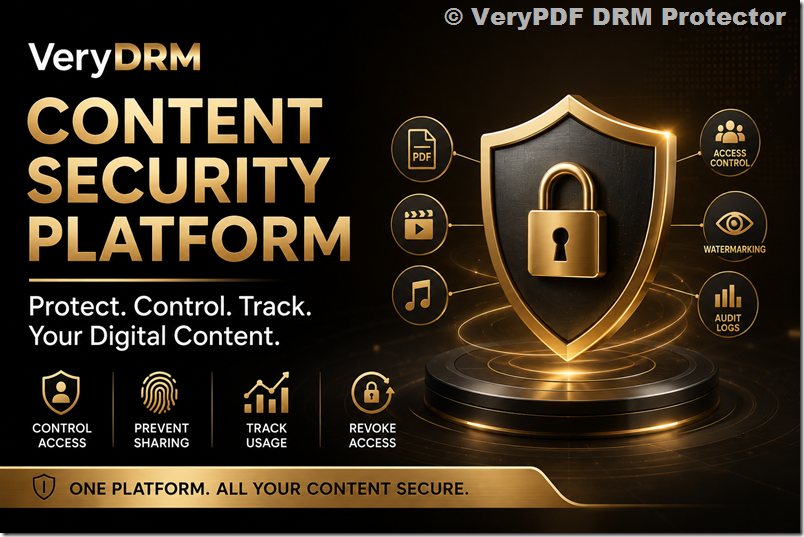
A Content Security Platform helps organizations protect digital content, control access, monitor usage, and reduce unauthorized sharing. Instead of protecting only one file type, it provides a single system for securing PDF files, videos, audio files, images, reports, training materials, and other business content.
This page explains the common content security problems organizations face and how a Content Security Platform helps solve them.
Why Traditional File Protection Is No Longer Enough
Many organizations still rely on simple methods such as:
| Method | Problem |
| Password protected PDF | Passwords can be shared |
| ZIP file encryption | Users can forward extracted files |
| Private download links | Links can be copied and shared |
| Email attachments | No control after delivery |
| Cloud storage permissions | Files can often be downloaded and redistributed |
The biggest weakness is simple.
Once a user receives a file, most systems lose control over what happens next.
This creates serious risks for businesses that distribute valuable content.
Common Content Security Problems Companies Face
Employees Sharing Confidential Documents
A company may spend years creating internal procedures, pricing documents, sales strategies, engineering specifications, or training materials.
An employee can copy these files and take them to a competitor in seconds.
Many businesses only discover the problem after sensitive information has already been leaked.
Students Sharing Course Materials
Online education providers often face the same issue.
Students purchase access to premium training materials and then share:
- PDF workbooks
- Course notes
- Training videos
- Audio lessons
One customer can become hundreds of unauthorized users.
This directly affects revenue.
Clients Forwarding Paid Reports
Consulting firms, market research companies, and financial analysts often sell premium reports.
The intended customer purchases one copy.
The report is then forwarded throughout the organization or even outside the company.
The content creator loses control completely.
Video Piracy and Screen Recording
Many organizations assume video content is harder to copy than documents.
Unfortunately, this is not true.
Users may:
- Download videos
- Record their screens
- Share access credentials
- Capture video streams
Without proper protection, premium video content can spread quickly.
What Is a Content Security Platform?
A Content Security Platform is a system that helps organizations:
- Protect digital content
- Control who can access content
- Prevent unauthorized sharing
- Track user activity
- Apply security policies
- Revoke access when needed
Instead of protecting files one by one, organizations can manage security from a central platform.
This approach is much easier to manage when hundreds or thousands of files are being distributed.
Key Features of a Content Security Platform
User-Based Access Control
One of the most important features is controlling exactly who can access content.
Organizations can allow access based on:
- User account
- Email address
- Device
- IP address
- Geographic location
- Organization
This helps prevent unauthorized users from opening protected content.
Dynamic Watermarking
Watermarks are one of the most effective ways to discourage content sharing.
Unlike static watermarks, dynamic watermarks can display:
- User name
- Email address
- Company name
- Date and time
- IP address
When users know their identity is visible on the content, they are much less likely to redistribute it.
PDF Content Security
PDF files remain one of the most common business document formats.
Organizations frequently need to protect:
- Training manuals
- Research reports
- Product documentation
- Employee handbooks
- Contracts
- Educational materials
PDF Content Security helps prevent:
| Risk | Protection |
| Unauthorized sharing | Access controls |
| Copying text | Copy restrictions |
| Printing | Print controls |
| Screenshots | Visible watermarking |
| Expired access | Automatic expiration |
Because image protection is built into PDF security, image-based documents and embedded graphics can also be protected using the same platform.
Video Content Security
Video content often represents significant investments in time and money.
Examples include:
- Online courses
- Employee training
- Product demonstrations
- Recorded webinars
- Educational content
Video security features may include:
- User authentication
- Device restrictions
- Expiration dates
- Playback controls
- Dynamic watermarking
- Access tracking
These controls help reduce unauthorized distribution.
Audio Content Security
Audio content is becoming increasingly valuable.
Examples include:
- Podcasts
- Training recordings
- Internal communications
- Premium audio programs
Organizations need the same level of protection for audio content as they do for documents and videos.
A Content Security Platform provides centralized management for all content types.
Usage Tracking and Audit Logs
One of the biggest questions content owners ask is:
“Who accessed my content?”
A Content Security Platform can record:
- User activity
- Login history
- Viewing history
- Device information
- Access times
- Security events
This visibility helps organizations understand how content is being used.
Remote Access Revocation
Sometimes access needs to be removed immediately.
Examples include:
- Employee termination
- Subscription expiration
- Contract completion
- Security incidents
Instead of relying on users to delete files, access can be revoked remotely.
This allows organizations to maintain control after distribution.
Why Businesses Choose a Unified Content Security Platform
Without a centralized platform, organizations often use separate tools for:
- PDF protection
- Video protection
- Audio security
- User management
- Activity tracking
Managing multiple systems increases cost and complexity.
A unified Content Security Platform provides:
- One administration portal
- One security policy framework
- One user management system
- One audit system
- One reporting system
This reduces operational overhead and improves security.
Industries That Benefit from Content Security
Education
Protect:
- Online courses
- Study guides
- Lesson plans
- Training videos
Corporate Training
Protect:
- Employee training
- Compliance programs
- Internal knowledge bases
Financial Services
Protect:
- Investment reports
- Market research
- Client documents
Healthcare
Protect:
- Medical training materials
- Internal procedures
- Compliance documents
Legal Services
Protect:
- Contracts
- Legal opinions
- Case files
Publishers and Content Creators
Protect:
- Premium reports
- Digital publications
- Subscription content
How Content Security Platform Helps
Content Security Platform helps organizations secure valuable digital content through centralized access control, dynamic watermarking, audit logging, content tracking, and remote access management.
The platform supports:
- PDF Content Security
- Video Content Security
- Audio Content Security
- User Authentication
- Dynamic Watermarking
- Access Expiration
- Usage Tracking
- Audit Logs
- Remote Revocation
- API Integration
Organizations can distribute digital content while maintaining control over how it is accessed and used.
Frequently Asked Questions
What is a Content Security Platform?
A Content Security Platform is software that helps organizations protect digital content, control access, monitor usage, and reduce unauthorized sharing.
How is Content Security different from DRM?
DRM is usually focused on restricting content access. Content Security is broader and includes access control, auditing, tracking, watermarking, and content management.
Can a Content Security Platform protect PDF files?
Yes. It can protect PDF files using access controls, dynamic watermarks, expiration policies, and usage restrictions.
Can videos be protected from unauthorized sharing?
While no system can guarantee that content will never be copied, security controls can significantly reduce unauthorized distribution.
What is dynamic watermarking?
Dynamic watermarking displays user-specific information directly on content to discourage sharing.
Can I revoke access after content has been distributed?
Yes. Authorized administrators can revoke access remotely.
Does Content Security work for audio files?
Yes. Audio content can be protected using the same access control and tracking mechanisms.
Can I track who viewed a document?
Yes. Audit logs can record viewing activity and other user actions.
Is Content Security useful for online training?
Yes. Training materials are among the most common use cases.
Can organizations manage multiple content types from one platform?
Yes. A Content Security Platform provides centralized management for PDF, video, audio, and other digital content.
Is Content Security suitable for universities?
Yes. Universities often use content security systems to protect educational materials and research documents.
What industries benefit most from Content Security?
Education, corporate training, publishing, legal services, healthcare, financial services, and consulting firms commonly use content security solutions.