How to Stop People from Sharing Your PDF eBook and Protect Revenue: A Practical, Scalable DRM Strategy for Authors and Publishers

Publishing an eBook is no small achievement. It represents hours, often months, of research, writing, editing, formatting, and refinement. When that work is distributed digitally as a PDF, however, it becomes extremely vulnerable to unauthorized sharing. As your client already experienced, once a PDF leaves your control, it can easily be forwarded via email, uploaded to cloud storage, or shared across messaging platforms like WhatsApp in seconds.

This is not a theoretical risk, it is the default behavior of digital files.

The core challenge is this: a standard PDF is inherently designed for portability and openness, not control. Therefore, if your goal is to completely prevent sharing using native PDF features alone, that goal is technically unattainable. However, if your goal is to significantly deter sharing, reduce unauthorized distribution, and maintain control over access, then there are robust, real-world solutions available.

This article will walk through:

  • Why traditional PDF protections fail
  • The psychology of deterrence vs. absolute prevention
  • Practical anti-sharing strategies that actually work
  • A deep dive into how VeryPDF DRM Protector solves this problem
  • A recommended implementation strategy for your client’s upcoming eBook launch

How to Stop People from Sharing Your PDF eBook and Protect Revenue: A Practical, Scalable DRM Strategy for Authors and Publishers


1. Why You Cannot “Stop” PDF Sharing (But Can Control It)

Let’s begin with a reality check.

A PDF file is fundamentally just data. Once downloaded, it behaves like any other file:

  • It can be copied infinitely
  • It can be transferred via any channel
  • It can be uploaded, duplicated, or redistributed without friction

Even so-called “protected PDFs” have critical limitations:

1.1 Password Protection Is Weak by Design

Password-protected PDFs rely on a shared secret:

  • If the buyer can open the file, they know the password
  • If they know the password, they can share it
  • Tools exist to remove PDF restrictions entirely

This makes password protection ineffective for commercial distribution.

1.2 Permissions (Disable Copy/Print) Are Easily Bypassed

PDF permissions (like disabling printing or copying) are:

  • Advisory, not enforced
  • Ignored by many PDF readers
  • Removable with widely available tools

1.3 File-Based Distribution Means Loss of Control

Once a PDF is downloaded:

  • You lose visibility
  • You lose control
  • You cannot revoke access

This is the fundamental weakness of traditional PDF distribution.


2. The Real Goal: Deterrence + Control

Instead of asking “How do I stop sharing completely?”, the better question is:

How do I make sharing difficult, risky, and inconvenient enough that most people won’t do it?

This is where strategy matters.

There are three layers of effective protection:

Layer 1: Psychological Deterrence

  • Visible personalization (watermarks)
  • User identification embedded in content
  • Awareness of traceability

Layer 2: Technical Restrictions

  • Device limits
  • Expiry controls
  • Offline restrictions
  • Controlled viewing environment

Layer 3: Access Control Infrastructure

  • Authentication-based viewing
  • Server-side permission enforcement
  • Real-time revocation

Traditional PDFs only support Layer 1 (and weakly at that).

DRM systems cover all three layers.


3. The Watermark Approach (Partial Solution)

As mentioned in the original discussion, watermarking is a valid deterrent:

What It Does Well:

  • Displays buyer identity (name/email)
  • Discourages casual sharing
  • Adds accountability

Limitations:

  • Can be cropped or edited
  • Does not prevent file sharing
  • No access control
  • No tracking or revocation

Watermarking is useful, but insufficient on its own.


4. The Only Scalable Solution: DRM-Based PDF Protection

To truly control distribution, you need to move away from:

File-based access → Permission-based access

This is exactly what Digital Rights Management (DRM) systems provide.

A DRM-protected document is no longer just a file, it becomes:

  • A controlled asset
  • Accessed through authorized environments
  • Governed by enforceable rules

5. How VeryPDF DRM Protector Solves the Problem

VeryPDF DRM Protector is designed specifically to address the weaknesses of standard PDF distribution.

Instead of relying on passwords or permissions, it transforms your PDF into a secure, encrypted format with enforced access controls.

Let’s break down its core capabilities.


5.1 No Passwords Required

This directly addresses your client’s concern.

  • Users do NOT need a shared password
  • Access is tied to authorized users/devices
  • Eliminates password leakage risk

5.2 Secure Viewer Environment

The PDF is converted into a protected format (e.g., .vpdf):

  • Can only be opened in a controlled reader
  • Prevents opening in standard PDF tools
  • Blocks unauthorized duplication workflows

This is critical: it removes the “open anywhere” nature of PDFs.


5.3 Device Locking

You can restrict access to:

  • A fixed number of devices per user
  • Specific devices only

Impact:
If someone shares the file:

  • Others cannot open it
  • Unauthorized access is denied

5.4 Expiry Controls

You can define:

  • Expiration date (e.g., 30 days)
  • Usage limits (e.g., number of opens)

This ensures:

  • Long-term sharing becomes useless
  • Access is time-bound

5.5 Dynamic Watermarking

Unlike static watermarks:

  • Each user sees their own identity embedded
  • Watermarks can include:
    • Name
    • Email
    • Date/time
    • IP address

Result:

  • Strong psychological deterrent
  • Traceability of leaks

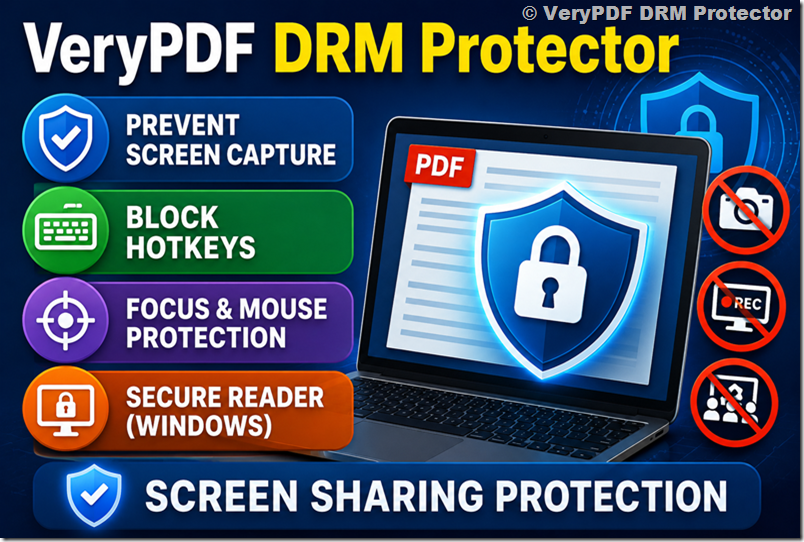
5.6 Anti-Screenshot and Anti-Print Controls

Advanced DRM features include:

  • Screenshot blocking
  • Screen recording prevention
  • Print restriction or watermarking

This significantly reduces content extraction.


5.7 Online & Offline Access Control

You can define:

  • Whether content requires internet validation
  • How long offline access is allowed

This balances:

  • Security
  • User convenience

5.8 Remote Revocation

This is one of the most powerful features.

You can:

  • Revoke access instantly
  • Disable specific users
  • Shut down compromised files

Traditional PDFs cannot do this.


5.9 Usage Tracking & Analytics

You gain visibility into:

  • Who opened the file
  • When and where it was accessed
  • Usage patterns

This provides actionable intelligence:

  • Identify suspicious behavior
  • Detect abuse early

6. Practical Scenario: Your Client’s eBook Launch

Let’s map this directly to your use case.

Without DRM:

1 purchase → shared in WhatsApp → unlimited free distribution

With DRM:

1 purchase → access restricted to:

  • 1–2 devices
  • Authorized user only
  • Time-limited session

If shared:

  • Others cannot open it
  • Access is denied

If leaked:

  • Watermark identifies the source
  • Access can be revoked

7. Implementation Strategy (Step-by-Step)

Here’s a practical rollout plan.


Step 1: Convert the eBook into DRM-Protected Format

Using VeryPDF DRM Protector:

  • Upload the PDF
  • Apply encryption
  • Convert to protected format

Step 2: Configure Access Rules

Define:

  • Device limit (e.g., 2 devices)
  • Expiry (e.g., 30 days or lifetime license)
  • Offline access duration

Step 3: Apply Dynamic Watermarks

Include:

  • Buyer name
  • Email address
  • Purchase ID

Make it visible but non-intrusive.


Step 4: Distribute Securely

Instead of sending raw files:

  • Deliver via secure download
  • Or controlled viewer access

Step 5: Monitor Usage

Track:

  • Access frequency
  • Device patterns
  • Suspicious behavior

Step 6: Enforce When Necessary

If abuse is detected:

  • Revoke access
  • Disable accounts
  • Update permissions

8. Balancing Security vs. User Experience

A common concern is:

“Will this make it harder for legitimate buyers?”

The answer depends on configuration.

Best practices:

  • Allow 1–2 devices per user
  • Enable limited offline access
  • Keep onboarding simple

The goal is:

Friction for pirates, not for customers.


9. Why DRM Is Superior to “Simple Deterrence”

Let’s compare approaches.

Method

Prevent Sharing

Deter Sharing

Control Access

Revoke Access

Password PDF

Watermark Only

DRM (VeryPDF)

This is why DRM is the only comprehensive solution.


10. Addressing Common Objections

“People can still screen record”

Yes, but:

  • It’s harder
  • Quality is reduced
  • Watermarks expose them

“Users don’t like special viewers”

Most users accept:

  • Netflix-style access control
  • App-based reading environments

Expectation has shifted.

“It’s not 100% secure”

Correct.

But security is about:

Raising the cost of abuse beyond convenience


11. Strategic Insight: Think Like a Platform, Not a File Sender

The biggest shift is conceptual.

Instead of:

“I’m selling a PDF file”

Think:

“I’m selling controlled access to content”

This mindset aligns with:

  • Streaming platforms
  • Online courses
  • Subscription models

12. Final Recommendation

For your client’s upcoming eBook launch:

  1. Do not rely on standard PDFs
  2. Avoid password-only protection
  3. Use watermarking, but not alone
  4. Implement DRM for real control

The most practical and scalable approach is to adopt a system like VeryPDF DRM Protector, which combines:

  • Strong technical enforcement
  • Psychological deterrence
  • Operational control

Conclusion

You cannot stop people from attempting to share a PDF, but you can:

  • Make sharing ineffective
  • Make access controlled
  • Make leaks traceable
  • Make abuse reversible

That is the difference between basic protection and professional-grade content security.

If your client is serious about protecting revenue, brand value, and intellectual property, then transitioning from open PDF distribution to DRM-controlled delivery is not just an option, it is a necessity.

Best 4 Methods to Protect Your eBook from Piracy, Copying, and Illegal Distribution

Creating an eBook requires significant time, expertise, and creative effort. Whether you are an independent author, educator, or publisher, protecting your digital content from unauthorized sharing and piracy is essential. As online distribution becomes easier, so does the risk of your work being copied, redistributed, or even sold without your permission.

To safeguard your intellectual property, you need a combination of modern security technologies and smart publishing practices. Below are four of the most effective ways to protect your eBook from piracy.

Best 4 Methods to Protect Your eBook from Piracy, Copying, and Illegal Distribution


1. Use Professional DRM Protection

Digital Rights Management (DRM) is the most powerful and reliable method for preventing unauthorized access and distribution of eBooks. DRM technology allows you to control exactly how your content is used after it is delivered to readers.

With DRM, you can:

  • Restrict copying, printing, and sharing
  • Limit access to specific devices or users
  • Set expiration dates for access
  • Prevent screen capture and redistribution

A leading solution in this space is VeryPDF DRM Protector, which provides advanced document security tailored for eBooks, training materials, and confidential documents.

Unlike basic protection tools, VeryPDF DRM Protector uses strong encryption and flexible permission controls to ensure that only authorized users can open and view your eBook. It also supports dynamic licensing, allowing you to revoke access at any time if misuse is detected.

You can explore and test the system online here: VeryPDF DRM Protector Online

This level of control makes DRM the foundation of any serious anti-piracy strategy.


2. Apply Smart Watermarking

Watermarking is another highly effective technique that complements DRM protection. It involves embedding identifying information into each copy of your eBook.

There are two main types:

Visible Watermarks

These include:

  • Buyer’s name
  • Email address
  • Purchase date

Visible marks act as a psychological deterrent. When users know their copy is traceable, they are far less likely to share it illegally.

Invisible Watermarks

Invisible (forensic) watermarks are hidden within the file and cannot be easily removed. If your eBook appears on piracy websites, you can trace it back to the original buyer.

VeryPDF DRM Protector includes advanced watermarking features (such as dynamic watermark overlays), allowing you to protect content without compromising readability or user experience.


3. Add a Clear Copyright Notice

While technology plays a key role, legal protection is equally important. Including a clear copyright notice in your eBook reinforces your ownership and warns users against misuse.

A standard copyright notice should include:

  • © symbol
  • Year of publication
  • Author or publisher name
  • Usage restrictions

For example:
“© 2026 Your Name. All rights reserved. No part of this publication may be reproduced or distributed without permission.”

This serves several purposes:

  • Establishes legal ownership
  • Acts as evidence in disputes
  • Deters casual piracy
  • Educates readers about proper usage

Although it won’t stop determined pirates on its own, it strengthens your overall protection strategy when combined with DRM.


4. Distribute Your eBook as a Secure PDF

PDF remains one of the most widely used formats for distributing eBooks, especially when combined with security features.

Key Advantages of Secure PDF:

Consistent Layout
Your fonts, images, and formatting remain unchanged across all devices.

Password Protection
You can restrict access with passwords to prevent unauthorized viewing.

Permission Controls
Disable copying, editing, or printing to limit misuse.

Digital Signatures
Ensure authenticity and prevent tampering.

However, basic PDF passwords are often easy to bypass with free tools. This is why combining PDF format with DRM protection (such as VeryPDF DRM Protector) is far more secure than relying on passwords alone.


Additional Tips to Strengthen eBook Security

To further reduce piracy risks, consider these best practices:

  • Monitor the Internet: Regularly search for unauthorized copies of your eBook
  • Keep Records: Maintain proof of ownership and distribution history
  • Educate Your Audience: Inform readers about copyright laws and ethical use
  • Use Controlled Distribution: Avoid sending raw files via email or public links

Conclusion

Protecting your eBook from piracy requires a layered approach. No single method is enough on its own, but combining DRM protection, watermarking, copyright notices, and secure PDF distribution creates a strong defense system.

Among these strategies, DRM stands out as the most effective solution—and tools like VeryPDF DRM Protector provide everything you need in one platform.

With powerful encryption, flexible access control, and built-in watermarking, VeryPDF DRM Protector allows you to confidently publish and distribute your eBook without worrying about unauthorized sharing.

Start protecting your digital content today by trying: VeryPDF DRM Protector Free Online Application

How to host DRM Protected .vpdf file to your own server and view it online by VeryPDF Secure Online Reader

Protecting your intellectual property and sensitive documents has become more important than ever. Whether you are sharing proprietary research, educational materials, business reports, or copyrighted content, keeping your PDF files secure and accessible only to authorized users is essential. VeryPDF DRM Protector offers a complete solution by enabling you to create .vpdf files, a secure, DRM-protected PDF format that safeguards your content against unauthorized access and distribution.

Many users, however, encounter challenges when trying to host .vpdf files on their own server, such as Superhosting, and make them accessible through the VeryPDF Secure Online Reader. The process may seem confusing, especially for those unfamiliar with server operations or DRM technology. This guide provides a complete, step-by-step workflow to host .vpdf files on your own server, create secure online access links, and ensure a smooth experience for your users.

How to host DRM Protected .vpdf file to your own server and view it online by VeryPDF Secure Online Reader


Understanding .vpdf Files and DRM Protection

Before diving into the hosting steps, it is important to understand what a .vpdf file is and why it is different from a regular PDF:

  • .vpdf is a proprietary file format created by VeryPDF to protect PDF content.
  • It incorporates DRM rules, including view-only, print-only, watermarking, expiration, and user-specific password protection.
  • Unlike standard PDF files, .vpdf cannot be opened with Adobe Acrobat or other PDF readers. Only VeryPDF Secure Online Reader or VeryPDF desktop readers can open them.
  • This ensures that sensitive content cannot be easily copied, printed, or shared without your permission.

Using .vpdf files is particularly useful for organizations distributing paid content, course materials, or confidential reports. Combined with your own server, it gives you full control over file distribution while providing users a seamless online reading experience.


Step 1: Upload Your PDF and Configure DRM Settings

The first step in creating a secure .vpdf file is uploading your PDF to VeryPDF and configuring DRM options. Here’s a detailed workflow:

  1. Login to VeryPDF Account
    Access your VeryPDF account using your credentials. If you do not have an account, register on the VeryPDF website and verify your email.
    https://drm.verypdf.com/wp-admin/admin.php?page=VeryPDFDRMFiles
  2. Upload PDF File
    • Go to VeryPDF DRM Online App web page,
    • https://drm.verypdf.com/online/
    • Select the PDF file from your computer. VeryPDF supports standard PDF formats, including text-based PDFs and image-based PDFs generated from scans.
  3. Configure DRM Settings
    VeryPDF allows you to configure several DRM options:
    • View permissions: Control whether users can read the file online. You can restrict the file to view-only mode.
    • Print permissions: Allow or deny printing. You can enable print-only mode if necessary.
    • User authentication: Set usernames and passwords for individual users. Each .vpdf file can have unique access credentials.
    • Watermarking: Apply dynamic or static watermarks to discourage unauthorized sharing.
    • Expiration: Set expiration dates for access if you want the file to be available for a limited time.
    • Device restrictions: Limit access to specific devices or IP addresses if needed.
  4. Generate .vpdf File
    After configuring your DRM options, click Generate. VeryPDF will create a .vpdf file that encapsulates your PDF content and all DRM rules.

Note: At this stage, the .vpdf file resides in your VeryPDF account. It is not yet available on your local system or your own server.


Step 2: Download .vpdf File to Your Local System

To host the file on your own server, you must first download it to your local computer. This step is crucial because hosting servers cannot directly access files stored in VeryPDF accounts.

  1. Navigate to your VeryPDF DRM Files in VeryPDF DRM Account.
  2. https://drm.verypdf.com/wp-admin/admin.php?page=VeryPDFDRMFiles
  3. Click Download menu item to download the .vpdf file.

    How to host DRM Protected .vpdf file to your own server and view it online by VeryPDF Secure Online Reader

  4. Save the file in a convenient location, such as your Desktop or Downloads folder.

Tip: Create a dedicated folder for .vpdf files on your computer to keep your protected content organized and easily accessible.

At this stage, your .vpdf file is on your local system and ready for upload to your server.


Step 3: Prepare Your Server for Hosting

Before uploading, ensure your server environment is ready to host .vpdf files. This guide uses Superhosting as an example, but the steps are similar for other hosting providers.

  1. Log in to Your Hosting Account
    Access the Superhosting dashboard with your credentials.
  2. Select Subdomain or Folder
    • Decide where you want to host your .vpdf file.
    • You may create a dedicated subdomain such as books.yourdomain.com or a folder like /protected/.
  3. Check Permissions
    • Ensure that the folder has the correct permissions for public access.
    • Users must be able to reach the .vpdf file via its URL, but only authorized users should be able to open it using VeryPDF Online Reader credentials.

Tip: If you are unsure about folder permissions, contact your hosting provider or moderator for guidance.


Step 4: Upload .vpdf File to Server

Now, upload the .vpdf file you downloaded in Step 2:

  1. Navigate to the folder or subdomain you selected.
  2. Click Add File or Browse, then select the .vpdf file from your local system.
  3. Wait for the file to upload completely.

After upload, the file will have a public URL. For example:

https://yourdomain.com/books/yourbook.vpdf

Important: The public URL is necessary to create the secure link for users.


Step 5: Create VeryPDF Secure Online Reader Link

Once your .vpdf file is hosted on your server, you need to create a link that allows users to access it securely through VeryPDF Online Reader.

  1. Copy your .vpdf file URL from your server.
  2. Combine the URL with the VeryPDF Online Reader address and the user credentials.
    Example format:

https://online.verypdf.com/app/reader2/reader.php?url=https://yourdomain.com/books/yourbook.vpdf&username=User001&password=123456

  1. This URL acts as a secure portal. Users who click it will be prompted for credentials and can view the file according to the DRM settings you configured (view-only, print-only, etc.).

Note: Each user can have unique credentials. You can generate multiple links for different users while maintaining file protection.


Step 6: Share the Link with Users

Once the link is ready:

  1. Send the URL to your authorized users via email or another secure channel.
  2. Provide instructions for accessing the file, such as entering their username and password.
  3. Users can open the .vpdf file in VeryPDF Secure Online Reader without downloading or installing additional software.

Benefit: The content remains protected, and you retain full control over file distribution.


Step 7: Verify and Troubleshoot

Before sharing widely, it is important to verify that everything works correctly:

  1. Test the Link
    • Log in as a test user to ensure the link opens the .vpdf file.
    • Confirm that the DRM permissions are enforced correctly.
  2. Check Server Accessibility
    • Ensure the .vpdf file is accessible via its public URL.
    • Verify that firewall or server settings are not blocking access.
  3. Troubleshoot Common Issues
    • File not appearing in Browse menu: Ensure you have downloaded it locally first.
    • Access denied: Check folder permissions on the server.
    • Credentials not working: Reconfirm username and password settings in VeryPDF.

Tip: Keep local backups of .vpdf files in case you need to re-upload or share additional links.


Advanced Tips and Best Practices

  • Organize Your Files: Store .vpdf files in a structured folder hierarchy on your server, e.g., /protected/books/2026/.
  • Maintain File Naming Consistency: Use clear and descriptive file names for easy identification.
  • Regular Backups: Keep copies of .vpdf files locally in case of server failure or accidental deletion.
  • Monitoring Access: Some hosting providers allow logging of file downloads or access attempts. Monitor this to ensure only authorized users are accessing your content.
  • Update DRM Settings When Needed: You can regenerate .vpdf files if you need to change permissions, watermarks, or expiration dates.

Benefits of Hosting .vpdf Files on Your Own Server

  1. Full Control Over Content
    • You decide where files are hosted, who can access them, and for how long.
  2. Secure Distribution
    • Files remain protected by DRM even if the public URL is exposed.
  3. Seamless User Experience
    • Users can open the file online without additional software.
    • VeryPDF Online Reader enforces DRM rules automatically.
  4. Scalable for Multiple Users
    • Assign unique credentials for each user.
    • Support multiple files and users on the same server efficiently.
  5. Integration with Your Existing Systems
    • Hosted .vpdf files can be integrated with websites, online courses, or subscription services.

Conclusion

Hosting DRM-protected .vpdf files on your own server and viewing them online using VeryPDF Secure Online Reader combines the flexibility of self-hosting with the robust security of VeryPDF DRM. By following the steps outlined in this guide, generate .vpdf, download locally, upload to server, create Secure Online Reader link, and share with users, you can confidently distribute sensitive PDFs while maintaining full control over access and permissions.

This workflow is ideal for educators, businesses, authors, and any organization that needs to securely distribute PDF content online. With careful implementation, .vpdf files offer a professional and reliable method to protect intellectual property and ensure secure online viewing.

Secure PDF Sharing: How to Protect PDF Files Using Advanced Methods

In today’s digital world, sensitive documents are constantly at risk. Businesses, researchers, educators, and individuals regularly share critical information in digital formats, and PDF files have become the standard for secure, consistent document distribution. However, the portability and accessibility of PDFs also make them vulnerable to unauthorized access, copying, or distribution. Protecting PDF files is no longer optional—it is a necessity for safeguarding intellectual property, confidential reports, legal documents, and proprietary data.

In this article, we will explore the different ways to protect PDF files, from basic methods like passwords and watermarks to advanced solutions such as Digital Rights Management (DRM) software. We will also examine the strengths and limitations of each method to help you choose the most appropriate protection strategy for your needs.

Secure PDF Sharing: How to Protect PDF Files Using Advanced Methods


Why Protect PDF Files?

Before discussing specific protection methods, it is important to understand why PDF protection matters. PDFs are widely used because they preserve the original formatting of a document across platforms, making them ideal for business contracts, financial reports, research papers, and intellectual property materials. However, this convenience comes with risks:

  1. Unauthorized Access: Sensitive PDFs can be accessed by anyone if not properly protected. This could include competitors, hackers, or even accidental recipients.
  2. Intellectual Property Theft: PDFs often contain proprietary content, such as research findings, product designs, or confidential reports. Without protection, unauthorized individuals can copy, modify, or redistribute this content.
  3. Uncontrolled Distribution: PDFs are easily forwarded or uploaded to file-sharing platforms. Businesses may lose control over who can view, copy, or print their documents.
  4. Revenue Loss: For companies distributing premium content, uncontrolled sharing of PDFs can reduce subscription revenue or compromise pay-per-view models.

Proper PDF protection ensures confidentiality, integrity, and control over your content, allowing businesses and individuals to share files securely.


Methods for Protecting PDF Files

There are several techniques for securing PDFs. Each has its own strengths and limitations. Let’s examine them in detail.

1. Protect PDFs with Passwords

Password protection is one of the simplest and most widely used methods for securing PDF files. By requiring a password to open the document, you restrict access to authorized users only. Here’s how it works:

  • Encryption: The PDF file is encrypted using a password. Only users with the correct password can open and read the document.
  • Implementation: Most PDF software, including Adobe Acrobat and free PDF tools, allow you to set passwords easily.

Advantages of Password Protection:

  • Easy to implement and understand.
  • Provides a basic barrier to unauthorized access.
  • Works well for small-scale sharing.

Limitations:

  • Passwords can be shared, reducing security.
  • Does not prevent printing, copying, or screen capture.
  • Cannot track who accessed the file or how it was used.

Best Practices:

  • Use strong, unique passwords (mix letters, numbers, and symbols).
  • Do not share passwords via insecure channels like email or chat.
  • Regularly update passwords for highly sensitive documents.

While password protection is useful for basic security, it is not sufficient for sensitive or high-value PDFs.


2. Protect PDFs with Watermarks

Watermarking adds visible or invisible identifiers to PDF files to discourage unauthorized sharing. Watermarks can include:

  • Company logos or brand names
  • Labels such as “Confidential” or “Internal Use Only”
  • Invisible digital markers that uniquely identify recipients

Advantages of Watermarks:

  • Reinforces ownership and copyright.
  • Acts as a deterrent against unauthorized redistribution.
  • Invisible watermarks can help trace leaks back to specific recipients.

Limitations:

  • Watermarks do not prevent access—they only discourage misuse.
  • Users can still copy or share files.
  • May not stop screen capturing or digital photography.

Watermarks are best used in conjunction with other protection methods, such as DRM or encryption, rather than as a standalone solution.


3. Protect PDFs with Encryption

Encryption encodes the content of a PDF so that it can only be read by authorized users. Even if the file is intercepted, its contents remain inaccessible without the decryption key. Common encryption methods include AES (Advanced Encryption Standard) with 128-bit or 256-bit keys.

How PDF Encryption Works:

  1. The PDF content is scrambled using a complex algorithm.
  2. A decryption key (usually a password or passphrase) is required to decode the content.
  3. Unauthorized users cannot access the readable content without the key.

Advantages:

  • Strong protection against unauthorized access.
  • Widely supported across PDF software.
  • Can prevent casual breaches and file tampering.

Limitations:

  • Like passwords, decryption keys can be shared.
  • Does not prevent printing, copying, or screen capturing.
  • Cannot track usage or enforce dynamic access policies.

Encryption is highly effective for basic confidentiality, but for advanced security needs, more robust solutions are required.


4. Protect PDFs with Digital Rights Management (DRM)

Digital Rights Management (DRM) is the most comprehensive and advanced method for protecting PDF files. DRM software combines encryption, access control, watermarking, and usage management into a single solution. It allows content owners to define who can access a PDF, how it can be used, and for how long.

Key Features of PDF DRM:

  • Access Control: Limit access to specific users or groups.
  • Print and Copy Restrictions: Prevent unauthorized printing, copying, or editing.
  • Dynamic Watermarking: Embed user-specific watermarks that are invisible until the PDF is opened.
  • Expiration and Revocation: Set time limits or revoke access at any time.
  • Tracking and Reporting: Monitor document usage, including views, prints, and attempted breaches.

Benefits of DRM for PDF Protection:

  1. Granular Control: Assign different access rights to individual users, such as view-only, print-limited, or time-bound access.
  2. Enhanced Security: Combine encryption, watermarks, and access control to prevent unauthorized use.
  3. Compliance: Meet regulatory requirements for healthcare, finance, and legal sectors.
  4. Revenue Protection: Secure premium content to enable subscriptions, pay-per-view access, or licensing without fear of piracy.
  5. Tracking and Auditing: Gain insights into document usage for security assessments and compliance audits.

Why DRM Outperforms Other Methods:
Unlike simple passwords or watermarks, DRM ensures that your PDF remains secure throughout its lifecycle, even after distribution. Unauthorized users cannot open, copy, or share the document, and content owners can revoke access or track usage in real time.


Choosing the Right PDF Protection Strategy

Selecting the appropriate method depends on the sensitivity of your documents, regulatory requirements, and distribution needs. Here’s a practical guideline:

Method

Best Use Case

Strength

Limitation

Password

Low-sensitivity documents, internal sharing

Simple, easy to implement

Passwords can be shared; no usage tracking

Watermark

Brand ownership, discouraging sharing

Visual deterrent; can trace leaks

Does not prevent access

Encryption

Sensitive content during transmission

Strong confidentiality

Keys can be shared; no usage tracking

DRM

High-value, confidential, or commercial content

Comprehensive control, tracking, usage policies

Requires setup and software licensing

For organizations handling confidential business reports, premium content, or intellectual property, DRM is the most reliable choice, providing full control and robust protection.


Implementing DRM for PDF Files

To implement DRM protection effectively:

  1. Choose a DRM Solution: Select a software provider that offers PDF DRM with encryption, watermarking, and access management.
  2. Define Policies: Decide who can access the document, whether printing or copying is allowed, and set expiration dates if necessary.
  3. Encrypt and Distribute: Protect PDFs with DRM encryption and distribute them securely.
  4. Monitor Usage: Use tracking features to ensure compliance and identify potential misuse.
  5. Update Access Controls: Revoke access or adjust permissions as needed.

Example: A company distributing confidential financial reports can use DRM to allow only executive team members to view the files, prevent printing, and track who opens each report.


Conclusion

Protecting PDF files is a critical step in securing sensitive information in an increasingly digital world. While passwords, watermarks, and encryption provide basic protection, they are limited in scope. Digital Rights Management (DRM) software offers advanced features for comprehensive PDF protection, allowing organizations and individuals to control access, usage, and distribution effectively.

By leveraging DRM, content owners can:

  • Safeguard intellectual property
  • Prevent unauthorized access and piracy
  • Maintain compliance with regulatory standards
  • Monitor document usage and detect potential breaches

In summary, if your PDFs contain sensitive, proprietary, or revenue-generating content, investing in DRM solutions is the most secure and reliable way to protect your digital assets.

[Solution] How to Enforce Secure "Print-Only" PDF Access, No On-Screen Viewing and Block Virtual Printers with VeryPDF DRM Protector

In today’s digital environment, organizations distributing sensitive documents, such as training materials, confidential reports, or licensed content, face a critical challenge: how to allow necessary usage (like printing) without risking unauthorized copying, redistribution, or leakage.

For enterprises operating across multiple locations or global centers, this challenge becomes even more complex. Traditional PDF protection methods, such as passwords or basic restrictions, are no longer sufficient. Users can easily bypass these protections using screen capture tools, virtual printers, or file conversion utilities.

This is where VeryPDF DRM Protector provides a powerful and flexible solution.

[Solution] How to Enforce Secure "Print-Only" PDF Access, No On-Screen Viewing and Block Virtual Printers with VeryPDF DRM Protector


The Core Security Challenge

Many organizations require a very specific level of control:

  • Prevent users from saving documents as new PDF files via virtual printers
  • Allow printing only to authorized physical printers
  • Restrict how many times a document can be printed
  • In some cases, completely prevent on-screen viewing while still allowing printing

These requirements are especially common in:

  • Educational institutions distributing exam materials
  • Corporate environments handling confidential reports
  • Training centers providing licensed content
  • Government or compliance-driven organizations

Blocking Virtual PDF Printers: A Critical Security Layer

One of the most common ways users bypass document protection is by “re-printing” a PDF using virtual printers such as:

  • Microsoft Print to PDF
  • Adobe PDF
  • XPS Document Writer

This effectively creates a new, unprotected copy of the document.

How VeryPDF DRM Protector Solves This

VeryPDF DRM Protector includes a robust virtual printer blocking mechanism:

  • ✅ Allows printing to physical printers only
  • ❌ Blocks all virtual printers (PDF, XPS, PS, PCL, etc.)
  • Prevents regeneration of digital copies through printing

This protection is enforced at the system level, ensuring that users cannot bypass it through standard operating system tools.

For step-by-step configuration guidance, you can refer to:


Enforcing “Print Only” Mode (No On-Screen Viewing)

In high-security scenarios, simply restricting copying is not enough. Some organizations require that:

Users should NOT be able to view the document on screen, but SHOULD be able to print it.

This is known as “Print Only” Mode.

Supported by VeryPDF DRM Protector

VeryPDF DRM Protector supports this advanced requirement through a specialized configuration:

  • On-screen content viewing is blocked or masked
  • ️ Printing is allowed under controlled conditions
  • Print count limits can be enforced (e.g., 1 print per user)
  • Content is only rendered securely during the printing process

This ensures that:

  • Users cannot read, screenshot, or record the document
  • The only way to access content is through a controlled physical print

Print Count Control: Limiting Document Usage

Another critical feature is print count limitation, which allows you to define exactly how many times a document can be printed.

Key Capabilities

  • Set maximum number of prints per user
  • Track printing activity
  • Prevent excessive or unauthorized duplication
  • Combine with expiry dates or user authentication

For example:

  • A training manual can be printed only once
  • An exam paper can be printed a limited number of times per center
  • A licensed document can have strict usage quotas

Flexible Permission Modes

VeryPDF DRM Protector provides multiple permission configurations to suit different use cases:

Mode

Description

View Only

Users can read but cannot print

View + Print

Standard controlled access

Print Only

No screen viewing, print-only access

Limited Access

Control by view count, print count, or expiration

This flexibility allows organizations to tailor security policies based on their operational needs.


Why Traditional PDF Protection Is Not Enough

Standard PDF security (such as passwords or “no print” flags) can be easily bypassed using:

  • Screenshot tools
  • PDF converters
  • Virtual printers
  • File extraction software

In contrast, VeryPDF DRM Protector uses:

  • Strong encryption
  • Secure document viewers
  • Hardware-aware print control
  • Dynamic permission enforcement

This creates a closed and controlled document environment, significantly reducing the risk of data leakage.


Ideal Use Cases

VeryPDF DRM Protector is particularly effective for:

  • Global training organizations
  • Educational institutions
  • Certification providers
  • Enterprises handling confidential documentation
  • Content publishers protecting intellectual property

Conclusion

If your organization needs to:

  • Block virtual PDF printers
  • Allow printing only to physical devices
  • Enforce strict print count limits
  • Enable secure “Print Only” access without on-screen viewing

Then VeryPDF DRM Protector offers a comprehensive and enterprise-ready solution.

To explore the full capabilities and test the system, visit: