
In today’s digital environment, PDF documents are widely used for education, corporate training, compliance distribution, research publication, and paid content delivery. However, while PDFs are easy to distribute and open, they have traditionally provided very limited insight into how users actually interact with the content.
Most traditional PDF tracking systems can only answer basic questions such as: Was the file opened? When was it opened? Was it downloaded or printed? These metrics are no longer sufficient for organizations that need to understand real user engagement.
To solve this gap, Heartbeat Tracking in VeryPDF DRM Protector introduces a much deeper level of document intelligence. It transforms static PDF access logs into continuous behavioral insights that reflect how users truly read a document.
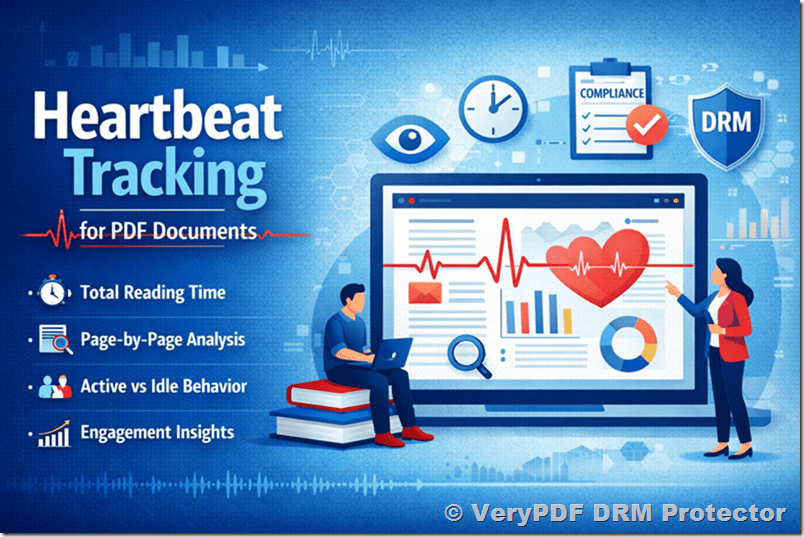
1. The Core Problem: Opening a PDF Does Not Mean Reading It
One of the biggest misconceptions in digital document distribution is assuming that an “open event” equals “reading behavior”.
In reality, users often:
- Open a document and close it within seconds
- Leave the file open in the background without reading
- Skip large portions of content
- Jump directly to specific pages without context
- Download files but never actually engage with them
For publishers, educators, and enterprises, this creates a serious blind spot. They cannot reliably answer:
- Did the user actually read the material?
- How deeply did they engage with it?
- Which parts of the document were actually consumed?
Heartbeat Tracking directly addresses this problem by continuously measuring user interaction over time.
2. What Is Heartbeat Tracking?
Heartbeat Tracking is a behavior-based monitoring system that periodically records user engagement signals while a PDF is open. Instead of relying on single events (like open/close), it collects ongoing “heartbeat” signals that reflect real-time activity.
These signals allow the system to reconstruct reading behavior with much higher accuracy.
Rather than simply recording access, it observes:
- Whether the document window is active
- Whether the user is interacting with the page
- Whether reading is continuous or interrupted
- How long each section of the document is actually viewed
This transforms PDF analytics from static logs into dynamic reading intelligence.
3. Key Insights Provided by Heartbeat Tracking
3.1 Total Reading Time per Document
One of the most important metrics is total reading duration. Unlike simple session duration, Heartbeat Tracking distinguishes between:
- Active reading time
- Idle or background time
This ensures a more realistic measurement of actual engagement.
Business value:
- Training completion validation
- Content consumption analysis
- User engagement scoring
3.2 Time Spent on Each Page
Heartbeat Tracking records how long a user stays on each page of a document.
This provides a page-level breakdown such as:
- Which pages were carefully read
- Which pages were skipped quickly
- Which pages were revisited multiple times
Business value:
- Identify the most important or confusing sections
- Improve educational materials
- Optimize document structure based on real usage
3.3 Active vs Idle Reading Behavior
A critical improvement over traditional tracking is the ability to distinguish between active reading and passive open sessions.
For example:
- If a user leaves the document open but switches tabs, the system detects inactivity
- If there is no interaction for a period of time, it is marked as idle
- Only active engagement is counted as meaningful reading time
Business value:
- Prevent false compliance reporting
- Ensure accurate engagement measurement
- Improve trust in analytics data
3.4 Page Navigation Patterns
Heartbeat Tracking also records how users move through the document:
- Sequential reading (page 1 → page 2 → page 3)
- Skipping behavior (jumping to later sections)
- Back-and-forth navigation (review behavior)
Business value:
- Understand user reading strategies
- Detect confusing or high-interest sections
- Improve document design and structure
3.5 Engagement Signals and Reading Depth
Beyond time and navigation, engagement signals provide a deeper layer of insight:
- Whether the document is in focus
- Whether the user is actively scrolling or interacting
- Whether the user returns to previous sections
This helps estimate reading depth rather than just surface interaction.
Business value:
- Measure content effectiveness
- Identify highly engaging sections
- Support premium content pricing models
4. Key Customer Pain Points Solved
Heartbeat Tracking is not just a technical feature—it directly addresses several critical business problems.
4.1 “We don’t know if users actually read the document”
This is the most common and important pain point.
Traditional systems only confirm access, not attention.
Heartbeat Tracking solves this by providing:
- Active reading time
- Page-by-page engagement
- Idle detection
So organizations can finally distinguish between opened and read.
4.2 Lack of visibility into content engagement
Without detailed analytics, content providers cannot answer:
- Which parts are valuable?
- Which sections are ignored?
- Where do users lose interest?
Heartbeat Tracking provides granular insights that help optimize content quality.
4.3 Compliance and training verification challenges
In corporate training and education, compliance is critical.
Organizations need to prove that:
- Employees completed training
- Students actually engaged with learning materials
- Mandatory reading requirements were met
Heartbeat Tracking provides structured evidence of engagement, not just access logs.
4.4 Inefficient content design decisions
Without behavioral data, content improvement is based on assumptions.
With Heartbeat Tracking, organizations can:
- Identify weak sections
- Improve document structure
- Optimize learning flow
This leads to better user outcomes and more effective communication.
4.5 Uncertainty in paid content value
For publishers and digital content sellers, a key question is:
“Are users actually consuming what they paid for?”
Heartbeat Tracking helps measure real consumption, supporting:
- Subscription models
- Premium content pricing
- Usage-based insights
5. Why Heartbeat Tracking Matters
The shift from basic tracking to heartbeat-based analytics represents a fundamental change:
- From “file access” → “reading behavior”
- From “download metrics” → “engagement intelligence”
- From “static logs” → “continuous monitoring”
This allows organizations to finally understand the real value of their documents.
6. Conclusion
Heartbeat Tracking transforms PDF documents from passive files into measurable learning and engagement systems. By capturing real user behavior—such as reading time, page engagement, activity levels, and navigation patterns—it solves one of the most persistent problems in digital document distribution: the lack of visibility into actual reading behavior.
With this capability, organizations can improve education effectiveness, ensure compliance, optimize content design, and better understand user engagement at a granular level.
In short, it answers a question that traditional PDF systems have never been able to answer well:
Not just “Was it opened?” but “Was it actually read?”