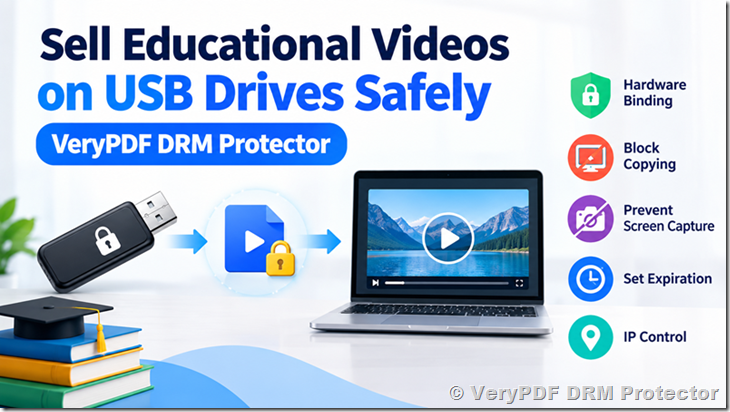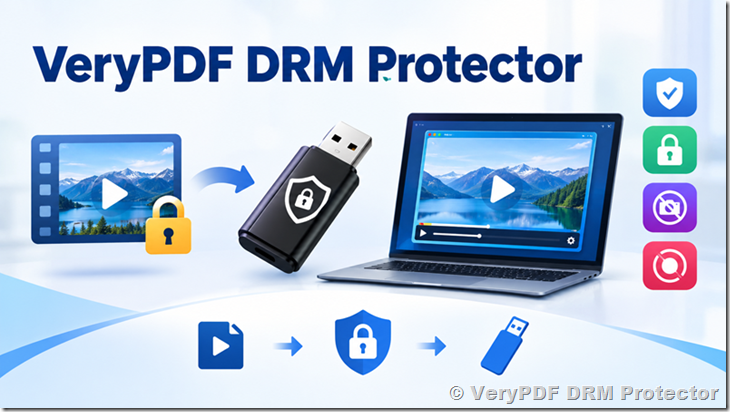
If your company creates valuable marketing videos, product demonstrations, training materials, product manuals, CAD files, images, or other digital content, delivering the files on a USB drive can be convenient.
But there is a serious problem.
Once you give someone a normal USB drive, you have very little control over what happens to your files.
They can copy the files to another USB drive, save them to their computer, send them through email, upload them to cloud storage, or share them with someone else.
For a company that has spent weeks or months creating 3GB or 4GB of valuable content, this can be a real concern.
So, how can you deliver large digital content on a USB drive while making unauthorized copying and redistribution much harder?
One option is to use a DRM-protected USB drive, such as VeryPDF DRM Protector.
Why a Normal USB Drive Is Not Enough
A standard USB flash drive is basically a portable storage device.
You copy your files onto it, give it to your partner or customer, and they can usually access the files using the normal operating system.
For example, imagine that you have created a USB drive containing:
| Content | Example size |
|---|---|
| Marketing videos | 2.5 GB |
| Product images | 500 MB |
| PDF manuals | 100 MB |
| Product presentations | 300 MB |
| Training materials | 600 MB |
| Total | 4 GB |
You send the USB drive to a business partner.
The partner can open the drive and copy everything to their computer.
After that, you have lost control of the files.
They may also:
- Copy the files to another USB drive
- Upload them to Google Drive or another cloud service
- Send them to another company
- Put the files on a shared network
- Copy videos to another computer
- Print PDF documents
- Take screenshots
- Extract images from presentations
- Keep the files after the business relationship ends
The problem is not the USB drive itself.
The problem is that normal USB storage gives the recipient direct access to the original files.
What If I Use a CD or DVD Instead?
CDs and DVDs may seem like an alternative, especially if you want to distribute content that should not be changed.
But they have several limitations.
Storage capacity is one of the biggest problems.
A large collection of high-quality marketing videos can easily reach several gigabytes. A normal CD cannot hold that much data, and even DVDs may not provide enough space for a large content package.
There is also another problem:
A physical disc does not automatically provide DRM protection.
If someone can access the original files on the disc, they may be able to copy them to their computer or create another copy of the disc.
So simply changing the physical storage medium does not solve the main problem.
A Better Approach: DRM-Protected USB Distribution
A DRM-protected USB drive takes a different approach.
Instead of treating the USB drive as ordinary storage, the content is protected by security controls that limit what the recipient can do with the files.
This can be useful when you need to distribute:
- Marketing videos
- Product videos
- Training videos
- PDF manuals
- eBooks
- Product catalogs
- Presentations
- CAD files
- Design files
- Images
- Audio files
- Software
- Technical documentation
- Educational materials
- Confidential business information
VeryPDF DRM Protector can be used for secure USB content distribution and USB copy protection.
The basic idea is simple:
Give your customer access to the content they need, while limiting common ways of copying, modifying, printing, or redistributing that content.
What Can USB DRM Protect?
USB DRM can be useful for many different types of content.
| Content | Common protection concern |
|---|---|
| Marketing videos | Copying and redistribution |
| Training videos | Sharing with people who did not pay |
| PDF manuals | Copying, printing, and redistribution |
| Product catalogs | Unauthorized distribution |
| CAD drawings | Copying valuable designs |
| Presentations | Forwarding or saving copies |
| Images | Unauthorized reuse |
| Audio files | Copying and redistribution |
| Software | Unauthorized duplication |
| Technical documents | Sharing outside the organization |
This is especially useful when the USB drive is being physically distributed to partners, customers, students, dealers, employees, or other authorized users.
How Does USB Copy Protection Work?
With a normal USB drive, the operating system sees the drive as ordinary storage.
The user can normally browse folders and work with files using standard Windows or macOS functions.
A protected USB solution changes this model.
The content is encrypted and access is controlled by the protection system.
Depending on the configuration, you can control things such as:
- Who can access the content
- When the content can be used
- How long the content remains available
- Whether printing is allowed
- Whether copying is allowed
- Whether screenshots should be blocked
- Whether content can be moved or saved elsewhere
- Whether access should expire
This creates a much stronger distribution model than simply putting unprotected files on a flash drive.
Encrypt the Content on the USB Drive
One important part of USB content protection is encryption.
If valuable files are simply stored as normal files, someone who gets physical access to the USB drive may be able to copy those files.
With DRM protection, the content can be stored in protected form instead.
The goal is to make the protected content useful to an authorized user while preventing direct extraction of the original files.
This is particularly important for high-value content.
For example, imagine that a company spends $50,000 producing a professional training video series.
Putting those videos onto an ordinary USB drive means the recipient may be able to copy the original video files.
A protected USB distribution system can instead provide controlled access to the content.
Stop USB Content From Being Easily Copied
One of the main reasons companies look for USB copy protection is simple:
They don’t want the recipient to make another copy.
A DRM-protected USB solution can restrict common operations such as:
- Copy
- Paste
- Save As
- Move
- Delete
- File extraction
- Printing
- Screen capture
The exact protection available depends on the content type and the deployment configuration.
For example, a company distributing a product training video may want customers to watch the video but not receive the original video file.
A publisher distributing technical documentation may want users to read the documents but restrict printing and copying.
An engineering company may want to distribute design information to a partner without allowing the files to be freely duplicated.
The protection requirements are different, but the basic idea is the same:
Control access to the content instead of giving away the original files.
Protect More Than PDF Files
USB copy protection is not limited to PDF documents.
A valuable content package may contain many different file types.
For example:
Marketing USB
│
├── Product Videos
│   ├── product-demo.mp4
│   ├── installation-video.mp4
│   └── training-video.mp4
│
├── Product Documents
│   ├── product-manual.pdf
│   └── installation-guide.pdf
│
├── Marketing
│   ├── presentation.pptx
│   └── product-images.zip
│
└── Technical
    ├── specifications.pdf
    └── drawings.cad
A USB copy protection solution can be useful when a single distribution package contains different types of valuable content.
Common formats that may need protection include:
- DOC
- XLS
- PPT
- TXT
- EXE
- CAD
- PSD
- Video
- Audio
- Image files
This makes the approach useful for companies that distribute complete content packages rather than a single PDF.
Set an Expiration Date
Another useful feature is content expiration.
Suppose you send a marketing USB drive to a partner for a product launch.
You may want the content to be available for 90 days.
After that period, the content should no longer be accessible.
Without DRM, the customer could simply keep the files forever.
With an expiration rule, you can configure the protected content to stop working after a specified date or period, depending on the protection configuration.
This can be useful for:
- Temporary marketing campaigns
- Product launches
- Training courses
- Demonstration materials
- Trial content
- Event materials
- Temporary partner access
- Time-limited business documents
For example:
Access period: September 1 – December 31
After December 31, the protected content can become inaccessible according to the configured DRM rules.
Set Usage Limits
In some situations, an expiration date is not enough.
You may want to limit how the content can be used.
For example:
Allow access for 30 days.
Or:
Allow a maximum number of permitted uses.
Usage controls can be useful for temporary demonstrations, training materials, evaluation packages, and other content that should not remain available indefinitely.
This gives you more options than simply choosing between “available” and “not available.”
Restrict Printing and Copying
PDF manuals, presentations, and technical documents can contain valuable information.
If you allow unrestricted printing, a user may simply print the entire document and distribute the printed copies.
Depending on the DRM configuration, you can restrict printing and other operations.
You can also restrict clipboard operations to make ordinary text copying more difficult.
This can be especially useful for:
- Product manuals
- Training materials
- Internal documentation
- Technical specifications
- Course materials
- Business reports
What About Screenshots?
Screen capture is another common problem with digital content.
Even if a user cannot directly copy a file, they may try to capture the screen and save the information as images.
For protected content, screen-capture restrictions can provide another layer of protection.
No DRM system should be treated as a magic solution that makes copying absolutely impossible in every situation. A person can always use another camera or another physical device to record a screen.
However, blocking common software-based copying methods can make casual copying and redistribution much more difficult.
Hardware-Based USB Protection
There is another approach to USB security: putting part of the protection into the USB hardware itself.
This can provide a different security model from ordinary software-only encryption.
According to the VeryPDF DRM Protector USB Copy Protection design, protection can be implemented at the flash-memory-controller level.
The purpose is to reduce reliance on the normal operating system’s file-copy functions.
This is important because a common weakness of ordinary file encryption is that once a user decrypts a file for normal use, the operating system may have access to the resulting data.
A hardware-oriented DRM approach attempts to keep protected content inside a controlled environment while it is being accessed.
This can be particularly interesting for organizations distributing high-value digital assets through physical media.
Does the USB Need an Internet Connection?
For some DRM systems, online license checking is an important part of the design.
But physical USB distribution can also be used in environments where Internet access is limited or unavailable.
VeryPDF’s Copy Secure design is intended to support offline use, with authentication and expiration controls stored on the protected media rather than depending on a continuous connection to an online server.
This can be useful for:
- Offline training
- Trade shows
- Industrial environments
- Secure facilities
- Remote locations
- Public computers
- Air-gapped environments
The exact deployment requirements should still be tested with your specific computers, operating systems, and content types before a large production run.
Can the Customer Format the USB Drive?
With an ordinary USB flash drive, the customer can normally format or modify the storage.
That creates another problem for controlled content distribution.
If you are distributing a protected commercial USB product, you may not want the recipient to be able to simply delete the protected content and reuse the drive as normal storage.
The Copy Secure approach is designed with protected media partitions and write restrictions intended to prevent end users from simply modifying or replacing the protected content.
This can also reduce the risk of the USB media being modified after distribution.
For commercial deployments, it is important to test the exact hardware and production configuration because protection behavior can depend on the specific USB media and deployment method.
Why USB DRM Can Be Useful for Marketing Materials
Marketing content is often treated as less sensitive than confidential business data.
But professional marketing content can represent a significant investment.
Consider a company that creates:
- 20 product videos
- 100 product images
- 50 pages of product documentation
- A 200-page PDF catalog
- Product presentations
- Installation instructions
- Sales training materials
Producing this material can require designers, photographers, video editors, engineers, writers, and marketing staff.
The files may represent months of work.
Giving the original files to hundreds of partners can create a distribution problem.
A protected USB drive can give partners access to the material while reducing their ability to make uncontrolled copies.
A Real Example: Distributing Product Videos to Dealers
Imagine that a manufacturer has 500 dealers around the world.
The manufacturer creates a 4GB marketing package containing:
- Product introduction videos
- Product photos
- Sales presentations
- Installation videos
- PDF brochures
- Technical manuals
The company wants every dealer to have access to the materials.
However, it does not want dealers to upload the videos to public websites or distribute the entire package to competitors.
Normal USB distribution
The company copies everything onto a standard USB drive.
The dealer receives it.
The dealer copies everything to a computer.
The original files now exist outside the USB drive.
The dealer can potentially make additional copies.
Protected USB distribution
The company prepares the content using USB DRM protection.
The protected content is placed on the secure USB media.
The dealer can access the materials according to the configured rules.
Copying, printing, screenshots, and other operations can be restricted where supported.
An expiration date can also be configured when temporary access is required.
This does not eliminate every possible method of unauthorized recording, but it can significantly reduce ordinary digital copying and redistribution.
USB DRM vs. Normal USB Storage
| Feature | Normal USB | DRM-Protected USB |
|---|---|---|
| Store large files | Yes | Yes |
| Store videos | Yes | Yes |
| Store PDFs | Yes | Yes |
| Encrypt content | Usually no | Yes |
| Control access | Limited | Yes |
| Restrict copying | No | Yes |
| Restrict printing | No | Yes |
| Restrict screenshots | No | Depending on configuration |
| Set expiration | No | Yes |
| Control usage | No | Yes |
| Prevent normal file extraction | No | Designed for this purpose |
| Protect valuable content after distribution | Weak | Stronger control |
The key difference is simple:
A normal USB drive gives someone files. A DRM-protected USB drive is designed to give someone controlled access to content.
Who Needs USB Copy Protection?
USB copy protection can be useful for many types of businesses.
Marketing agencies
Agencies can distribute large video and design packages to clients without simply handing over unrestricted files.
Publishers
Publishers can distribute eBooks, manuals, catalogs, and other digital publications.
Training companies
Training providers can distribute course videos and documents to customers while controlling how the content is used.
Manufacturers
Manufacturers can distribute product videos, manuals, technical documents, and sales materials to dealers.
Engineering companies
Engineering firms can distribute CAD drawings, specifications, and technical documentation.
Software companies
Software vendors can distribute software packages or product documentation with additional access controls.
Educational organizations
Schools and training providers can distribute offline learning materials to students.
Corporate organizations
Companies can distribute internal training and business materials to employees or partners.
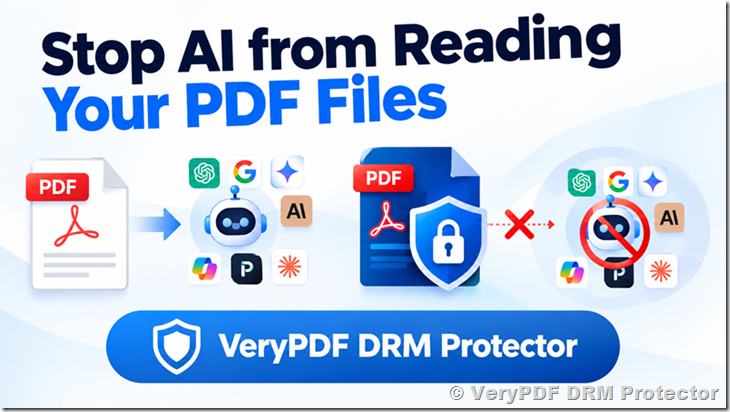
What About AI Scraping?
There is also a newer content-security concern that companies should consider.
If valuable documents or videos are distributed as ordinary files, recipients may upload them to AI tools such as ChatGPT, Gemini, Copilot, or other AI applications.
They may also upload documents to online services for summarization, translation, analysis, or other processing.
For sensitive or commercially valuable content, this can create another reason to control access and copying.
DRM does not magically stop every possible use of AI tools, and it cannot control what someone does with information they can legitimately see.
But restricting file extraction, copying, printing, and other common ways of moving content outside the protected environment can reduce some of the easy paths for unauthorized redistribution or uploading.
If AI-related content protection is important to your organization, test your specific workflow carefully before deployment.
What About a 4GB or Larger USB Package?
Large files are one reason USB drives remain attractive.
A USB drive can carry much more content than a CD.
For example, a company could distribute:
4GB marketing package
- 2GB product videos
- 800MB training videos
- 500MB product images
- 300MB PDF documents
- 400MB presentations and other materials
Instead of splitting the package across several discs, the company can use a suitable USB storage device.
The important part is not simply the storage capacity.
The important question is:
How much control do you have after the USB drive leaves your office?
That is where DRM becomes useful.
Why Password Protection Alone Is Not Enough
A password can protect access to a USB drive.
But password protection and DRM are not the same thing.
A password may answer:
“Can this person open the storage?”
DRM asks a different question:
“What is this person allowed to do with the content after they open it?”
For example, you may want the user to:
- View a PDF
- Watch a video
- Read a manual
But you may not want them to:
- Copy the file
- Save another copy
- Print it
- Capture the screen
- Move it to another device
- Continue using it after expiration
That is the difference between simple password protection and a content-rights management approach.
How VeryPDF DRM Protector Can Help
VeryPDF DRM Protector provides a solution for organizations that need to distribute protected digital content through USB drives.
Depending on the deployment, it can provide features such as:
- USB copy protection
- Content encryption
- Access control
- Password protection
- Expiration dates
- Usage limits
- Copy and paste restrictions
- Clipboard restrictions
- Print restrictions
- Screen-capture restrictions
- Protection for multiple file formats
- Offline content access
- Hardware-oriented USB protection
The goal is not to make the USB drive complicated for the customer.
The goal is to make the content useful to an authorized person while making unauthorized copying much harder.
When Should You Use a DRM-Protected USB Drive?
A DRM-protected USB drive is worth considering when all of the following are true:
- Your content has significant production value.
- You need to distribute large files physically.
- Your customers or partners need to access the content offline.
- You do not want to give them unrestricted copies of the original files.
- You need controls such as expiration, printing restrictions, or copy protection.
- You want a physical distribution method rather than depending entirely on cloud delivery.
If the files are completely public and can be downloaded freely from your website, DRM may not be necessary.
But if you are giving someone valuable content and want to maintain some control after distribution, a protected USB solution can make sense.
Final Thoughts
USB drives are convenient because they are cheap, portable, and can hold several gigabytes of videos, documents, images, and other content.
The problem is that a normal USB drive does not give the content owner much control.
Once you hand over the drive, the recipient may be able to copy the files, save them elsewhere, print them, upload them, or distribute them to other people.
For valuable marketing materials, training videos, product documentation, technical files, and other commercial content, that can be a serious problem.
A DRM-protected USB drive provides a different approach.
Instead of simply delivering the original files, you can deliver the content together with access controls designed to limit common forms of copying and redistribution.
VeryPDF DRM Protector is one solution to consider if your company needs to distribute valuable digital content on USB drives while adding copy protection, encryption, access controls, expiration rules, and other restrictions.
Before purchasing or producing a large number of protected USB drives, it is a good idea to test your actual content, computers, operating systems, and required restrictions with a proof-of-concept.
Frequently Asked Questions
1. Can I protect marketing videos on a USB drive?
Yes. USB DRM can be used to protect video content and restrict common methods of copying and redistribution, depending on the protection method and video format.
2. Can I put several gigabytes of content on a protected USB drive?
Yes. USB drives can hold large amounts of data, making them suitable for distributing large video, document, image, and audio collections.
3. Can I protect PDF files on a USB drive?
Yes. PDF files can be included in a protected USB content package. Printing and copying restrictions may also be applied depending on the DRM configuration.
4. Can USB DRM prevent users from copying files to their computer?
The purpose of USB copy protection is to restrict unauthorized copying and extraction of protected content. The exact behavior depends on the implementation and supported file types.
5. Can I set an expiration date?
Yes. USB DRM solutions can support expiration rules so that protected content becomes unavailable after a specified date or period.
6. Can I limit how many times someone uses the content?
Usage limits can be configured for supported DRM deployments. This can be useful for demonstrations, temporary training, and evaluation materials.
7. Can users print protected documents?
Printing can be restricted in supported protected environments. This is useful when printed copies could become another source of unauthorized distribution.
8. Can USB DRM stop screenshots?
Screen-capture restrictions can block common software-based screenshot methods where supported. However, no digital DRM system can prevent someone from photographing a screen with another physical device.
9. Does a protected USB drive need an Internet connection?
Some USB DRM solutions can operate offline. VeryPDF’s Copy Secure design is intended to support offline use, which can be useful for environments without continuous Internet access.
10. Can the customer format the protected USB drive?
The protection design can include restrictions intended to prevent end users from simply formatting or modifying the protected media. The exact behavior depends on the USB hardware and deployment configuration.
11. Can I protect videos, PDFs, images, and other files together?
Yes. A USB distribution package can contain different types of digital content. The protection available for each format may vary.
12. Is a password enough to protect a USB drive?
A password can prevent unauthorized access, but it does not necessarily control what an authorized user can do with a file after opening it. DRM adds content-use controls such as copy, print, expiration, and other restrictions.
13. Is USB DRM useful for training companies?
Yes. Training companies can use protected USB drives to distribute course videos, PDFs, presentations, and other learning materials while adding controls against unauthorized copying.
14. Can I use USB DRM for product manuals and technical documents?
Yes. Product manuals, technical documentation, specifications, and other business documents are common types of content that may benefit from USB copy protection.
15. Is USB DRM completely impossible to bypass?
No security system should make that claim. DRM is designed to make unauthorized copying and redistribution much harder by controlling common digital access and copying methods. Someone who can physically view content may still find other ways to record or reproduce what they see.
16. How can I test VeryPDF DRM Protector before using it for a large distribution?
A proof-of-concept is the best approach. Test your real videos, PDFs, images, computers, operating systems, and required restrictions before producing a large number of protected USB drives.