How to Annotate PDF Files for Healthcare Reports, Insurance Claims, and Medical Documentation Without Uploading Files

Secure and Annotate Course PDFs Without Risk of Sharing or Piracy

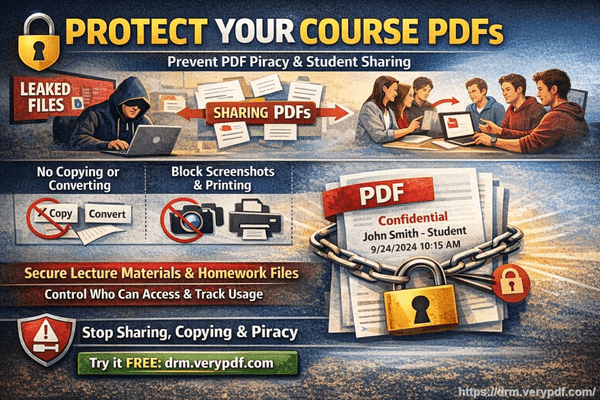
Protecting your lecture materials and homework from student sharing and PDF piracy has never been easier with VeryPDF DRM Protector.

How to Annotate PDF Files for Healthcare Reports, Insurance Claims, and Medical Documentation Without Uploading Files

I remember the first time a student sent a copy of my lecture slides to an online forum. At first, I was frustratednot just because my content was being shared without permission, but because all the careful formatting, notes, and references I included were being misused. Many professors face this same dilemma: you create PDFs for your course, but once they’re distributed digitally, control slips away. Students can copy text, print pages, or even convert your PDFs into Word documents, sharing them freely. The concern isn’t hypotheticalit happens every semester. That’s why protecting your content is crucial, and tools like VeryPDF DRM Protector make this process straightforward.

One of the biggest headaches I’ve faced is students forwarding homework PDFs to peers who aren’t enrolled. Not only does this compromise the learning process, but it also impacts grading fairness. Another pain point is losing control over paid course materials. When you’ve invested hours crafting lecture slides or homework guides, it’s disheartening to see them appear online for free. Finally, unrestricted printing or copying can lead to unintentional plagiarism or redistribution.

This is where VeryPDF DRM Protector shines. It allows you to restrict PDF access to enrolled students or specific users, preventing anyone else from opening your files. You can also disable printing, copying, or forwarding, ensuring that your content stays exactly where it should. Even better, it stops attempts to bypass DRM, convert your PDFs into Word, Excel, or images, and keeps full control over your course materials.

I’ve found the annotation features particularly useful. In one course, I provided PDFs with case studies for a group project. Instead of emailing multiple versions with comments, I used VeryPDF’s annotation tools. Each student could highlight, add notes, or insert stamps in their copy, all saved individually. This meant that students could work interactively with the materials without risking unauthorized distribution. Here’s how the annotation system helps in practice:

  • Highlighting and Marking: Students can highlight text or strikeout irrelevant sections while keeping your original content secure.

  • FreeText and Ink Annotations: Perfect for adding personal notes, sketches, or responses to prompts without altering the base PDF.

  • Stamps and Signatures: Students or teachers can insert approval stamps, timestamps, or even signatures for assignments.

  • Export and Reuse: Annotations can be saved and reused on future PDF sessions, allowing ongoing engagement without compromising security.

  • Mobile Support: Students can annotate directly on tablets or phones, which is increasingly important for hybrid learning environments.

Activating these annotation features is simple. After opening your protected PDF on VeryPDF, just click “Actions” -> “Edit Settings,” enable the toolbar buttons for annotations, and save. Your students can then interact with the PDF safely using the enhanced web viewerno downloads needed, no risk of losing control over your content.

Let me give you a real example. During a graduate-level medical course, I uploaded lecture PDFs on insurance claim workflows. Previously, students would sometimes forward these PDFs to peers in other institutions. With VeryPDF DRM Protector, each student received a personal copy they could annotate. They highlighted important sections, added notes, and inserted timestamps on exercises. At the same time, I knew the content couldn’t be printed or copied elsewhere. This simple step saved hours of manual monitoring and prevented unauthorized sharing.

Another scenario involves paid online courses. When selling digital content, maintaining control over PDF distribution is essential. With DRM Protector, I can restrict access to paying students, stop PDFs from being converted, and even track who accessed the materials. Students can interact with content, annotate it, and submit assignments without the fear that the core course material will leak online.

For daily teaching, these features streamline the workflow significantly:

  • Step 1: Upload your PDF content to VeryPDF DRM Protector.

  • Step 2: Set access restrictions for enrolled students only.

  • Step 3: Enable annotation tools like highlights, FreeText, and stamps.

  • Step 4: Distribute the secured PDFs. Students can annotate, interact, and submit without compromising your content.

  • Step 5: Monitor access logs to ensure content remains secure.

The anti-piracy benefits are also worth noting. Students or hackers cannot bypass the DRM to convert the PDF to Word, Excel, or images. Print options can be disabled entirely. Even if someone tries to forward a PDF, the permissions are linked to the user account, ensuring your content remains secure.

Over time, I’ve seen how this tool reduces misuse and maintains the integrity of digital course materials. It gives both professors and students the freedom to interact with content safely. Imagine being able to focus on teaching rather than worrying about where your PDFs ended up.

I highly recommend VeryPDF DRM Protector to anyone distributing PDFs to students, whether for free classroom content or paid courses. It protects your intellectual property, prevents piracy, and simplifies annotationsall while keeping your workflow efficient. Try it now and protect your course materials: https://drm.verypdf.com. Start your free trial today and regain control over your PDFs.

Frequently Asked Questions

How can I limit student access to PDFs?

You can restrict PDF access to specific users or enrolled students through VeryPDF DRM Protector, preventing anyone else from opening the files.

Can students still read the PDFs without copying, printing, or converting them?

Yes. Students can view and annotate the PDFs online without the ability to copy, print, or convert them, ensuring content security.

How can I track who accessed the files?

VeryPDF DRM Protector includes access logs that let you monitor which students opened your PDFs and when, giving you complete oversight.

Does it prevent PDF piracy and unauthorized sharing?

Absolutely. DRM restrictions stop copying, forwarding, or converting, and access is tied to user accounts to prevent piracy.

How easy is it to distribute protected lecture slides and homework?

Distribution is simple: upload PDFs to the platform, set user permissions, enable annotations, and share links with your students.

Can annotations be saved for future use?

Yes, students can save highlights, notes, and stamps for each PDF and reuse them when revisiting the materials.

Is it mobile-friendly for students using tablets or phones?

Yes. The annotation tools and viewing platform work on both desktop and mobile devices, making it suitable for hybrid or remote learning environments.

Tags or Keywords:

protect course PDFs, prevent PDF piracy, stop students sharing homework, secure lecture materials, prevent DRM removal, anti-conversion PDF DRM, digital course protection, PDF annotations, secure homework distribution, educational content security

VeryPDF DRM Protector Tips Save Time, Reduce Errors, and Automate Annotation Reuse Across Projects for Efficient Workflo

Secure Your Course PDFs: Stop Students Sharing Homework and Prevent PDF Piracy

Keep your lecture materials safe, prevent unauthorized sharing, and maintain control over PDFs with practical DRM solutions.

VeryPDF DRM Protector Tips Save Time, Reduce Errors, and Automate Annotation Reuse Across Projects for Efficient Workflo

I still remember the moment I realised a student had shared my entire lecture slides with an online forum. I had spent hours creating those PDFs, carefully formatting examples, exercises, and notesbut in a single click, they were circulating outside my classroom. Like many professors, I’d thought distributing PDFs digitally would be easier than printing and handing out physical copies. Instead, it opened a new headache: how to protect my course materials while still letting students access them efficiently.

Students sharing PDFs, unauthorized printing, or converting files to Word or Excel is more common than you’d think. It’s frustrating when paid course materials or exclusive homework assignments end up on public sites, potentially devaluing your work and undermining classroom control. I needed a solution that balanced accessibility with security. That’s when I turned to VeryPDF DRM Protector.

One of the biggest headaches in my teaching workflow used to be managing who could view or annotate my PDFs. Students often wanted to highlight sections or make notes, but if the PDF could be freely copied or shared, those annotations could end up in the wrong hands. With VeryPDF DRM Protector, I can restrict access to only enrolled students or specific users. That means only those I authorize can open the files, while preventing anyone else from downloading, printing, or forwarding them.

Imagine you’re preparing a set of homework PDFs for your class. Without protection, a single student could share the files with an entire cohortor even post them online. VeryPDF DRM Protector prevents this by enforcing strict access controls. Students can view, annotate, or complete exercises, but the files cannot be copied, printed, or converted to other formats like Word or Excel. I’ve used this feature for several online courses, and it’s been a lifesaver for maintaining the integrity of my materials.

Another pain point I faced was the time wasted dealing with lost or misused PDFs. Students would often email me asking for the same lecture notes or accidentally overwrite their annotations. Using VeryPDF DRM Protector’s PDF annotation tools, each student can save their notes securely in their own account. Highlights, free text, ink, and stamps stay private per user, and annotations can even be reused when they revisit the PDF. This automated workflow saves me hours each semester.

Here’s how I implement it in my classes:

  • Lecture Slides: I protect the PDF slides for every class session. Students can view and annotate them online, but can’t print or distribute them.

  • Homework Assignments: PDFs for exercises are restricted to enrolled students. Even if a student tries to share the file, DRM restrictions prevent access by others.

  • Paid Course Materials: For online courses, paid PDFs are fully protected against unauthorized sharing or conversion. Students can interact with the material safely, while I retain full control.

Beyond simply restricting access, the anti-piracy features are essential. VeryPDF DRM Protector stops attempts to bypass security, so PDFs cannot be converted to Word, Excel, or images. That means my contentwhether lecture slides, homework, or research notesremains exactly as intended, reducing the risk of unauthorized redistribution. I remember one instance where a student tried to extract the text from a PDF to upload it elsewhere. The DRM restrictions blocked it immediately, saving me from potential intellectual property issues.

Annotation management is another huge benefit. Students can highlight text, add freehand notes, or insert stamps like checkmarks or custom images. I even use the timestamp and username features to track who added which annotation. It’s been especially useful for group projects, where multiple students need to contribute feedback in a controlled environment.

Setting it up is straightforward. I simply:

  1. Open the VeryPDF DRM file management page.

  2. Click “Actions” “Edit Settings” on the PDF file.

  3. Enable annotation tools like highlight, free text, ink, and stamps in the advanced settings.

  4. Save and return to the book list, then click “Enhanced Web Viewer” to access the PDF with annotations enabled.

This step-by-step process makes it easy to distribute PDFs while maintaining tight control over security and annotations. I no longer worry about students forwarding assignments or losing their notes. Everything is securely stored in their individual accounts, and I can focus on teaching rather than policing file sharing.

The impact on my workflow has been profound. I spend less time chasing down lost PDFs or addressing unauthorized sharing. Students can engage with course materials actively, making notes and highlighting important concepts, while I retain full control. For paid online courses, this has also protected revenue streams by preventing piracy.

I highly recommend VeryPDF DRM Protector to anyone distributing PDFs to students. It’s practical, easy to use, and protects both your content and your peace of mind. The anti-piracy measures, combined with flexible annotation tools, make it ideal for classroom and online teaching environments.

Try it now and protect your course materials: https://drm.verypdf.com

Start your free trial today and regain control over your PDFs.

FAQs

Q: How can I limit student access to my PDFs?

A: You can restrict access to enrolled students or specific users using VeryPDF DRM Protector. Only authorized users can open, view, and annotate the PDFs.

Q: Can students still read PDFs without copying, printing, or converting them?

A: Yes. DRM protection allows full reading access, including annotations, while blocking printing, copying, or conversion to other formats.

Q: How can I track who accessed the files?

A: The DRM system logs access by username and allows tracking of annotations, highlights, and other interactions per student.

Q: Does it prevent PDF piracy and unauthorized sharing?

A: Absolutely. The DRM restrictions prevent downloading, forwarding, printing, or converting the files, maintaining full control over distribution.

Q: How easy is it to distribute protected lecture slides and homework?

A: Very easy. PDFs can be uploaded, access controlled, and annotated online. Students can interact with the material securely without risking unauthorized distribution.

Q: Can students save and reuse their annotations on protected PDFs?

A: Yes. Annotations like highlights, free text, ink, and stamps are saved per user and can be reused each time the student opens the PDF.

Q: Does it support mobile devices for annotation and viewing?

A: Yes. VeryPDF DRM Protector supports touch devices, allowing students to annotate, highlight, and review PDFs on tablets and smartphones.

Tags / Keywords

protect course PDFs, prevent PDF piracy, stop students sharing homework, secure lecture materials, prevent DRM removal, anti-conversion PDF DRM, PDF annotation tools, secure homework distribution, online course PDF protection, classroom PDF security

How to Highlight, Underline, and Strikeout PDF Text for Legal and Research Documents Using VeryPDF DRM Protector Online

How to Secure and Annotate PDFs for Class Materials While Preventing Student Sharing

Ensure your lecture slides, homework PDFs, and course materials stay protected while letting students highlight and annotate securely.

How to Highlight, Underline, and Strikeout PDF Text for Legal and Research Documents Using VeryPDF DRM Protector Online

I remember one semester when I uploaded my lecture slides as PDFs for students to review before class. By the second week, I noticed some of my carefully prepared notes had appeared on a public forum. It was frustratingnot only had someone shared my work without permission, but it also undermined the trust I was trying to build in the classroom. Like many professors, I struggled with balancing accessibility for students and protecting my intellectual property. I needed a way to allow annotations, highlights, and notes without letting my content get stolen or misused. That’s when I discovered VeryPDF DRM Protector.

One of the biggest headaches for educators is controlling how students interact with digital content. Students often share homework PDFs or lecture notes online, sometimes without realizing the consequences. In other cases, students may copy, print, or convert PDFs into Word or Excel files, spreading materials far beyond the intended audience. These situations lead to loss of control over paid course materials, reduced enrollment trust, and increased risk of academic dishonesty.

VeryPDF DRM Protector addresses these issues directly. With it, I can:

  • Restrict PDF access to enrolled students or specific users, ensuring that only authorized individuals can open my materials.

  • Prevent printing, copying, forwarding, or DRM removal, so my lecture slides and assignments remain secure.

  • Protect paid course content, homework PDFs, and online learning resources from unauthorized distribution.

For example, I once uploaded a set of research PDFs with heavy annotations for a law class. Using VeryPDF DRM Protector, each student could highlight, underline, and strikeout text within the secure environment. Yet, none could download a copy to share externally, print, or convert it to another format. This feature alone saved hours of administrative follow-up and prevented potential content leaks.

The platform’s annotation tools are surprisingly flexible. Students can:

  • Highlight or underline key points in lecture slides.

  • Strikeout text for editing exercises or legal document studies.

  • Add freehand notes, arrows, shapes, or stamps for collaborative projects.

  • Save their annotations securely to their personal accounts for later reference.

And it’s all accessible from a browser, with touch-friendly tools for tablets or phones. I’ve seen students use the annotation tools to create personalized study guides without ever compromising the PDF’s security.

What makes this solution even more effective is its anti-piracy focus. VeryPDF DRM Protector prevents:

  • Unauthorized sharing of PDFs by students or third-party users.

  • Conversion of PDFs into Word, Excel, or image formats, protecting the integrity of your work.

  • Circumvention of security features through DRM removal attempts.

In one memorable case, I was preparing a paid online course with 20 lecture PDFs. I wanted to allow students to annotate and engage deeply, but I also had to ensure that none of the materials were leaked online. Using VeryPDF DRM Protector’s PDF annotation and access controls, I maintained complete control over content distribution. Students could interact with the materials safely, and I could see who accessed each file, making it easy to address any suspicious activity.

Activating PDF annotations is straightforward:

  1. Visit the protected PDF page on VeryPDF DRM Protector.

  2. Click “Actions” “Edit Settings” for the PDF.

  3. Enable annotation tools such as Highlight, FreeText, Ink, and Stamp in the Advanced Settings.

  4. Save the settings and open the “Enhanced Web Viewer” to let students annotate online.

From personal experience, this setup not only secured my PDFs but also streamlined the teaching workflow. I no longer had to email updated versions every time a student requested a note, nor worry about PDFs ending up on public forums. The annotation system is intuitive, even for students who aren’t tech-savvy.

Moreover, annotations are tied to each student and PDF, meaning individual work is private and reusable. Students can save their notes and refer back during exam preparation or group work. And as an instructor, I can export annotations or review student engagement for assessment purposes, all while keeping the original PDF content protected.

I’ve also noticed improved student behaviour. When they know materials are protected and monitored, the temptation to share or misuse content diminishes. This system reinforces academic integrity and allows me to focus more on teaching rather than policing PDFs.

In conclusion, VeryPDF DRM Protector solves the common classroom pain points of content leakage, unauthorized sharing, and misuse of digital PDFs. By combining strong DRM protection with flexible annotation tools, it allows students to interact meaningfully with materials while keeping your intellectual property secure. I highly recommend this to anyone distributing PDFs to students.

Try it now and protect your course materials: https://drm.verypdf.com

Start your free trial today and regain control over your PDFs.

Frequently Asked Questions

Q: How can I limit student access to my PDFs?

A: VeryPDF DRM Protector lets you restrict PDF access to enrolled students or specific users, ensuring only authorized individuals can open the files.

Q: Can students still read and annotate PDFs without copying, printing, or converting them?

A: Yes. Students can highlight, underline, strikeout, and add notes directly in the protected PDF environment, while all content remains secure from external use.

Q: Is it possible to track who accessed each PDF?

A: Absolutely. The platform records which students access the PDFs, making it easy to monitor engagement and detect suspicious activity.

Q: Does this solution prevent PDF piracy and unauthorized sharing?

A: Yes. VeryPDF DRM Protector blocks printing, copying, forwarding, conversion to Word or Excel, and attempts to remove DRM, keeping your materials safe.

Q: How easy is it to distribute protected lecture slides and homework?

A: It’s simple. Upload your PDFs, set access permissions, enable annotation tools, and share the secure link with your studentsno extra software required.

Q: Can students save their annotations for future use?

A: Yes. Annotations are saved per user and per PDF, allowing students to revisit their notes without compromising the original content.

Q: Does it support annotations on mobile devices?

A: Yes. VeryPDF DRM Protector’s tools are touch-friendly, supporting tablets and phones for easy on-the-go studying.

Keywords: protect course PDFs, prevent PDF piracy, stop students sharing homework, secure lecture materials, prevent DRM removal, anti-conversion PDF DRM, PDF annotations, secure online PDFs, classroom content protection, DRM-protected study materials

How to Use Freehand Drawing and Shape Tools for PDF Annotation in VeryPDF DRM Protector for Education Materials

Teach, Annotate, and Protect: How I Secure My Lecture PDFs and Stop Students Sharing Homework

As a lecturer, I used to have the same uneasy feeling at the end of every semester.

How to Use Freehand Drawing and Shape Tools for PDF Annotation in VeryPDF DRM Protector for Education Materials

I’d upload my lecture slides and homework PDFs to our learning portal, tell students, “Please don’t share these outside class,” and hope for the best.

But hope isn’t a strategy.

One afternoon, a colleague forwarded me a link to a public forum. Right there were my carefully prepared PDFs. My diagrams. My assignments. Even my handwritten explanations.

That was the moment I realised something: once a PDF leaves your computer, you’ve basically lost controlunless you do something about it.

If you’ve ever worried that your course materials might be copied, converted, or passed around without permission, this article is for you. I’ll share how I now annotate my teaching PDFs freely while still protecting them from piracy and misuse, using VeryPDF DRM Protector.


The everyday teaching problems no one warns you about

Let’s be honest. Teaching in the digital age comes with new challenges.

Here are a few I personally ran into:

Students sharing PDFs outside the classroom

You send homework to 30 enrolled students. Next week, it’s in a WhatsApp group with 200 people. Or uploaded to a file-sharing site.

You didn’t approve that. You can’t stop it. Or at least, you couldn’t before.

Unauthorized printing, copying, and conversion

I once found my PDF lecture notes converted into a Word document, with my name removed. Someone had edited it and redistributed it as their own.

That stings.

Losing control over paid or restricted content

If you sell courses or provide premium materials, this one hurts even more. One leaked PDF can destroy months of work.

These are exactly the reasons so many educators search for ways to:

  • protect course PDFs

  • stop students sharing homework

  • secure lecture materials

  • prevent PDF piracy

  • prevent DRM removal

I was in the same boat.


Why I chose VeryPDF DRM Protector

After testing a few tools, I landed on VeryPDF DRM Protector (https://drm.verypdf.com). What stood out wasn’t just the securityit was how practical it felt for everyday teaching.

I didn’t want something complicated or overly technical.

I wanted:

  • My students to read and annotate PDFs normally

  • Me to stay in control of who accesses files

  • No printing, copying, or converting unless I allow it

  • Real protection against DRM removal and PDF piracy

VeryPDF DRM Protector checked all those boxes.

And surprisingly, it also gave me something I didn’t expect: powerful built-in PDF annotation tools that work right in the browser.


Annotating lecture PDFs while keeping them locked down

Here’s where things got interesting.

With VeryPDF DRM Protector, I can upload my lecture slides or homework PDFs, protect them, and still allow students to annotatewithout giving them the ability to download, copy, or convert the files.

That’s huge.

Students can:

  • Highlight important text

  • Draw freehand notes

  • Add shapes like rectangles, circles, arrows, and clouds

  • Insert comments or sticky notes

  • Add signatures

  • Use stamps and custom images

  • Save their annotations and see them again next time

But they can’t:

  • Print unless I allow it

  • Copy text

  • Convert PDFs to Word or images

  • Share the original file freely

Annotations are saved per user and per document. That means each student sees only their own notes.

In other words, they can study properly, but they can’t misuse your content.


A real classroom example

Last term, I taught an online statistics course.

I uploaded:

  • Weekly lecture slides

  • Worked example PDFs

  • Homework assignments

  • A paid revision pack

Using VeryPDF DRM Protector, I restricted access to enrolled students only.

During live sessions, I used the freehand drawing tools to explain formulas directly on the PDF. Circles, arrows, quick sketcheseverything felt natural, like writing on a whiteboard.

Students highlighted sections and added their own notes.

At the same time:

  • Printing was disabled

  • Copy-paste was blocked

  • Conversion to Word or Excel was impossible

  • File forwarding didn’t work

One student later told me, “I love that I can annotate the slides, but I can’t accidentally share them.”

Exactly.


What you can annotate (and how it helps teaching)

The annotation tools are surprisingly rich. Here’s what I use most:

Drawing & marking

  • Freehand pencil and highlighter

  • Adjustable colour, opacity, and thickness

  • Smart eraser that removes intersecting elements

Great for explaining diagrams or marking up examples live.

Shapes and connectors

  • Rectangles, circles, arrows, stars, clouds

  • Lines that connect comments to specific areas

Perfect for pointing out mistakes or emphasising key concepts.

Text and comments

  • Inline text editing

  • Sticky notes for quick feedback

  • Free text annotations

I use these for personalised feedback on homework PDFs.

Stamps and signatures

  • Default stamps or custom ones

  • Image-based stamps

  • Sign documents using typed text or uploaded images

Useful for approvals or marking submissions.

Highlights and strikeouts

  • Highlight important passages

  • Strike out incorrect answers

  • Underline or squiggle text

Just like marking on paperbut digital.

And yes, it works on touch devices too.


How I activated annotations (simple steps)

If you’re using VeryPDF DRM Protector, enabling annotations takes only a few minutes.

Here’s what I did:

  1. Open the protected PDF list page.

  2. Click “Actions” “Edit Settings” on the file.

  3. In Advanced Settings, enable:

  • ToolbarButton_Download=show

  • ToolbarButton_ViewBookmark=show

  • ToolbarButton_editorHighlight=show

  • ToolbarButton_editorFreeText=show

  • ToolbarButton_editorInk=show

  • ToolbarButton_editorStamp=show

  • ToolbarButton_SaveAnnotations=show

  1. Click “Save”.

  2. Return to the book list and open “Enhanced Web Viewer”.

That’s it. Your PDF now supports secure online annotation.


The anti-piracy side that really matters

Annotations are great, but the real value is what happens behind the scenes.

VeryPDF DRM Protector lets me:

  • Restrict access to specific users or email addresses

  • Set expiration dates for PDFs

  • Prevent screenshots (optional)

  • Block printing, copying, and forwarding

  • Stop PDF conversion entirely

  • Protect against DRM removal attempts

This means:

  • Students can’t upload your files elsewhere

  • Hackers can’t bypass protection easily

  • Your lecture materials stay yours

For anyone serious about preventing PDF piracy, this is a game changer.


How it changed my teaching workflow

Before:

  • I emailed PDFs and hoped students behaved.

  • I manually tracked who had access.

  • I worried about leaks constantly.

Now:

  • I upload once and control everything centrally.

  • Students annotate directly in their browsers.

  • I can revoke access anytime.

  • I sleep better knowing my content is protected.

It’s also saved me hours each week.

No more chasing shared files.

No more rewriting leaked assignments.

No more awkward emails asking students to delete copies.


Who this is perfect for

In my experience, VeryPDF DRM Protector works especially well for:

  • Professors distributing lecture slides

  • Teachers sharing homework PDFs

  • Course creators selling digital materials

  • Training providers offering paid content

  • Anyone who wants to secure lecture materials

If you care about protecting your intellectual property, this tool makes life easier.


Final thoughts

I never thought I’d say this about DRM software, but VeryPDF DRM Protector genuinely improved how I teach.

I can annotate freely.

My students can learn interactively.

And I still maintain full control over my PDFs.

If you’re struggling with students sharing homework, losing control of your materials, or dealing with unauthorized printing and conversion, I highly recommend giving this a try.

Start protecting your course materials today:
https://drm.verypdf.com

Take back control of your PDFsand focus on what really matters: teaching.


Frequently Asked Questions

How can I limit student access to my PDFs?

With VeryPDF DRM Protector, you can restrict files to specific users or email accounts. Only authorised students can open the documents.

Can students still read and annotate without copying or printing?

Yes. They can highlight, draw, and add notes, but copying, printing, and converting can be completely disabled.

Does it prevent PDF piracy and unauthorized sharing?

Absolutely. The DRM blocks forwarding, conversion, and most common piracy methods, helping you protect course PDFs effectively.

Can I track who accessed my lecture materials?

Yes. You can monitor access activity and manage permissions from your dashboard.

Is it hard to distribute protected lecture slides and homework?

Not at all. Upload your PDF, set permissions, and share the secure link with students.

Will this stop students converting PDFs to Word or images?

Yes. Conversion is blocked, which helps prevent DRM removal and content misuse.

Do annotations save for each student?

They do. Each student’s notes are private and saved to their account for future sessions.


Tags / Keywords

protect course PDFs, prevent PDF piracy, stop students sharing homework, secure lecture materials, prevent DRM removal, anti-conversion PDF DRM, protected teaching PDFs, educational content security

VeryPDF DRM Protector Features User-Specific Annotation Permissions and Reusable Notes for Education and Business Profes

How I Keep Lecture PDFs Safe: Prevent Sharing, Copying, and DRM Removal

As a professor, there’s nothing more frustrating than discovering that my carefully prepared lecture PDFs or homework assignments are circulating online without permission. I’ve spent hours designing content, yet a single leaked PDF can undermine my course, confuse students, and even affect paid course enrolments. It’s a reality many educators face: students sharing files, copying content, or converting PDFs to Word or Exceloften without any ill intent, but it still disrupts my workflow and control over my materials.

VeryPDF DRM Protector Features User-Specific Annotation Permissions and Reusable Notes for Education and Business Profes

For years, I struggled to maintain control. Sending PDFs via email or uploading them to a learning platform always felt risky. Then I discovered VeryPDF DRM Protector, and it completely changed the way I manage digital course content.

The Common Challenges of Sharing PDFs in Education

One of the biggest pain points in teaching is content leakage. Here are a few examples from my classroom experience:

  • Students sharing PDFs online: Last semester, I noticed several students discussing homework solutions in a public forum. While collaboration is encouraged, uncontrolled sharing meant my assignments were effectively public.

  • Unauthorized printing or copying: Some students printed lecture slides or copied content to create personal notes. This can be harmless at times, but when you have paid or restricted course materials, it becomes a real issue.

  • Loss of control over course content: Whether distributing PDFs for homework, lecture slides, or paid online courses, there’s always a risk that someone might forward the file, convert it to another format, or bypass protections altogether.

These problems don’t just affect teachersthey impact the quality of learning. Students might rely on shared files instead of doing their own work, which undermines the educational process.

How VeryPDF DRM Protector Solves These Issues

VeryPDF DRM Protector offers practical solutions for educators who need secure digital content distribution. I started using it to protect all my lecture slides, homework PDFs, and online course materials. Here’s what it does in real classroom scenarios:

  • User-specific access: I can restrict PDFs to only enrolled students. Each user has a unique account, so only the intended student can open and annotate their copy. No more worrying about forwarded files.

  • Preventing unauthorized actions: Printing, copying, forwarding, and converting are blocked. Even if a student tries to convert a PDF to Word, Excel, or images, the DRM protection ensures they can’t bypass restrictions.

  • Protecting annotations: With VeryPDF’s PDF annotation tools, students can highlight, add free text, ink, stamps, and even imagesbut only within their own account. Annotations are saved and reusable whenever they revisit the PDF. This feature encourages active learning while keeping content secure.

For example, in one online course, a student tried to share their homework PDF with a friend. Thanks to DRM Protector, the friend couldn’t open the fileit was tied to the student’s account. That simple feature saved me hours of follow-ups and potential academic integrity issues.

Practical Benefits in Day-to-Day Teaching

The best part about VeryPDF DRM Protector is how it fits seamlessly into my workflow. Some real-life benefits I’ve experienced include:

  • Time-saving: I no longer spend hours emailing PDFs individually or worrying about access rights. Everything is managed through the DRM interface.

  • Enhanced engagement: Students can annotate PDFs freely in a controlled environment, making notes that are private to them. They can even reuse their annotations on future sessions, which helps in reviewing past lectures or assignments.

  • Preventing piracy: Paid course materials are fully protected. I’ve distributed content online without the fear of it being leaked or shared illegally.

Setting up PDF annotations is straightforward:

  1. Open the protected PDF through VeryPDF DRM’s web interface.

  2. Click “Actions” “Edit Settings” and enable annotation tools like Highlight, FreeText, Ink, and Stamp.

  3. Save your settings, then return to the PDF list and open it in the Enhanced Web Viewer to allow students to annotate safely.

This step-by-step process ensures my students have a rich, interactive learning experience without compromising content security.

Anti-Piracy and Content Control Made Simple

VeryPDF DRM Protector doesn’t just stop students from sharing PDFsit also prevents hacks and conversions. Here’s why that matters:

  • PDFs can’t be converted into Word, Excel, or image files, eliminating the risk of content leakage.

  • Annotations are user-specific, so even if someone screenshots, the notes aren’t transferable.

  • Every PDF stays tied to my control, making unauthorized distribution almost impossible.

I’ve had situations where a student wanted to access material from multiple devices. With DRM Protector, they could log into their account and continue annotating safely, without me worrying that the PDF was copied or shared elsewhere.

Conclusion: Why I Recommend VeryPDF DRM Protector

I highly recommend VeryPDF DRM Protector to anyone distributing PDFs to students. It solves the core teaching pain points: preventing students from sharing homework, securing lecture materials, and stopping unauthorized printing or conversion. The combination of DRM protection with user-specific annotations ensures students remain engaged while my content stays secure.

If you’re serious about protecting your course materials and maintaining control over your PDFs, try it now and protect your course materials: https://drm.verypdf.com. Start your free trial today and regain control over your PDFs.

FAQs

How can I limit student access to my PDFs?

You can restrict PDF access to individual students using VeryPDF DRM Protector. Each PDF is tied to a user account, so only enrolled students can open and annotate the file.

Can students still read PDFs without copying, printing, or converting them?

Yes. Students can view and annotate the PDFs directly in the secure web viewer, but printing, copying, and conversion are blocked.

How do I track who accessed the files?

DRM Protector logs each user’s activity, allowing you to see who accessed the file and when. This ensures accountability for all distributed materials.

Does it prevent PDF piracy and unauthorized sharing?

Absolutely. DRM protection ties each PDF to a user account and prevents forwarding, copying, or conversion to other formats.

Is it easy to distribute protected lecture slides and homework?

Yes. Once PDFs are uploaded and protected, students can access them securely through their accounts. Annotations and updates are simple to manage online.

Can annotations be reused or saved?

Yes. Students’ annotations are saved in their accounts and can be reused whenever they revisit the PDF. This enhances learning without compromising security.

What types of annotations are supported?

VeryPDF DRM Protector supports highlights, free text, ink, stamps, shapes, arrows, cloud lines, signatures, and even image annotations. All annotations remain user-specific and secure.

Tags/Keywords

protect course PDFs, prevent PDF piracy, stop students sharing homework, secure lecture materials, prevent DRM removal, anti-conversion PDF DRM, DRM-protected PDFs, secure online course content, PDF annotation for education, control course material distribution