How to Protect a PDF File with DRM Options and View PDF File Access Statistics Report

Protecting PDF documents is essential when sharing sensitive or valuable content such as educational materials, research data, training guides, or corporate reports. VeryPDF DRM Protector offers a powerful way to control access, prevent unauthorized sharing, and monitor how your files are being used. With its easy-to-use online interface, you can enable DRM protection, configure access permissions, and track file usage statistics in just a few steps.

This guide walks you through the process of protecting your PDF files with DRM and viewing the access statistics report.


How to Protect a PDF File with DRM Options and View PDF File Access Statistics Report


Step 1: Register and Log Into Your Account
  1. Open your browser and go to https://drm.verypdf.com/wp-login.php.
  2. Click on “Register” to create a new account using your email address.
  3. After registration, check your email for confirmation details.
  4. Log in to your account with your email and password.

Your account will be the central place to manage PDF uploads, DRM settings, and file access reports.

How to Protect a PDF File with DRM Options and View PDF File Access Statistics Report


Step 2: Enter your Email address into Subscription Field
  1. Navigate to https://drm.verypdf.com/online/.
  2. In the “Subscription” field, enter the exact same email address you used when registering your account.
  3. Subscribing your email ensures that all PDF documents you upload and protect are linked correctly to your account.

How to Protect a PDF File with DRM Options and View PDF File Access Statistics Report


Step 3: Configure DRM Protection Options

Before uploading a file, you need to select the DRM policies to apply.

  1. On the Online Protection Page, locate the “Enable PDF DRM Protection” checkbox and make sure it is selected.
  2. Review and choose the available DRM settings, which can include:
  • Restrict Printing – Prevents users from printing your document.
  • Restrict Copying – Blocks copy-and-paste of text and images.
  • Expiration Settings – Define how long or how many times a file can be viewed.
  • Watermarking – Add dynamic or static watermarks to discourage screenshots or unauthorized sharing.
  • Dynamic Text Watermark – Display user-specific information (such as email, IP, or name) as a visible watermark to identify the source of leaks.
  • Screen Shield – Overlay a semi-transparent shield or dynamic text layer to reduce the risk of screen recording and screenshots.
  • Access Control – Limit viewing to specific email addresses, accounts, or predefined user groups.
  • Device Restriction – Bind documents to a particular device (such as one computer or mobile phone) to prevent multiple-device access.
  • Offline Access Control – Allow temporary offline reading with restrictions, ensuring that files cannot be shared outside the authorized device.
  • Open Limitations – Define how many times a document can be opened before access is revoked.
  • Time-Limited Access – Set start and end dates for access, making the document valid only during a specific time period.
  • Online Authentication – Require users to log in through the DRM server before viewing the document, ensuring identity verification.
  • Disable Save As – Prevent users from saving an unprotected copy of the file.
  • Dynamic Watermark Rotation – Apply watermarks that change position or angle during reading to further prevent clean screenshots.

These options give you flexible control over how your PDF can be used after it is distributed.

How to Protect a PDF File with DRM Options and View PDF File Access Statistics Report


Step 4: Upload and Protect Your PDF
  1. Use the upload function on the page to select a PDF document from your computer.
  2. Confirm that your DRM protection options are checked.
  3. Click “Upload and Secure PDF” button to submit your file for processing.
  4. Once uploaded, the system will generate a protected version of your PDF.
  5. You will receive a secure access link that you can distribute to authorized readers.

The uploaded file is now fully DRM-protected and linked to your account for monitoring.

How to Protect a PDF File with DRM Options and View PDF File Access Statistics Report


Step 5: View PDF File Access Statistics Report

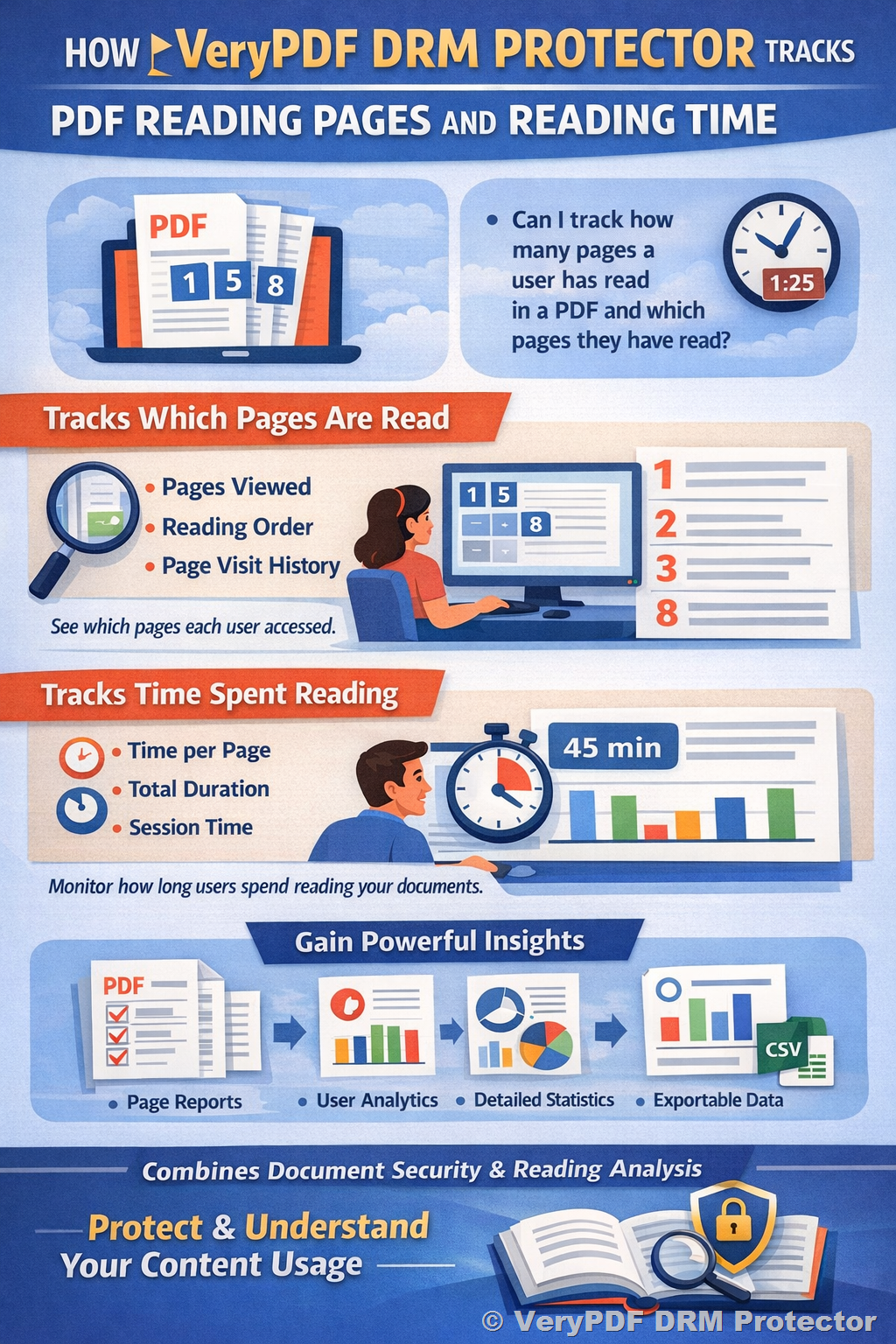
VeryPDF DRM Protector not only secures your PDF but also gives you detailed insight into how it is accessed.

  1. Log back into your account.
  2. Go to https://drm.verypdf.com/wp-admin/admin.php?page=VeryPDFDRMFiles.
  3. This page displays the PDF File Access Statistics Report for all the PDFs you have protected.

The statistics report allows you to:

  • See how many times each protected file has been opened.
  • Identify which users have accessed your document.
  • Track access times and dates for better auditing and compliance.

This feature ensures you always have visibility and control over how your secure documents are being used.

How to Protect a PDF File with DRM Options and View PDF File Access Statistics Report


Conclusion

With VeryPDF DRM Protector, securing your PDF files and tracking their usage is straightforward. By registering an account, enabling DRM protection, uploading your document, and checking the access statistics, you gain full control over your digital documents.

Whether you are an educator sharing course materials, a business professional handling confidential files, or a publisher distributing premium content, VeryPDF DRM Protector gives you the tools to:

  • Protect your PDFs with strong DRM policies.
  • Control and customize access permissions.
  • Monitor usage with real-time statistics reports.

Start protecting your PDF files today by visiting https://drm.verypdf.com/.

If you encounter any problems while using our VeryPDF DRM Protector application, or if you need a custom-built feature tailored to your specific workflow, please don’t hesitate to contact us. Our support team is always ready to assist you and provide professional solutions. You can reach us directly at https://support.verypdf.com/.

VeryPDF DRM Protector: How Dynamic Text Watermarks Protect PDF Files from Screenshots and Unauthorized Sharing

Protecting sensitive documents is not just about encryption—it’s also about making sure your content cannot be easily leaked through screenshots or unauthorized screen recordings. To address this challenge, VeryPDF DRM Protector now introduces a powerful new feature: Dynamic Text Watermarking.

Unlike static watermarks that remain the same for every viewer, Dynamic Text Watermarks are generated in real-time when a user opens a protected PDF file. These watermarks are not embedded inside the PDF itself. Instead, they are dynamically rendered on the viewing page. This ensures maximum security while keeping the original PDF intact.

By displaying unique, real-time information tied to each viewer, Dynamic Text Watermarks make screenshots traceable and significantly discourage unauthorized sharing.

You can try it online here:

https://drm.verypdf.com/online/


Why Dynamic Text Watermarks?

Traditional watermarks often use static text such as “Confidential” or “Do Not Copy.” While helpful, they do not directly connect the document to a specific user or access session. Dynamic Text Watermarks take this further by automatically inserting user-specific or session-specific details, such as the IP address, username, or timestamp, directly onto the viewed page.

This approach serves two key purposes:

  1. Deterrence – Users are far less likely to take screenshots if their personal information (like IP, username, or access time) is stamped onto every page.
  2. Traceability – If a screenshot is leaked, the watermark provides critical clues about who accessed the content, when, and from where.

Supported Dynamic Variables

VeryPDF DRM Protector supports a wide range of dynamic variables, all case-insensitive. Below is a detailed introduction to each:

1. User & Client Information
  • {ip} – Inserts the client’s IP address.
    Example: 192.168.1.45
  • {host} – Inserts the client’s hostname (reverse DNS of IP).
    Example: pc123.corporate-network.local
  • {username} – Inserts the login username used by the viewer.
    Example: jdoe
  • {useragent} – Displays the browser’s User-Agent string.
    Example: Mozilla/5.0 (Windows NT 10.0; Win64; x64)...
    (Tip: This value can be long, so use it selectively.)
  • {referer} – Shows the referrer URL from where the user accessed the file.
    Example: https://universityportal.edu/courses/pdfviewer
  • {url} – Displays the current request URI being viewed.
    Example: /protected/lesson1.pdf
  • {email} – Inserts the user’s registered or authenticated email address.
    Example: jdoe@example.com
  • {firstname} – Displays the user’s first name.
    Example: John
  • {lastname} – Displays the user’s last name.
    Example: Doe
  • {phone} – Inserts the user’s registered phone number.
    Example: +1-202-555-0147
Placeholder Description Example
{ip} Inserts the client’s IP address. 192.168.1.45
{host} Inserts the client’s hostname (reverse DNS of IP). pc123.corporate-network.local
{username} Inserts the login username used by the viewer. jdoe
{useragent} Displays the browser’s User-Agent string. (Tip: This value can be long, so use it selectively.) Mozilla/5.0 (Windows NT 10.0; Win64; x64)
{referer} Shows the referrer URL from where the user accessed the file. https://universityportal.edu/courses/pdfviewer
{url} Displays the current request URI being viewed. /protected/lesson1.pdf
{email} Inserts the user’s registered or authenticated email address. jdoe@example.com
{firstname} Displays the user’s first name. John
{lastname} Displays the user’s last name. Doe
{phone} Inserts the user’s registered phone number. +1-202-555-0147

2. Server Information
  • {server_ip} – Inserts the server’s IP address hosting the document.
  • {server_name} – Inserts the server’s hostname.

These variables can help trace which server delivered the content in multi-server environments.


3. Date and Time Variables
  • {date} – Current date in Y-m-d format (e.g., 2025-09-26).
  • {time} – Current time in H:i:s format (e.g., 14:32:10).
  • {datetime} – Current date and time in Y-m-d H:i:s format.
  • {timestamp} – Unix timestamp (e.g., 1737981736).
Extended Date/Time Formatting

Dynamic Text also supports custom formats:

  • {date:d/m/Y}26/09/2025
  • {time:H:i}14:32
  • {datetime:d/m/Y H:i}26/09/2025 14:32
Individual Components

You can also display date/time parts separately:

  • {year}2025
  • {month}09
  • {day}26
  • {hour}14
  • {minute}32
  • {second}10

4. Custom Variables
  • {custom:Key} – Inserts a value provided from a custom array.
    Example: {custom:Department}Physics

This is useful for organizations that want to inject their own identifiers, such as employee IDs, course codes, or project numbers.


VeryPDF DRM Protector: How Dynamic Text Watermarks Protect PDF Files from Screenshots and Unauthorized Sharing

Screenshot for Dynamic Text Watermarks (the demo watermark “VeryPDF.com Demo Version” will be removed in paid subscription accounts).

VeryPDF DRM Protector: How Dynamic Text Watermarks Protect PDF Files from Screenshots and Unauthorized Sharing


Example Usage

Here’s how a watermark template might look:

User: {username} | IP: {ip} | Date: {date:d/m/Y} | Time: {time:H:i}

On the viewer’s screen, it may appear as:

User: jdoe | IP: 192.168.1.45 | Date: 26/09/2025 | Time: 14:32

This unique watermark ensures every user sees a personalized traceable mark while viewing the document.


How Dynamic Text Helps Against Screenshots

When a user attempts to take a screenshot, the visible watermark already contains their identity and session details. This makes any leaked image directly traceable back to them, discouraging sharing or misuse.

Unlike DRM measures that solely rely on access restrictions, Dynamic Text Watermarks add an active layer of accountability.


Try It Yourself

Dynamic Text Watermarking is now live in VeryPDF DRM Protector. You can test it online here:

https://drm.verypdf.com/online/

Simply enable the Dynamic Text Watermark option, choose your variables, and preview how your protected PDF will look with live-generated watermarks.


Final Thoughts

With Dynamic Text Watermarks, VeryPDF DRM Protector goes beyond traditional static watermarks, giving publishers, educators, and enterprises a powerful tool to deter screenshots and track leaks.

Whether you are protecting eBooks, training manuals, financial reports, or academic materials, this feature ensures that every copy viewed online is uniquely marked, traceable, and secure.

VeryPDF Screen Shield: Protect PDFs by Showing Only Part of Each Page and Prevent Screenshots

What is Partial Page View in VeryPDF Screen Shield?

Partial Page View is a patented feature of VeryPDF Screen Shield that limits the visible area of your PDF. Instead of showing the entire page, recipients see only a portion at a time, making unauthorized screenshots and copying much more difficult.


Key Features of Partial Page View:
  • Configurable Partial View – Show 20%, 35%, or 50% of a page at a time.
  • Moveable View Filter – Users can only view the selected portion of the document.
  • Automatic Screenshot Protection – Content blurs or hides when a screenshot or screen capture is attempted.
  • Disabled Zoom Controls – Prevents zooming to bypass partial view restrictions.
  • Dynamic Watermarked Area – Shows recipient identifiers like email, IP, and timestamp directly on the visible portion.
Why Use Partial Page View to Protect PDFs?

Even with traditional DRM, full-page screenshots can still leak sensitive information. By showing only part of each page, VeryPDF Screen Shield:

  • Reduces the risk of content leaks.
  • Increases the effort required to reconstruct the full document.
  • Makes unauthorized sharing less appealing.

Partial Page View is ideal for highly confidential documents, including:

  • Intellectual property and research materials
  • Financial performance reports
  • Exam papers and answer keys

VeryPDF Screen Shield: Protect PDFs by Showing Only Part of Each Page and Prevent Screenshots


How Partial Page View Works in VeryPDF Screen Shield
  1. Recipients only see a restricted portion of the PDF page (20%, 35%, or 50%).
  2. Screenshot attempts automatically blur or hide content.
  3. Switching tabs or minimizing the window triggers content hiding.
  4. Zooming is disabled to prevent bypassing restrictions.
  5. Dynamic watermarks display recipient details on the visible area, discouraging leaks.

Combine Partial Page View with Dynamic Watermarks for Maximum PDF Security

Partial Page View works best with Dynamic Watermarks, overlaying:

  • Recipient email
  • IP address
  • Date and time of access

This combination ensures that even if someone tries to capture a partial page, the content is traceable and leaks are discouraged.


Benefits of Partial Page View in VeryPDF Screen Shield
  • Blocks Full-Page Screenshots – Only a small portion of the document is visible at a time.
  • Prevents Screen Capture Software Bypasses – Dynamic filters protect against third-party tools.
  • Discourages Unauthorized Sharing – Partial visibility and watermarks reduce incentive to leak content.
  • Customizable Viewing Area – Control how much of each page is displayed.
  • Enhanced Document Security – Adds an extra layer of protection beyond encryption and DRM.

VeryPDF DRM Protector Features with Partial Page View

Partial Page View is part of the comprehensive VeryPDF DRM Protector solution:

  • Encryption & Copy Protection – Prevent unauthorized copying, printing, or downloading.
  • Access Control – Secure sharing via invitations, links, or passwords.
  • Identity Verification – Confirm recipient identity before access.
  • File Versioning & Replacement – Update files even after sharing.
  • Detailed Tracking & Analytics – Monitor who views your files, for how long, and from where.
  • Expiry & Self-Destruct Options – Control access duration and auto-delete files.
  • Multi-Format Support – Protect PDFs, Word, Excel, PowerPoint, images, and videos.

When to Enable Partial Page View

Enable Partial Page View for highly sensitive PDFs:

  • Proprietary corporate data
  • Intellectual property
  • Exams and confidential reports

For routine files, standard DRM and watermarks may be sufficient.


The Ultimate Way to Protect Sensitive PDFs

With VeryPDF Screen Shield and Partial Page View, you secure your PDFs not only against copying or printing but also against screenshots.

By combining partial page display, encryption, access control, rights management, tracking, and watermarks, VeryPDF offers comprehensive PDF protection in one solution.


Learn more and try it free online at: https://drm.verypdf.com/

PDF Screen Shield — Prevent Screenshot Capture of PDF Documents

PDF Screen Shield is a set of techniques and client-side protections designed to deter and reduce the ability of end users to capture screenshots of protected PDF content on desktop and laptop devices.
This article explains how Screen Shield works, shows demo videos, lists benefits and limitations, and explains deployment and customization options.

Demo videos

Below are two demonstration videos: the first shows the standard Block Screenshot Capture feature and the second shows our advanced Screen Shield (custom-built) behavior.

Block Screenshot Capture for PDF

Watch how the built-in viewer attempts to block common screenshot methods.

PDF Screen Shield — Custom Built

This demonstrates an advanced Screen Shield available as a custom-built module (additional dev cost applies).

What is PDF Screen Shield?

PDF Screen Shield is a term covering techniques used inside a secure PDF viewer to make capturing readable screenshots of PDF content more difficult.
Rather than only relying on server-side DRM rules (like disabling download or printing), Screen Shield focuses on client-side protections that actively interfere with attempts to capture readable screen images while the document is being viewed.

Key features

Block Screenshot Capture

Detects common screenshot triggers and either blanks, obfuscates, or shows a watermark overlay to make captured images useless.

Dynamic Watermarking

Overlay visible, dynamic watermarks (username, email, timestamp) to discourage sharing and to trace leaks.

Secure Viewer

Protected files open only in our secure viewer which enforces policy (no external PDF readers allowed).

Custom Screen Shield

Advanced client-side behaviors (e.g., partial page masking, mouse-tracking obfuscation) available as custom development.

PDF Screen Shield — Prevent Screenshot Capture of PDF Documents

How Screen Shield works (technical overview)

Screen Shield typically combines several client-side techniques inside a secure viewer application (desktop app or web-app with native-level control):

  • Active screenshot detection: Intercept OS-level screenshot hotkeys and keyboard events in the viewer and react by temporarily obfuscating the document view or displaying a decoy overlay.
  • Render-time obfuscation: When suspicious activity is detected, the viewer quickly replaces the readable content region with a scrambled or semi-transparent overlay so any captured image is unreadable.
  • Watermarking: Apply permanent or dynamic watermarks embedded into rendered pages (visible or invisible). Dynamic watermarks include user data and timestamps to discourage distribution and enable tracing.
  • Protected file format: Files are stored in an encrypted container that only the secure viewer can decrypt, preventing opening with standard PDF readers.
  • Custom visual tricks (advanced): Partial region masking, jittering the viewport during capture attempts, or rendering critical text as protected graphics rather than selectable text to reduce easy OCR success.

Note: Because screenshot capabilities are provided by operating systems and/or third-party tools, no client-side method can guarantee absolute prevention of screenshots on all devices — Screen Shield is about risk reduction and deterrence rather than a perfect guarantee.

Deployment options

1. Standard SaaS viewer (recommended first step)

Use our online DRM service and secure web/desktop viewers. This option gives you:

  • Immediate deployment with minimal setup
  • Block download/print/copy policies
  • Basic Screenshot Block behavior for common capture methods
  • Dynamic watermarking

2. Custom-built Screen Shield (advanced)

For higher-risk use cases, we offer a custom development package that implements a tailored Screen Shield for your environment. Typical deliverables:

  • Custom viewer behaviors (partial masking, advanced detection)
  • Integration with your identity and access management
  • On-premises or dedicated hosting if required
  • Development and QA — additional cost and timeline apply

If you are interested in the custom-built option, we can provide a requirements assessment and a quote.

Benefits

  • Deters casual copying: Reduces the chance of employees or third parties making usable screenshots.
  • Forensic traceability: Watermarks help identify leakers if a screenshot is shared.
  • Layered protection: Combines viewer controls with DRM policies for stronger overall protection.
  • Flexible deployment: SaaS or custom deployments to meet corporate security policies.

Limitations & realistic expectations

Be transparent with stakeholders: Screen Shield reduces risk but does not produce a 100% guarantee. Key limitations:

  • Hardware cameras: Someone can record the screen with an external camera — Screen Shield cannot stop that.
  • OS-level tools: Some OS-level or third-party capture tools can circumvent simple intercepts; advanced custom work reduces but does not eliminate this.
  • Accessibility tradeoffs: Aggressive obfuscation may impact usability or accessibility; design choices should balance security and user experience.
  • Platform differences: Windows, macOS and Linux differ in what a viewer can intercept—desktop apps typically have more control than web-only viewers.

For most corporate needs, Screen Shield plus DRM policies and robust watermarking provides strong deterrence and traceability suitable for confidential content distribution.

Integration & compatibility

Our secure viewer is designed to integrate with:

  • Single Sign-On (SAML/OAuth/Active Directory)
  • Document management systems and LMS platforms
  • Existing content workflows via API-based upload and policy management

We also support PDF encryption formats and provide SDKs if you want deeper integration into your existing applications.

FAQ

  • Q: Can Screen Shield completely prevent screenshots?
    A: No single solution can absolutely prevent all screenshots (especially external camera captures), but Screen Shield significantly raises the difficulty of obtaining usable screenshots and discourages sharing.
  • Q: Does Screen Shield affect performance?
    A: Minimal performance overhead is expected. Custom solutions may introduce more processing depending on the techniques used (e.g., real-time image obfuscation).
  • Q: Is accessibility supported?
    A: We aim to preserve accessibility; any aggressive obfuscation is configurable and we can work with you to find an acceptable balance for users with assistive technologies.
  • Q: How do I try it?
    A: Try our online demo at https://drm.verypdf.com/. The demo includes the Block Screenshot Capture feature and basic policy controls.

Next steps & contact

If you’d like a live demo or a custom quote for the advanced Screen Shield:

  • Email our team at support@verypdf.com
  • Try the online demo: https://drm.verypdf.com/
  • Request a custom assessment (we will provide scope, timeline and cost estimate for custom Screen Shield development)