Introducing Blind Watermark in VeryPDF DRM Protector: Protect Your PDFs Like Never Before

In the world of digital documents, protecting your intellectual property is more important than ever. While visible watermarks have been the standard for years, they are not always enough to prevent unauthorized distribution or document misuse. That’s why VeryPDF DRM Protector now introduces Blind Watermark technology, an invisible yet powerful way to secure your PDFs.

Introducing Blind Watermark in VeryPDF DRM Protector: Protect Your PDFs Like Never Before

What is Blind Watermark?

A Blind Watermark is an invisible watermark embedded directly into the PDF content. Unlike traditional visible watermarks (like “Confidential” or your company logo), blind watermarks are not seen when viewing or printing the document. Instead, they are encoded into the file itself and can be detected later using specialized software.

This makes blind watermarks an excellent tool for tracking, tracing, and enforcing document rights without disrupting the reading experience.

Blind Watermark vs Visible Watermark

Feature

Visible Watermark

Blind Watermark

Visibility

Clearly seen on the page; e.g., text or logo

Invisible to readers; does not affect document layout

User Experience

Can distract from reading or presentations

Seamless; reading experience remains unaffected

Security

Can be cropped, removed, or edited

Embedded at file level; extremely difficult to alter

Tracking

Typically does not contain traceable information

Can embed unique identifiers, user data, or metadata

Primary Use

Indicate confidentiality, brand, or ownership

Trace leaks, enforce DRM, track document usage

Typical Scenarios

Public-facing PDFs, branding

Educational materials, corporate reports, digital publishing, legal and financial documents

In short, while visible watermarks are mainly deterrents, blind watermarks are tracking and protection tools that work quietly behind the scenes.

Advantages of Blind Watermark

  1. Invisible Protection: No interference with reading or presentation quality.
  2. Document Traceability: Each PDF can carry a unique identifier, allowing you to trace leaks or unauthorized sharing back to the source.
  3. Hard to Remove: Unlike visible watermarks, blind watermarks are embedded at the file level, making them extremely difficult to alter or remove.
  4. Supports DRM Policies: Blind watermarks work perfectly with access control, copy restrictions, and printing policies enforced by VeryPDF DRM Protector.
  5. Customizable for Enterprises: Unique identifiers, user information, and even encrypted metadata can be embedded per user or group, making it ideal for sensitive corporate or educational materials.

Key Uses of Blind Watermarks

1. Education Sector

  • Student Assignment Tracking: Each PDF can carry a unique watermark containing student-specific identifiers such as name, ID, or class. If a student shares a homework PDF without permission, the source can be traced accurately.
  • Secure Lecture Materials: Course slides, study guides, and e-textbooks can be distributed with blind watermarks. Students enjoy an uninterrupted reading experience while instructors maintain control and accountability.
  • Examination Protection: Exams and answer sheets can carry invisible markers, preventing unauthorized sharing and ensuring academic integrity.

2. Corporate and Enterprise Documents

  • Protect Sensitive Reports: Financial statements, internal strategies, contracts, and presentations can embed recipient-specific blind watermarks. If leaked, these identifiers allow organizations to pinpoint the source.
  • Prevent Unauthorized Modification: Embedded blind watermarks are extremely difficult to remove or tamper with, maintaining file integrity even if the document is copied, edited, or printed.
  • Compliance and Auditing: For regulated industries, blind watermarks serve as invisible audit trails, helping meet compliance requirements.

3. Publishing and Digital Content Distribution

  • E-books and Research Papers: Publishers can embed unique blind watermarks for each buyer or subscriber, ensuring every digital copy is traceable.
  • Anti-Piracy and Rights Management: Even if a PDF is shared, converted, or printed, blind watermarks remain detectable, deterring unauthorized redistribution and protecting intellectual property.

4. Legal and Financial Documents

  • Confidential File Tracking: Contracts, agreements, and financial reports can carry invisible identifiers to monitor access and distribution.
  • Secure Collaboration: Law firms or financial institutions can safely share sensitive files internally or externally, knowing that blind watermarks provide a traceable layer of protection.

VeryPDF Custom Development Based on Blind Watermark

For organizations with unique requirements, VeryPDF DRM Protector offers custom development services based on Blind Watermark technology. We can tailor the watermarking system to include:

  • User-specific identifiers
  • Custom metadata embedding
  • Integration with your existing ERP, LMS, or document management systems
  • Automated batch watermarking for large-scale PDF distribution

This ensures that your documents are secure, traceable, and tailored to your operational needs.


Try the Blind Watermark demo now with VeryPDF DRM Protector: https://drm.verypdf.com

With blind watermarking, your PDFs are no longer just visible, they’re secure, trackable, and uniquely yours. Whether you’re protecting sensitive educational materials or critical corporate reports, VeryPDF DRM Protector ensures that your content stays in the right hands.

Understanding the Free Trial of VeryPDF DRM Protector: Features, Duration, and Limitations

When evaluating digital rights management (DRM) solutions for protecting sensitive PDF documents, it’s important to fully understand what a free trial version offers. Many users are curious about trial duration, included features, and potential limitations. Here, we provide a detailed overview based on common questions from users considering VeryPDF DRM Protector.

Understanding the Free Trial of VeryPDF DRM Protector: Features, Duration, and Limitations


How Long Does the Free Trial Last?

One of the biggest concerns users have is whether a free trial provides enough time to properly evaluate a DRM solution. Unlike many competitors that restrict trials to 7 or 14 days, VeryPDF DRM Protector offers a permanent free trial version.

This means you can test the software without worrying about time limits. The permanent trial allows you to experiment with real-world scenarios, protecting and distributing your own documents while exploring the system’s capabilities.


What Features Are Included in the Free Trial?

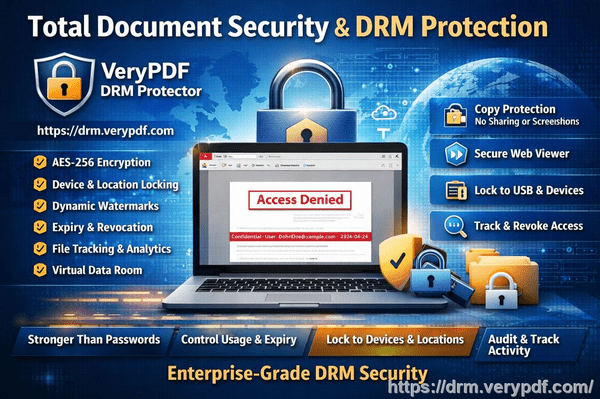
The free trial version of VeryPDF DRM Protector is designed to give you access to the full range of core features, enabling you to thoroughly test the software. Key features include:

  • 256-bit AES encryption – Ensures your PDF content is securely protected.
  • User-based access control – Assign access permissions to individual users.
  • Web-based secure PDF viewing – Users can view protected PDFs directly in a secure online viewer.
  • Printing and copy restrictions – Control whether users can print documents or copy text.
  • Conversion prevention – Stop PDFs from being converted into Word or other editable formats.
  • Expiry date control – Set expiration dates for documents to limit long-term access.
  • Device restrictions – Restrict access to specific devices.
  • Dynamic watermarking – Embed user-specific information (e.g., name, email, date/time, IP address) on the PDF.
  • User management and tracking – Monitor which users access which documents and when.

This ensures that even in the trial, you can experience nearly all the functionality available in the full version.


Are There Any Limitations in the Free Trial?

While the free trial is robust, a few limitations are designed to differentiate testing from commercial deployment:

  • Trial watermark – Some protected documents may include a visible watermark to indicate they are in trial mode.
  • User/document volume limits – There may be restrictions on how many documents you can protect or how many users can access them.
  • Testing purposes only – The free trial is intended for evaluation and not large-scale production use.

Despite these limitations, all core DRM features are accessible, allowing you to fully test encryption strength, user management, access controls, and other protections.


Why Choose VeryPDF DRM Protector?

VeryPDF DRM Protector is ideal for organizations that need to secure sensitive PDF documents, including:

  • Educational institutions – Protect course materials, lecture notes, and homework PDFs from unauthorized sharing.
  • Corporate training – Secure training manuals, reports, and internal documents.
  • Research and intellectual property – Prevent circulation of valuable research papers or proprietary content.
  • Financial and legal sectors – Maintain confidentiality for financial statements, contracts, and other sensitive files.

With VeryPDF DRM Protector, you can prevent unauthorized distribution, control printing and copying, and safeguard your documents with strong encryption—all while testing the system thoroughly using the free trial.

You can try the free online demo here: https://drm.verypdf.com


Final Thoughts

The free trial of VeryPDF DRM Protector provides a permanent, fully functional environment to evaluate document security solutions. Users can:

  • Test all core features, including encryption, DRM policies, and watermarking.
  • Understand system capabilities without worrying about time-limited trials.
  • Decide if the solution meets their workflow and security requirements before purchasing.

If you have specific requirements—such as the number of users, document volume, or industry-specific needs, the VeryPDF team is ready to provide guidance and recommend optimal DRM settings for your workflow.

VeryPDF DRM Protector Review Mobile-Friendly Annotation Tools for Adding FreeText, Ink, Stamps, and Shapes on the Go

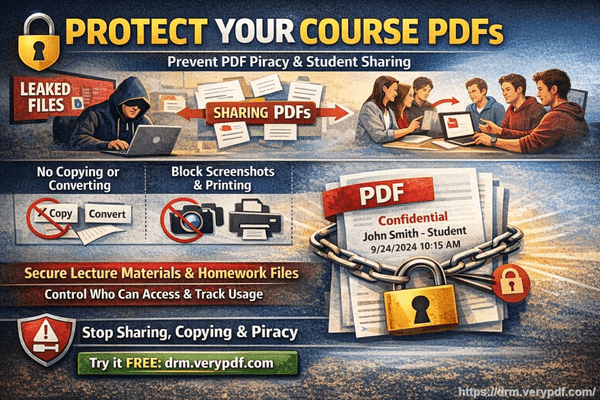
Secure Your Course PDFs: Prevent Sharing and Protect Lecture Materials on Any Device

Ever handed out a set of lecture slides only to later discover that students had uploaded them to public forums or shared them with friends? As a professor, there’s nothing more frustrating than realizing your hard workyour carefully curated assignments, homework PDFs, and paid course materialsis circulating without your permission. I’ve experienced it firsthand: a student emailed me a screenshot showing our weekly lecture notes being shared in a private online group. It made me thinkhow can I protect my content while still providing a seamless learning experience? That’s where VeryPDF DRM Protector comes in.

VeryPDF DRM Protector Review Mobile-Friendly Annotation Tools for Adding FreeText, Ink, Stamps, and Shapes on the Go

In today’s classroom, digital materials are essential. Yet, every PDF I distribute is vulnerable to copying, printing, or conversion to Word or Excel formats, which can easily lead to piracy or misuse. Students might unintentionally share homework, or others may deliberately bypass protections to access paid materials for free. The challenge is balancing accessibility for legitimate learners with robust security that stops unauthorized distribution.

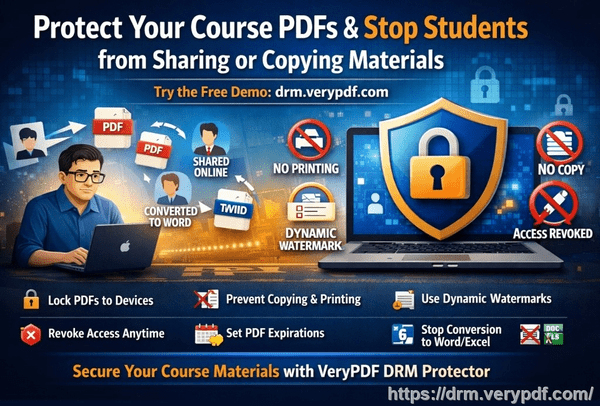
VeryPDF DRM Protector offers a practical solution for these scenarios. It’s a tool designed for educators like me who need to protect digital course content without complicating the teaching workflow. Using this software, I can restrict access to enrolled students, prevent printing and copying, and stop PDFs from being converted to other formats. The result is peace of mind: my lecture slides, homework, and paid course materials remain secure, and I retain full control over who can view or interact with them.

One common issue in classrooms is students sharing PDFs online. Even with classroom policies in place, a single unsecured file can spread rapidly. Before I adopted DRM Protector, I found homework solutions from my class floating on student forums. With DRM protection, I can assign PDFs that only specific students can access. For instance, I can grant access to my “Advanced Genetics” lecture slides only to the students enrolled this semester. Attempting to forward, print, or copy the PDF triggers the DRM restrictions, effectively blocking unauthorized sharing.

Another frequent pain point is unauthorized printing or converting PDFs to editable formats. I’ve seen colleagues lose control of their paid course materials when students converted PDFs to Word documents or Excel spreadsheets. VeryPDF DRM Protector solves this elegantly: it prevents printing, copying, and conversion while still allowing students to read the content on their devices. The software even stops tech-savvy students from bypassing protections or removing DRM. This ensures that sensitive materiallike research guides, graded homework, or subscription-based contentremains in my hands.

The software also shines when it comes to annotating PDFs. The mobile-friendly annotation tools in VeryPDF DRM Protector allow students to highlight text, add freehand notes, or use stamps and shapes without compromising content security. I remember one class where I shared a complex economics case study. Students could mark sections for discussion, draw connections between data points, and add commentsall while the DRM ensured the original PDF remained unaltered and inaccessible to outsiders. The annotations are saved per user, meaning each student has their own workspace, which encourages engagement without risking the material itself.

Setting up annotations is simple. I open my protected PDFs through the enhanced web viewer, enable the annotation toolbar, and select which tools students can usehighlights, free text, ink, stamps, or shapes. Students can then interact with the PDFs directly in their browser or on mobile devices, and any annotations they create are stored securely in their accounts. This level of control is invaluable when managing large classes or distributing paid course materials online.

One of the most practical benefits is workflow efficiency. Before using DRM Protector, I spent hours checking whether my PDFs were being shared or misused. Now, I can focus on teaching rather than monitoring content leakage. For example:

  • Lecture Slides: I can release slides for a single lecture, confident that students can only access them during the course period.

  • Homework PDFs: Assignments remain secure, preventing students from copying and distributing solutions prematurely.

  • Paid or Subscription Materials: DRM ensures that only authorized students who have purchased access can view the content.

Anti-piracy benefits extend beyond simple access control. The software prevents unauthorized users from converting PDFs to Word, Excel, or images, effectively blocking common methods used to redistribute content. This is critical for universities offering premium online courses or for educators monetizing specialty materials. I recall a colleague whose rare linguistic research PDFs were widely shared online before DRM protection; implementing VeryPDF DRM Protector immediately stopped unauthorized distribution.

VeryPDF DRM Protector also supports annotation types that enhance learning. Students can use:

  • Ink and freehand drawing for note-taking.

  • Stamps and signature annotations for collaborative projects.

  • Highlight, underline, strikeout, and text notes for detailed study.

  • Shapes, arrows, and cloud annotations for diagrams or problem-solving.

All of these are mobile-friendly, meaning students can annotate while commuting or studying remotely. Importantly, all these features are secured by DRM, so the original PDFs cannot be copied or printed without permission.

I highly recommend integrating DRM-protected PDFs into your teaching workflow. Not only does it protect your content, but it also simplifies how students engage with your materials. Here’s a simple step-by-step for activating PDF annotations:

  1. Open the protected PDF via the VeryPDF DRM web page.

  2. Click “Actions” “Edit Settings” on the selected PDF.

  3. In the “Advanced Settings” field, enable the toolbar buttons for download, bookmarks, highlights, free text, ink, stamps, and save annotations.

  4. Click “Save” to confirm.

  5. Return to the book list and select “Enhanced Web Viewer” to access the PDF with annotation tools.

This setup ensures your students can interact with the content while you maintain complete control.

In conclusion, VeryPDF DRM Protector addresses the top concerns educators face when distributing PDFs: unauthorized sharing, printing, copying, and conversion. I’ve personally seen it prevent content leakage, simplify student engagement, and safeguard both free and paid course materials. If you want to maintain control over your PDFs and stop piracy in its tracks, this is the solution I trust. I highly recommend this to anyone distributing PDFs to students.

Try it now and protect your course materials: https://drm.verypdf.com

Start your free trial today and regain control over your PDFs.

Frequently Asked Questions

Q: How can I limit student access to my PDFs?

A: VeryPDF DRM Protector lets you restrict PDFs to specific users or enrolled students, preventing unauthorized access.

Q: Can students still read PDFs without copying, printing, or converting?

A: Yes, the software allows full reading and annotation capabilities while blocking printing, copying, and conversion.

Q: How can I track who accessed my PDFs?

A: DRM Protector logs user activity, letting you see who opened the files and when.

Q: Does it prevent PDF piracy and unauthorized sharing?

A: Absolutely. The DRM system prevents forwarding, copying, printing, and conversion, ensuring your materials remain secure.

Q: Is it easy to distribute protected lecture slides and homework?

A: Yes, you can share secure PDFs via the web viewer, with access control for each student.

Q: Can students annotate PDFs on mobile devices?

A: Yes, annotation tools are mobile-friendly, supporting highlights, free text, ink, stamps, and more.

Q: Can annotations be saved for individual students?

A: Yes, each user’s annotations are stored in their account, keeping their work private and secure.

Tags/Keywords

protect course PDFs, prevent PDF piracy, stop students sharing homework, secure lecture materials, prevent DRM removal, anti-conversion PDF DRM, PDF annotations, mobile PDF protection, secure homework distribution, lecture slide security

How to Annotate PDF Files for Teachers and Students Without Uploading Files Using VeryPDF DRM Protector Securely

Securely Annotate and Protect Course PDFs for Teachers and Students Without Uploading Files

As a professor, I’ve often found myself worrying about the security of my course materials. I remember one semester when a student accidentally shared an entire set of lecture PDFs with a broader student group online. The documents were meant only for my enrolled students, and suddenly I lost control over who could access or modify them. For educators like us, protecting our digital course content from unauthorized sharing, copying, or conversion isn’t just a preferenceit’s a necessity. Fortunately, tools like VeryPDF DRM Protector have made it possible to annotate, share, and secure PDFs without risking piracy or losing control.

How to Annotate PDF Files for Teachers and Students Without Uploading Files Using VeryPDF DRM Protector Securely

One of the biggest challenges in today’s digital classroom is ensuring that students engage with materials responsibly. PDFs, while convenient, are easy to duplicate, print, or even convert into editable formats like Word or Excel. Without proper safeguards, your carefully prepared lecture slides, homework assignments, and paid course content can easily leak outside your classroom.

I’ve faced this issue personally. After a busy week of creating a detailed PDF guide for a research methods course, I discovered that a student had forwarded the file to someone not enrolled in my class. That’s when I realized I needed a solution that not only allows me to annotate PDFs for teaching purposes but also prevents unauthorized distribution.

VeryPDF DRM Protector addresses these concerns directly. It offers a secure way to annotate PDF files online without requiring students to upload their copies elsewhere. Here’s how it solves the problems many educators face:

  • Restrict Access to Specific Users: You can limit PDF access only to enrolled students. This ensures that even if someone attempts to forward a file, it won’t open outside authorized accounts.

  • Prevent Printing, Copying, and Conversion: DRM protection blocks attempts to print or copy content and stops students from converting PDFs into editable formats.

  • Secure Lecture Slides and Homework: Any annotations or highlights you make remain tied to the protected file, visible only to you and authorized users.

For example, I use VeryPDF DRM Protector to prepare lecture slides with interactive annotations. Using tools like freehand drawing, highlights, text comments, and stamps, I can mark important sections, leave instructions, or even insert images directly into the PDF. My students see these annotations when they access the protected files online, but they cannot modify, download, or distribute the content. This level of control has significantly reduced incidents of content leakage in my courses.

One semester, I experimented with assigning a group project via DRM-protected PDFs. Each student received their own annotated copy of the dataset and instructions. Because annotations were saved per user, students could make notes for themselves, but couldn’t interfere with the master document or share it externally. It saved me countless hours of clarifying instructions and prevented the potential chaos of files circulating online.

Here’s a quick look at the types of annotations supported by VeryPDF DRM Protector:

  • Highlight and Strikeout Emphasize or remove emphasis on key text.

  • Free Text and Ink Add comments or draw directly on the PDF.

  • Shapes, Arrows, and Connectors Draw attention to diagrams or sections.

  • Stamps and Signatures Apply default or custom stamps, including your name, date, or course identifier.

  • Export Annotations Save notes or annotations for review, including Excel export.

Activating PDF annotations is straightforward. You simply open your protected PDF in the VeryPDF DRM web interface, adjust settings in the Advanced Settings field to enable annotation tools, and then use the Enhanced Web Viewer to make and save your annotations online. This means no uploads to external servers and no risk of losing control over your files.

The anti-piracy benefits are a real game-changer. In one instance, a student tried to bypass DRM protections to convert my lecture PDF into Word. The system blocked the attempt entirely. Not only did this prevent unauthorized sharing, but it also maintained the integrity of the course content, ensuring that all students accessed materials exactly as intended.

For educators who distribute paid or restricted materials, this is especially valuable. Imagine releasing a specialized research guide to your class without worrying about it being copied and shared outside the course. DRM ensures that only authorized users can read the PDF, annotate it, and engage with the contentall while keeping your intellectual property safe.

Here’s a practical step-by-step example I follow when preparing DRM-protected, annotated PDFs for my students:

  1. Log into the VeryPDF DRM account and select the PDF file I want to protect.

  2. Go to “Edit Settings” and enable toolbar options like highlights, free text, ink, stamps, and annotation saving.

  3. Click “Save” to lock in the settings for the file.

  4. Use the Enhanced Web Viewer to annotate the PDF with highlights, arrows, and text notes.

  5. Assign the file to students; each gets a secure, personalized copy with annotation visibility restricted to their account.

  6. Monitor access logs to see who opened the file, providing accountability and insight into student engagement.

The result is a seamless workflow that allows me to maintain control over course materials while still providing interactive and engaging content for students. No more worrying about files being shared illegally or edited without permission.

Beyond security, VeryPDF DRM Protector makes teaching easier. I can prepare PDFs with pre-set annotations before class, save my comments, and even allow students to make personal notes that are tied to their account. It’s like having a digital version of classroom interaction but with security and anti-piracy measures built in.

I highly recommend this to any educator distributing PDFs to students. Protecting course materials doesn’t have to be complicated or time-consuming. By combining annotation features with strong DRM protections, you ensure your content remains secure while enhancing the learning experience.

Try it now and protect your course materials: https://drm.verypdf.com

Start your free trial today and regain control over your PDFs.

FAQs

Q1: How can I limit student access to PDFs?

A1: VeryPDF DRM Protector lets you restrict PDF access to specific users or enrolled students. Only authorized accounts can open and annotate the files.

Q2: Can students read PDFs without copying, printing, or converting them?

A2: Yes. DRM protection prevents printing, copying, or conversion, so students can view and annotate materials without risking unauthorized duplication.

Q3: How do I track who accessed my PDFs?

A3: The platform provides access logs, showing which users opened each protected PDF and when, giving you insight into engagement and accountability.

Q4: Does it prevent PDF piracy and unauthorized sharing?

A4: Absolutely. DRM protections stop files from being forwarded, converted, or printed outside authorized accounts, maintaining full control over your content.

Q5: How easy is it to distribute protected lecture slides and homework?

A5: Very easy. You can assign DRM-protected PDFs directly to students, ensuring secure access while still allowing annotations and interactive engagement.

Q6: Can annotations be saved and reused later?

A6: Yes. Annotations are saved per user and per protected PDF, allowing students and educators to revisit notes or highlights in future sessions.

Q7: Are mobile devices supported for annotations?

A7: Yes. VeryPDF DRM Protector supports annotations on touch devices, including smartphones and tablets, making it convenient for students on the go.

Tags/Keywords:

protect course PDFs, prevent PDF piracy, stop students sharing homework, secure lecture materials, prevent DRM removal, anti-conversion PDF DRM, PDF annotations for teachers, secure homework PDFs, prevent unauthorized PDF sharing, digital course content security